For laboratory research only. Not for human or animal use. This article gives no dosing, administration or therapeutic advice.
Short answer: tesamorelin and sermorelin are both synthetic versions of growth hormone-releasing hormone (GHRH), the hypothalamic peptide that tells the pituitary to release growth hormone through the GHRH receptor [1]. The difference is how much of the natural chain each keeps and how each deals with the enzyme that destroys it. Sermorelin is the first 29 residues of human GHRH, the shortest synthetic peptide with the full biological activity of the hormone [2]. Tesamorelin keeps all 44 residues and adds a trans-3-hexenoyl group to the first tyrosine, a change that made it resistant to dipeptidyl peptidase IV (DPP-IV) in plasma [3]. One is a minimal fragment; the other is the full hormone with a protective cap.
Spec cards from our COA library
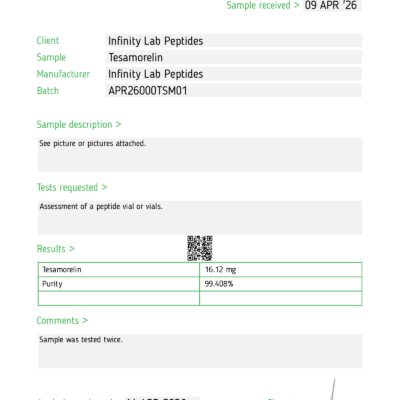
Tesamorelin
Purity: 99.408%
Batch: APR26000TSM01
Analysis date: 14 April 2026
Lab: Janoshik
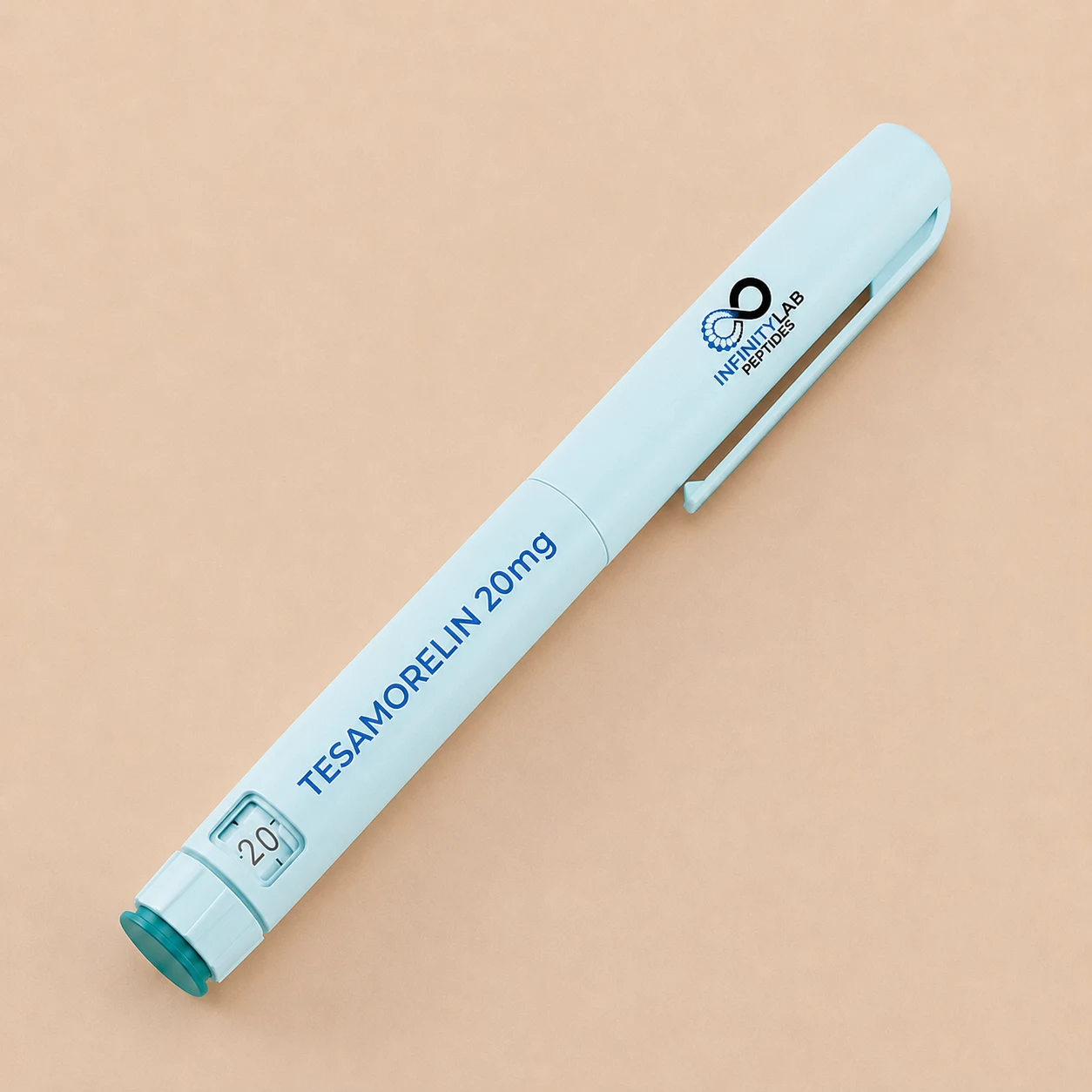
Listings: Tesamorelin 10 mg, Tesamorelin 20 mg, Tesamorelin 20 mg (Pen)
Figures as shown on our COA page at the time of writing; the same batch card covers the 10 mg, 20 mg and pen listings.
Sermorelin
Purity: not applicable
Listing: none
We do not currently carry sermorelin, so there is no certificate to show. It is included here as the reference point most tesamorelin comparisons use.
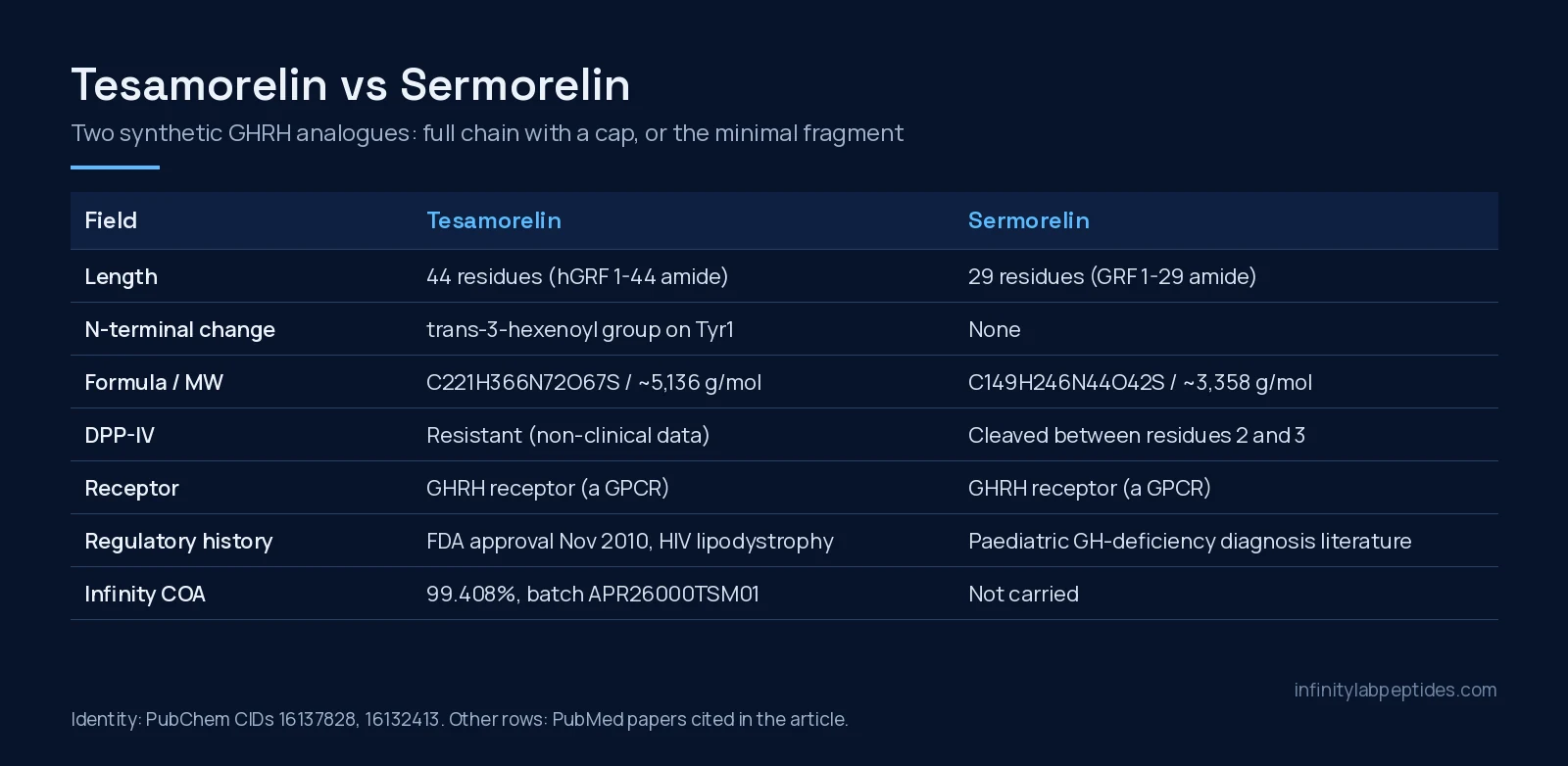
Identity at a glance
Formula and mass values come from PubChem; structural notes come from the cited papers.
| Field | Tesamorelin | Sermorelin |
|---|---|---|
| Other names | TH9507, Egrifta [3][4] | GRF(1-29)-NH2, Geref [5][4] |
| Relation to human GHRH | Full 44-residue sequence (hGRF1-44-NH2) with an N-terminal trans-3-hexenoyl group on Tyr1 [3] | Identical to the first 29 residues of GHRH(1-44) [5] |
| Molecular formula | C221H366N72O67S | C149H246N44O42S |
| Molecular weight | about 5,136 g/mol | about 3,358 g/mol |
| CAS (PubChem synonym) | 218949-48-5 | 86168-78-7 |
| PubChem CID | 16137828 | 16132413 |
| DPP-IV resistance | Yes, by design [3] | No; cleaved at the N-terminus [6][5] |
| Regulatory history | FDA approval in November 2010 for HIV-associated lipodystrophy [7] | Reviewed for diagnosis and treatment of idiopathic GH deficiency in children [2] |
Where both come from: the GHRH story
Human GHRH was first extracted from two pancreatic tumours in patients with acromegaly, and it turned out to be a 44-residue amidated peptide, along with C-terminally shortened forms [8]. Rat GHRH is a 43-residue peptide with about 70% homology to the human sequence [8]. Both tesamorelin and sermorelin start from the human chain.
The receptor they share is a class of G protein-coupled receptor with seven membrane-spanning domains, expressed in the anterior pituitary [1]. A 2010 review describes it as expressed almost exclusively there, where it is needed for somatotroph proliferation and for growth hormone synthesis and secretion; mutations in the receptor gene are estimated to cause about 10% of autosomal recessive familial isolated growth hormone deficiency [9]. Splice variants of the receptor also occur in tumours and other tissues outside the pituitary, and splice variant 1 still signals through cAMP when stimulated by GHRH [1][10]. That extra-pituitary biology is a research area in its own right, and it applies to any GHRH agonist, not to one of these two in particular.
The problem both designs answer: DPP-IV
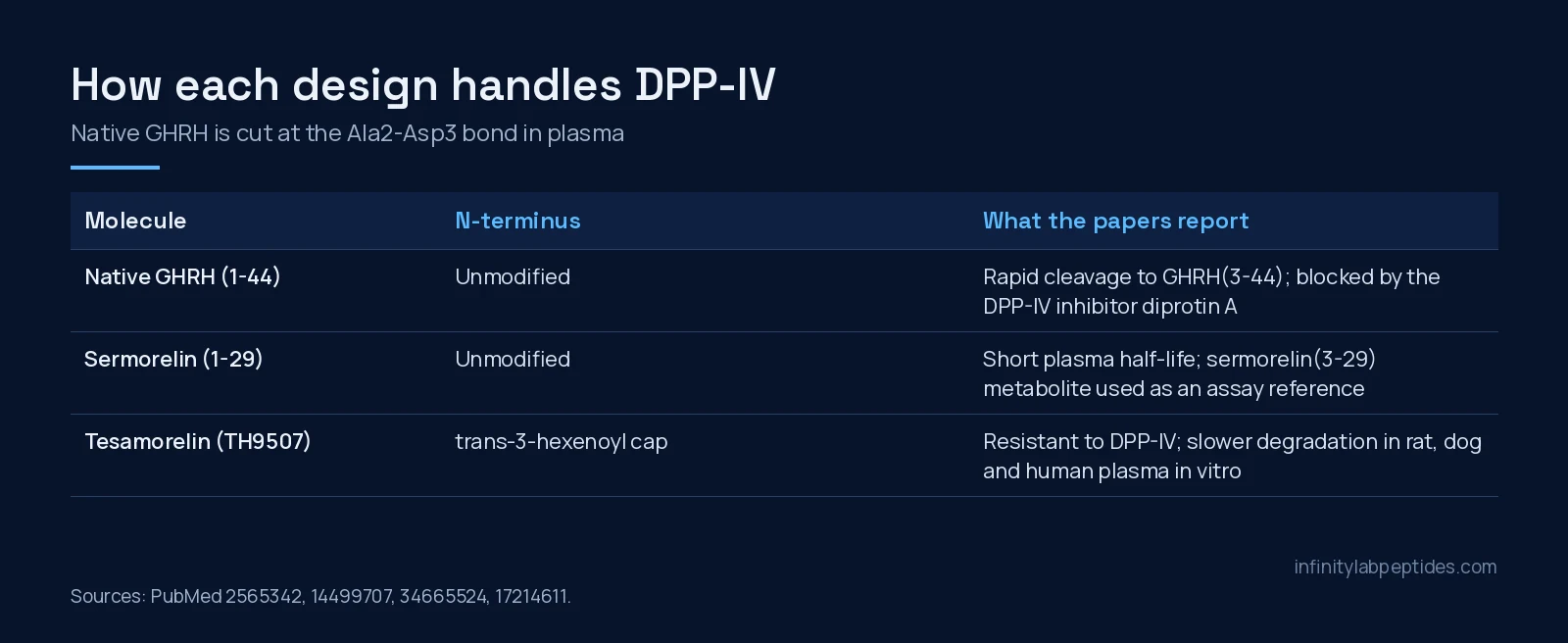
Native GHRH is fragile in blood. A 1989 plasma study characterised the enzyme behind the first cleavage: GHRH(1-44)-NH2, GHRH(1-40)-OH and the shorter 1-32 and 1-29 fragments were all rapidly cut at the bond between residues 2 and 3. The resulting GHRH(3-44) metabolite was formed in a single step by a dipeptidyl peptidase, and its formation was blocked by diprotin A, a DPP-IV inhibitor [6]. A later analogue paper adds chemical routes to the list: in water, GHRH(1-44) also undergoes rearrangement at Asn8 and oxidation at Met27 [11].
So the shared weakness is the N-terminus. The two molecules respond to it in opposite ways.
Sermorelin: the minimal active fragment, left unprotected
Sermorelin keeps only residues 1-29. A 2003 review notes that it keeps bioactivity in vitro and is almost as effective as the full hormone at eliciting endogenous growth hormone secretion in vivo, but that its main drawback is a short plasma half-life, put at about 10-20 minutes in humans, driven mostly by renal ultrafiltration and N-terminal enzymatic degradation [5]. Because its N-terminus is unchanged, sermorelin is cut by DPP-IV in the same way as the native peptide, and a sermorelin(3-29)-NH2 metabolite is used as a reference material in anti-doping assays [12].
A great deal of medicinal chemistry has used GRF(1-29) as a scaffold. Early solid-phase work found that swapping position 2 to D-alanine made [D-Ala2]-GRF(1-29)-NH2 about 50 times more potent than the parent at releasing growth hormone in rats, and D-Tyr1, D-Asp3 and N-acetyl-Tyr1 versions were also more potent [13]. Systematic alanine scans of the 1-29 fragment later mapped which residues tolerate substitution [14]. Other groups tried PEGylation at Lys12 or Lys21 [5] and albumin conjugation, which improved stability against DPP-IV in vitro [15]. Sermorelin, in other words, is the unmodified baseline that these analogues were measured against.
Tesamorelin: the full chain with a cap
Tesamorelin took a lighter-touch route. The non-clinical pharmacology paper on TH9507 describes the molecule as hGRF1-44-NH2 “minimally modified” by a trans-3-hexenoyl group on Tyr1. That cap made it resistant to DPP-IV, slowed its degradation in rat, dog and human plasma in vitro compared with the natural hormone, and prolonged elimination of immunoreactive peptide in vivo [3]. In dogs the apparent elimination half-life ranged from 21 to 45 minutes [3].
The same paper reports raised growth hormone and IGF-1 in pigs, rats and dogs, and it describes the safety signals seen in repeat-exposure animal studies: a stronger anabolic effect in dogs, with reversible liver, kidney and blood findings that the authors attributed to prolonged supraphysiological growth hormone or IGF-1 [3]. For anyone designing an animal study, that is the relevant point: a more stable agonist means longer exposure, and longer exposure carried its own findings.
Telling them apart in the lab
Their size difference makes analytical identification straightforward. A validated plasma method captured sermorelin (Geref), tesamorelin (Egrifta), CJC-1293 and CJC-1295 with a polyclonal GHRH antibody, then separated and identified them by nano-UHPLC with high-resolution tandem mass spectrometry, along with two metabolites of sermorelin and CJC-1293 [4]. A 2021 study went further for urine: it generated in vitro metabolites of sermorelin, tesamorelin, CJC-1295 and CJC-1295 with drug affinity complex, synthesised 19 of them as reference materials, and used them to build an LC-MS/MS method [12].
Both papers come from anti-doping work, because GHRH and its analogues are prohibited by the World Anti-Doping Agency [12][4]. For a research buyer, the useful takeaway is simpler: mass spectrometry separates these peptides cleanly, so a certificate that reports an observed mass alongside HPLC purity is the document to ask for. Our article on why purity matters in research peptides walks through what to look for.
Regulatory history, stated plainly
Tesamorelin (Egrifta) was approved by the US Food and Drug Administration in November 2010 for lipodystrophy associated with HIV infection [7]. Reviews from 2009 and 2011 describe it as a synthetic GHRH analogue developed for conditions that may involve relative growth hormone deficiency, and as the first treatment indicated for excess abdominal fat in that population [16][17]. Sermorelin’s clinical literature is older and centred on paediatric endocrinology: a 1999 review covers its use as a diagnostic test for growth hormone deficiency and in treatment of idiopathic growth hormone deficiency in children [2]. We report these histories as context only; the products we supply are for laboratory research and are not drug products.
Which one fits a given research question?
Questions that point to sermorelin
Structure-activity work on the 1-29 fragment, assays comparing new GRF analogues against an unmodified baseline, or studies of DPP-IV cleavage itself [13][14][6].
Questions that point to tesamorelin
Work that needs the full 44-residue sequence, a GHRH agonist with documented DPP-IV resistance, or comparison against the published non-clinical pharmacology of TH9507 [3].
If your question is about secretagogues that act through a different receptor, our comparisons of tesamorelin and ipamorelin and CJC-1295 and ipamorelin cover the ghrelin-receptor side. Tesamorelin is listed at 10 mg and 20 mg, with the batch certificate shown above. For the wider catalogue, you can buy research peptides in Canada from Infinity Lab Peptides.
Frequently asked questions
What is the main difference between tesamorelin and sermorelin?
Length and protection. Sermorelin is the first 29 residues of human GHRH with no modification. Tesamorelin is the full 44-residue GHRH sequence with a trans-3-hexenoyl group added to the first tyrosine, which made it resistant to DPP-IV in non-clinical studies.
Do tesamorelin and sermorelin act on the same receptor?
Yes. Both are GHRH analogues and act on the GHRH receptor, a G protein-coupled receptor expressed mainly in the anterior pituitary.
Why is sermorelin’s half-life short?
A 2003 review attributes it mostly to renal ultrafiltration and enzymatic cleavage at the N-terminus. Native GHRH and its 1-29 fragment are cut between residues 2 and 3 by dipeptidyl peptidase IV in plasma.
Can a lab tell tesamorelin and sermorelin apart?
Yes. Validated anti-doping methods separate and identify both, along with their metabolites, by liquid chromatography and tandem mass spectrometry. Their masses differ by roughly 1,800 g/mol.
Does Infinity Lab Peptides post a COA for tesamorelin?
Yes. At the time of writing our COA page shows batch APR26000TSM01 at 99.408% purity, analysed by Janoshik on 14 April 2026, covering the 10 mg, 20 mg and pen listings. We do not carry sermorelin.
References
- Halmos G, Szabo Z, Dobos N et al. (2025). Growth hormone-releasing hormone receptor (GHRH-R) and its signaling. Rev Endocr Metab Disord. PMID: 39934495. doi: 10.1007/s11154-025-09952-x.
- Prakash A, Goa KL (1999). Sermorelin: a review of its use in the diagnosis and treatment of children with idiopathic growth hormone deficiency. BioDrugs. PMID: 18031173. doi: 10.2165/00063030-199912020-00007.
- Ferdinandi ES, Brazeau P, High K et al. (2007). Non-clinical pharmacology and safety evaluation of TH9507, a human growth hormone-releasing factor analogue. Basic Clin Pharmacol Toxicol. PMID: 17214611. doi: 10.1111/j.1742-7843.2007.00008.x.
- Knoop A, Thomas A, Fichant E et al. (2016). Qualitative identification of growth hormone-releasing hormones in human plasma by means of immunoaffinity purification and LC-HRMS/MS. Anal Bioanal Chem. PMID: 26879649. doi: 10.1007/s00216-016-9377-3.
- Esposito P, Barbero L, Caccia P et al. (2003). PEGylation of growth hormone-releasing hormone (GRF) analogues. Adv Drug Deliv Rev. PMID: 14499707. doi: 10.1016/s0169-409x(03)00109-1.
- Frohman LA, Downs TR, Heimer EP et al. (1989). Dipeptidylpeptidase IV and trypsin-like enzymatic degradation of human growth hormone-releasing hormone in plasma. J Clin Invest. PMID: 2565342. doi: 10.1172/JCI114049.
- Spooner LM, Olin JL (2012). Tesamorelin: a growth hormone-releasing factor analogue for HIV-associated lipodystrophy. Ann Pharmacother. PMID: 22298602. doi: 10.1345/aph.1Q629.
- Grossman A, Savage MO, Besser GM (1986). Growth hormone releasing hormone. Clin Endocrinol Metab. PMID: 2429796. doi: 10.1016/s0300-595x(86)80012-3.
- Martari M, Salvatori R (2009). Diseases associated with growth hormone-releasing hormone receptor (GHRHR) mutations. Prog Mol Biol Transl Sci. PMID: 20374725. doi: 10.1016/S1877-1173(09)88003-4.
- Halmos G, Szabo Z, Juhasz E et al. (2023). Signaling mechanism of growth hormone-releasing hormone receptor. Vitam Horm. PMID: 37717982. doi: 10.1016/bs.vh.2023.06.004.
- Campbell RM, Stricker P, Miller R et al. (1994). Enhanced stability and potency of novel growth hormone-releasing factor (GRF) analogues derived from rodent and human GRF sequences. Peptides. PMID: 7937325. doi: 10.1016/0196-9781(94)90211-9.
- Memdouh S, Gavrilović I, Ng K et al. (2021). Advances in the detection of growth hormone releasing hormone synthetic analogs. Drug Test Anal. PMID: 34665524. doi: 10.1002/dta.3183.
- Lance VA, Murphy WA, Sueiras-Diaz J et al. (1984). Super-active analogs of growth hormone-releasing factor (1-29)-amide. Biochem Biophys Res Commun. PMID: 6231028. doi: 10.1016/0006-291x(84)91647-4.
- Cervini LA, Donaldson CJ, Koerber SC et al. (1998). Human growth hormone-releasing hormone hGHRH(1-29)-NH2: systematic structure-activity relationship studies. J Med Chem. PMID: 9513600. doi: 10.1021/jm970618s.
- Jetté L, Léger R, Thibaudeau K et al. (2005). Human growth hormone-releasing factor (hGRF)1-29-albumin bioconjugates activate the GRF receptor on the anterior pituitary in rats: identification of CJC-1295 as a long-lasting GRF analog. Endocrinology. PMID: 15817669. doi: 10.1210/en.2004-1286.
- Wang Y, Tomlinson B (2009). Tesamorelin, a human growth hormone releasing factor analogue. Expert Opin Investig Drugs. PMID: 19243281. doi: 10.1517/13543780802707658.
- Dhillon S (2011). Tesamorelin: a review of its use in the management of HIV-associated lipodystrophy. Drugs. PMID: 21668043. doi: 10.2165/11202240-000000000-00000.