For laboratory research only. Not for human or animal use. This article gives no dosing, administration or therapeutic advice.
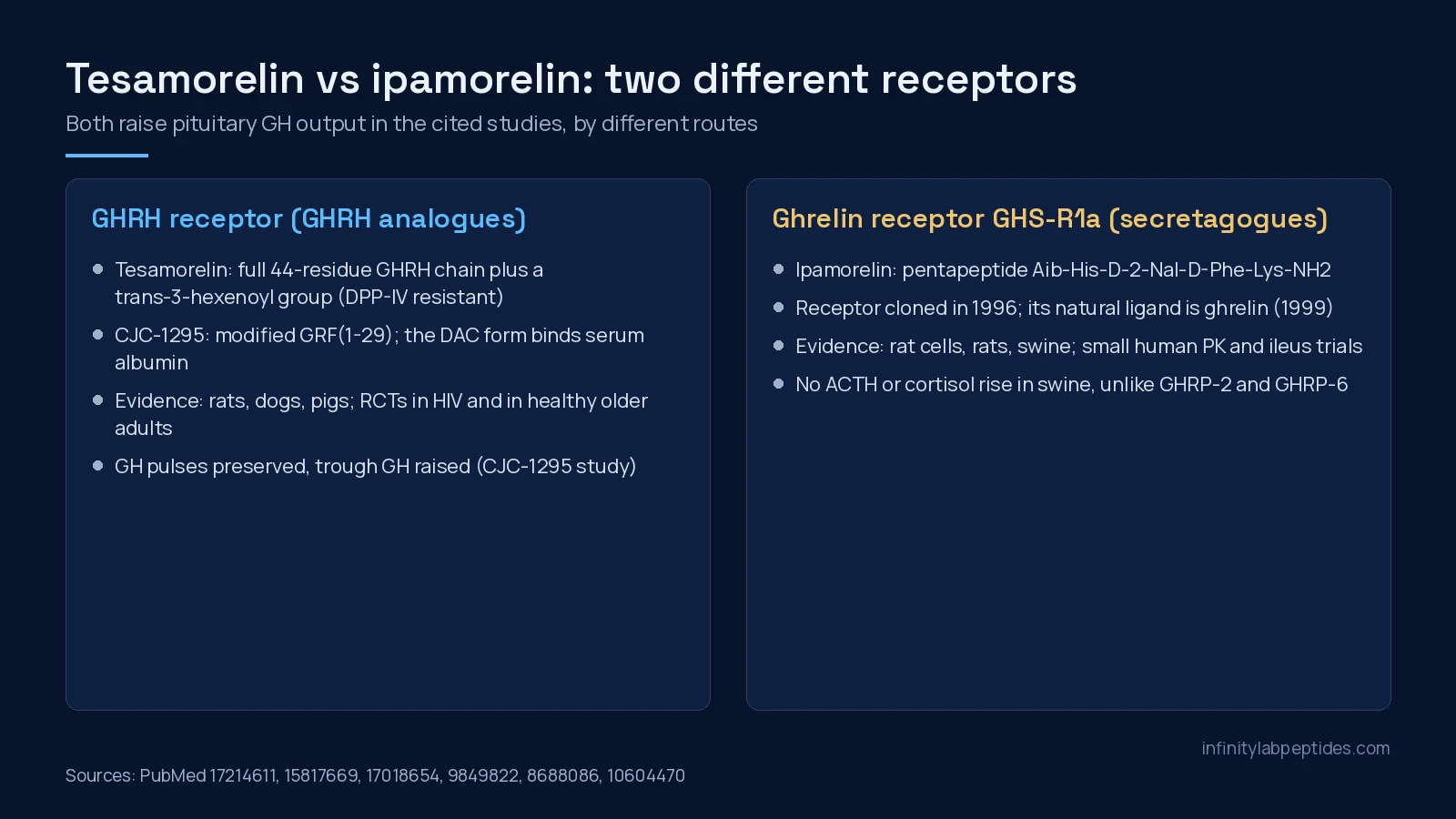
Short answer: tesamorelin and ipamorelin both push the pituitary to release growth hormone (GH), but they do it through two unrelated receptors. Tesamorelin is a stabilised copy of the body’s own 44-residue growth hormone-releasing hormone (GHRH) and acts on the GHRH receptor[1],[2]. Ipamorelin is a five-residue synthetic peptide that acts on the ghrelin receptor (GHS-R1a), the target of the “growth hormone secretagogue” class[3],[4]. The CJC-1295 + ipamorelin blend pairs one compound from each side. The evidence behind them is very different in size: tesamorelin has phase 3 randomised trials and a regulatory approval for one indication, while ipamorelin’s human record is a pharmacokinetic study and one phase 2 trial that missed its endpoints[5],[6],[7],[8].
This page sets out the batch documentation we post for each listing, then the research comparison: structure, receptor biology, what the human and animal studies measured, the null results, and the limits of what any of it tells a lab.
Batch documentation at a glance
These cards repeat only what our COA library shows today. Where no report is posted, we say so.
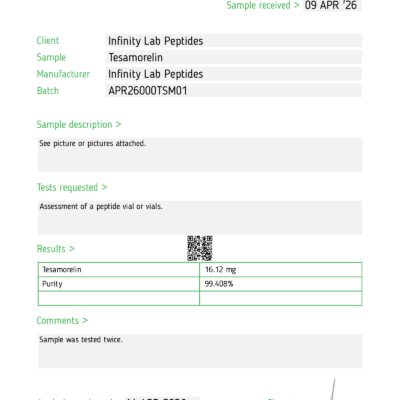
Tesamorelin
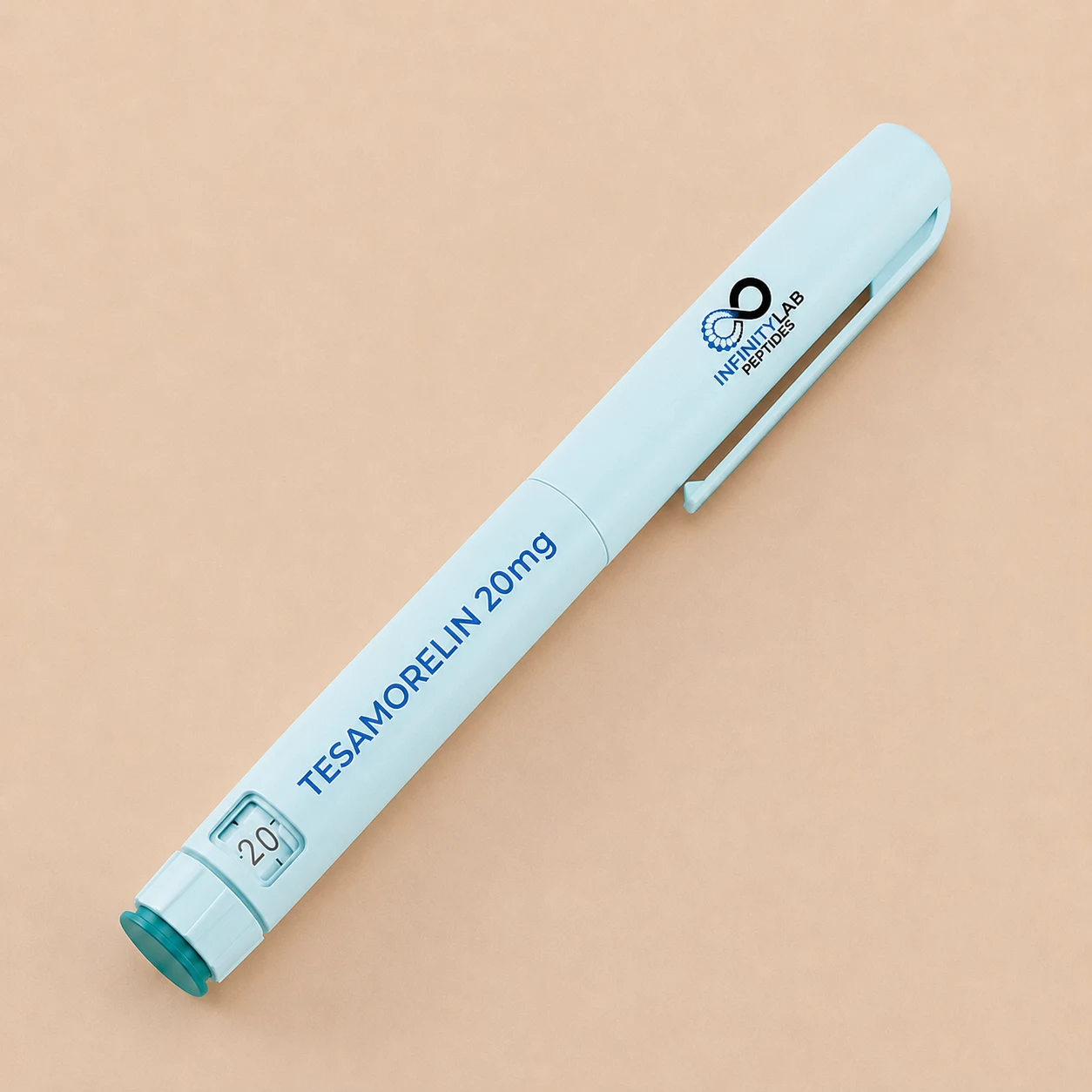
Listings: 10 mg vial, 20 mg vial, 20 mg pen
Purity: 99.408%
Batch: APR26000TSM01
Analysis date: 14 APR 2026
Lab: Janoshik
Verification key: PTTVETFRVUH9
One report is shown for all Tesamorelin entries in the library (10 mg, 20 mg, Pen and “Tesamorelin”); the library does not post a separate report per strength.
Ipamorelin 10 mg
Listing: Ipamorelin 10 mg vial
Purity: not available
Batch: not available
No certificate is posted for this product on our COA page at the time of writing.
CJC 1295 + Ipamorelin 10 mg
Listing: CJC 1295 + Ipamorelin 10 mg (5 mg + 5 mg)
Purity: no figure shown on the library card
Batch: APR26000129501
Analysis date: 09 APR 2026
Lab: Janoshik
Verification key: 3DPIULXTAV86
The card does not display a purity percentage, so we do not quote one.
A blend report and a single-compound report answer different questions. A Janoshik key lets you open the original report and check what was actually measured; for a two-peptide vial, look for whether both components were identified and quantified separately.
Identity: three different molecules
The identifiers below come from PubChem, not from product labels or lab reports.
| Property | Tesamorelin | Ipamorelin | CJC-1295 (two forms) |
|---|---|---|---|
| Class | GHRH(1-44) analogue | Ghrelin-receptor agonist (GH secretagogue) | GHRH(1-29) analogue |
| Structure note | Human GHRH 1-44 with a trans-3-hexenoyl group on Tyr1[1] | Aib-His-D-2-Nal-D-Phe-Lys-NH2[3] | Tetrasubstituted GRF(1-29); the “DAC” form adds a maleimidopropionamide lysine that binds albumin[9] |
| Molecular formula | C221H366N72O67S | C38H49N9O5 | With DAC: C165H269N47O46 · without DAC: C152H252N44O42 |
| Molecular weight | 5136 g/mol | 711.9 g/mol | With DAC: 3647.2 · without DAC: 3367.9 g/mol |
| Synonyms / codes | TH9507, Egrifta | NNC 26-0161 | CJC1295; “Mod GRF 1-29” is the common name for the no-DAC form |
| CAS | 218949-48-5 | 170851-70-4 | 446262-90-4 (CID 91971820 record) |
| PubChem CID | 16137828 | 9831659 | 91971820 (with DAC) · 91976842 (without DAC) |
Our blend listing gives its composition as 5 mg + 5 mg and does not state which CJC-1295 form it contains. That matters, because the published human CJC-1295 studies used the albumin-binding DAC form[10],[11], whose behaviour in the body is built around that binding. Data from the DAC form should not be assumed to describe the no-DAC peptide.
Two receptors, one gland
GH release from the anterior pituitary is controlled by two stimulatory signals and one brake. The first stimulatory signal is hypothalamic GHRH. The second runs through a G protein-coupled receptor that was cloned from pig and human pituitary and hypothalamus in 1996 as the target of small synthetic “GH secretagogues”; the authors argued at the time that these drugs were mimicking a hormone nobody had found yet[4]. That hormone turned out to be ghrelin, a 28-residue acylated peptide purified from rat stomach in 1999, whose octanoyl group on serine 3 is required for activity[12].
Tesamorelin sits on the first pathway. It keeps the full human GHRH 1-44 sequence and adds a trans-3-hexenoyl group to the first tyrosine. In plasma from rats, dogs and humans that change slowed breakdown by dipeptidyl peptidase-IV, the enzyme that inactivates native GHRH, and repeated dosing raised GH and IGF-1 in pigs, rats and dogs[1]. In thirteen healthy men, two weeks of tesamorelin raised mean overnight GH, GH peak area and basal GH secretion, with IGF-I rising and no significant change in fasting glucose or insulin-stimulated glucose uptake[2].
Ipamorelin sits on the second pathway. It came out of a chemistry programme built on GHRP-1, with the central Ala-Trp dipeptide removed. In rat pituitary cells it released GH with potency similar to GHRP-6, and antagonist studies showed it works through the GHRP receptor rather than the GHRH receptor[3].
CJC-1295 is a second GHRH-side compound. It was selected from three maleimido derivatives of GRF(1-29) designed to bind the free thiol on Cys34 of serum albumin; in rats the conjugate was detected bound to albumin and remained in plasma beyond 72 hours[9].
Why the GHRH + secretagogue pairing exists
The logic behind blends such as CJC-1295 + ipamorelin comes from older human physiology studies. When GHRH and a GHRP are given together, the GH response is larger than either alone, a pattern described as synergy. In a study of 23 people, GHRP-6 plus GHRH produced a strong synergistic response in healthy controls, but that synergy was absent in patients with hypothalamopituitary disconnection, suggesting the GHRP acts partly above the pituitary[13]. A later study in 47 men infused GHRH with GHRP-2 and found the size of the synergy fell with age and abdominal visceral fat and rose with IGF-I[14].
Note what those studies used: native GHRH with GHRP-6 or GHRP-2, given intravenously in a clinical research unit. None of them tested ipamorelin with CJC-1295, and we found no published human study of that specific pair.
What the human studies measured
Tesamorelin
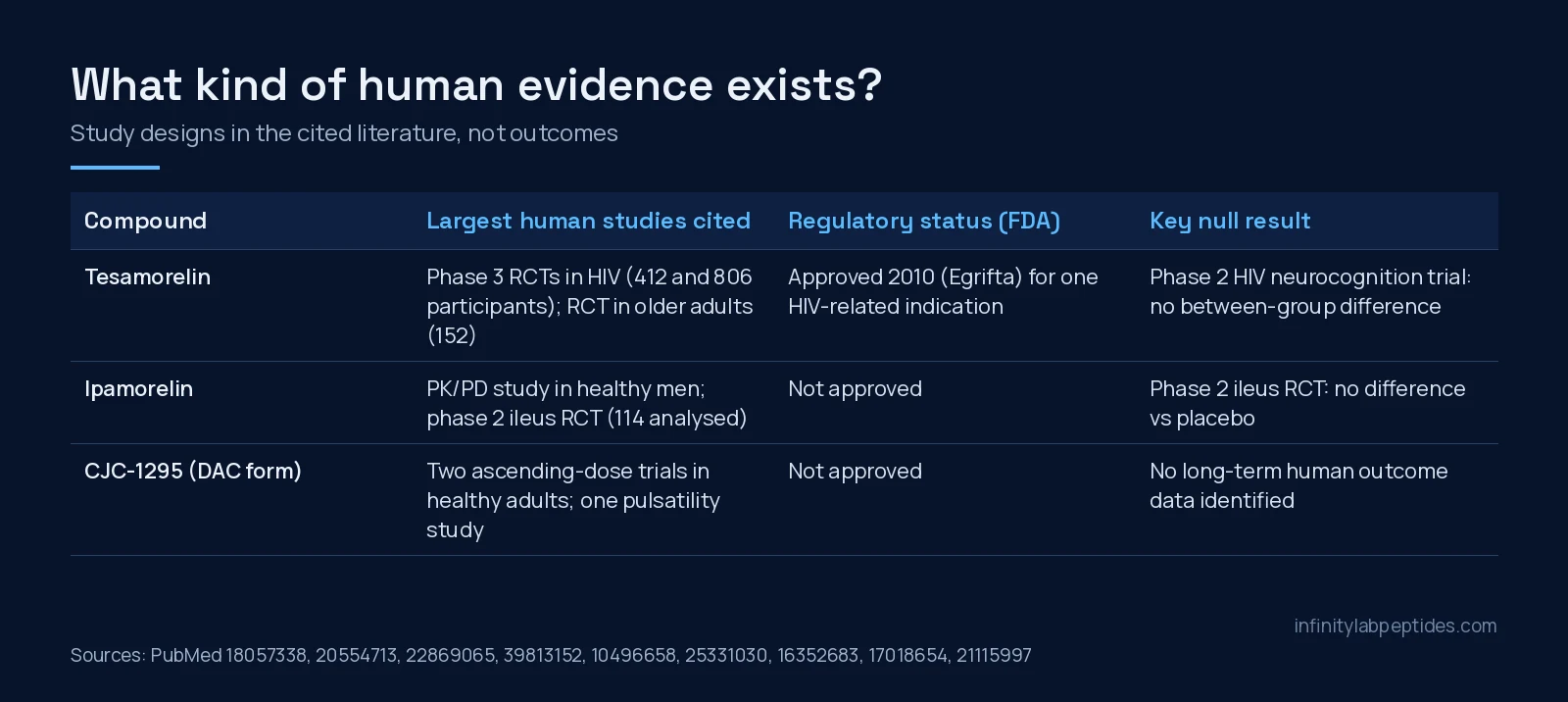
Tesamorelin has the largest human dataset of the three. A phase 3 trial randomised 412 people with HIV and abdominal fat accumulation to tesamorelin or placebo for 26 weeks, with visceral adipose tissue on CT as the primary endpoint[5]. A pooled analysis of two phase 3 trials covered 806 participants with a 26-week safety extension[15]. On the basis of this programme the US FDA approved tesamorelin (Egrifta) in 2010 for one indication: reduction of excess abdominal fat in HIV-infected patients with lipodystrophy[6]. That approval is specific to that population and use.
Outside HIV, a randomised, placebo-controlled trial in 152 adults aged 55 to 87, including 66 with mild cognitive impairment, examined cognition over 20 weeks and reported a favourable effect on a cognitive composite, driven mainly by executive function[16]. A population pharmacokinetic analysis in 38 HIV-infected and healthy subjects found age, body size, race and health status did not explain differences in its pharmacokinetics[17].
Ipamorelin
In healthy male volunteers given ipamorelin by infusion across five dose levels, GH rose as a single episode peaking at about 40 minutes and then declined, and the peptide’s terminal half-life was about 2 hours[7]. Its one published efficacy trial was a multicentre, double-blind, placebo-controlled phase 2 study in 114 patients after bowel resection[8] (covered in the null-results section below).
CJC-1295
Two randomised, placebo-controlled, ascending-dose trials in healthy adults aged 21 to 61 found sustained, dose-dependent rises in GH and IGF-I after single injections, with an estimated half-life of 5.8 to 8.1 days[10]. A separate study in men aged 20 to 40 sampled GH every 20 minutes overnight and found that pulse frequency and size were unchanged while trough GH rose markedly, i.e. pulsatility was preserved[11]. Both used the DAC form.
Side-by-side research comparison
| Question | Tesamorelin | Ipamorelin | CJC-1295 + ipamorelin blend |
|---|---|---|---|
| Receptor | GHRH receptor[1] | Ghrelin receptor / GHS-R1a[3],[4] | One component on each receptor |
| Native hormone it mimics | GHRH (1-44) | Ghrelin[12] | GHRH (1-29 fragment) + ghrelin |
| Design feature | Resists DPP-IV breakdown | Selective for GH over ACTH/cortisol in swine | DAC version binds albumin; blend listing does not state the form |
| GH pattern in humans | Raised overnight GH and peak area[2] | Single release episode, short half-life[7] | No human study of this pair found |
| Largest human design | Phase 3 RCTs (412; 806 pooled)[5],[15] | Phase 2 RCT (114)[8] | None; DAC CJC-1295 alone: ascending-dose trials in healthy adults[10] |
| Regulatory status | FDA-approved for one HIV indication[6] | Not approved | Not approved |
| Our posted COA | Yes: APR26000TSM01, 99.408% | None posted | Yes: APR26000129501, no purity figure on the card |
Selectivity: where ipamorelin differs from older secretagogues
The feature that made ipamorelin interesting in the 1990s was selectivity. In swine, GHRP-6 and GHRP-2 raised ACTH and cortisol alongside GH, while ipamorelin did not raise ACTH or cortisol beyond the levels seen with GHRH, even at doses more than 200-fold above its ED50 for GH release; none of the compounds changed FSH, LH, prolactin or TSH[3]. That is an animal result. We did not find a human study that measured the same hormone panel with the same rigour.
Ipamorelin has also been studied in rats for skeletal growth: in adult female rats it raised longitudinal bone growth rate in a dose-dependent way, yet total IGF-I and bone-turnover markers did not change[18]. And GH is not the whole story. In mice, ipamorelin and GHRP-6 increased fat mass and food intake even in GH-deficient animals, while GH itself did not, which the authors read as a GH-independent effect, possibly through feeding[19]. A ghrelin-receptor agonist therefore cannot be treated as a pure “GH releaser” in experimental design.
Null and negative results
- Ipamorelin, postoperative ileus (phase 2): in the 114-patient trial, time to first tolerated solid meal did not differ significantly from placebo, and no key or secondary efficacy analysis showed a difference[8]. This came after a rat model in which repeated dosing increased faecal output and food intake[20], a reminder that rodent motility results did not carry over.
- Tesamorelin, HIV neurocognition (phase 2): in a 6-month open-label trial of 73 people with HIV and abdominal obesity, the between-group difference in neurocognitive performance versus standard of care was not significant[21].
- Tesamorelin, glucose handling: in healthy men, neither fasting glucose nor insulin-stimulated glucose uptake changed significantly after two weeks[2]; the phase 3 reports likewise found no clinically meaningful glucose differences[15]. These are absences of an effect on the measured endpoints, not evidence of safety in any other setting.
- Synergy is not universal: GHRP-6 plus GHRH synergy disappeared in patients with hypothalamopituitary disconnection[13], and it shrank with age and visceral fat in men[14].
What the evidence does not show
- It does not show that tesamorelin and ipamorelin are interchangeable. They act on different receptors with different downstream profiles[1],[3].
- It does not show that the CJC-1295 + ipamorelin pair produces synergy. Human synergy data come from native GHRH with GHRP-6 or GHRP-2[13],[14], not this combination.
- It does not show how no-DAC CJC-1295 behaves in humans. The human CJC-1295 trials used the albumin-binding DAC form[10],[11].
- It does not extend tesamorelin’s approval to anything else. The FDA approval covers one indication in one population[6].
- It does not show long-term human effects of ipamorelin. Its human record is a short PK/PD study and one negative phase 2 trial[7],[8].
- It does not show that a purity figure on a COA predicts any biological result. Purity and identity describe the material in the vial, nothing more.
Practical notes for a research inventory
If your protocol is about the GHRH receptor, tesamorelin is the better-characterised tool, and its PubChem record, regulatory history and published pharmacology make reference checks straightforward. If it is about the ghrelin receptor, ipamorelin is the selective secretagogue in the literature, but remember its feeding and adiposity effects in mice[19]. If you are studying combined stimulation, document which CJC-1295 form you have before interpreting anything, and ask whether the blend’s report identifies both components.
For a wider view of the catalogue, see our research peptides overview, or buy research peptides in Canada with the batch reports open beside you.
Frequently asked questions
Is tesamorelin the same as ipamorelin?
No. Tesamorelin is a modified version of the 44-residue hormone GHRH and acts on the GHRH receptor. Ipamorelin is a five-residue synthetic peptide that acts on the ghrelin receptor (GHS-R1a). Both raise pituitary GH output in published studies, but by different routes, and their evidence bases differ greatly in size.
Which has more human research, tesamorelin or ipamorelin?
Tesamorelin. It has phase 3 randomised trials in people with HIV, a randomised trial in older adults and an FDA approval for one HIV-related indication. Ipamorelin’s human record is a pharmacokinetic study in healthy men and one phase 2 trial in postoperative ileus that did not show a difference from placebo.
Why are CJC-1295 and ipamorelin sold as a blend?
The idea comes from human studies showing that GHRH given together with a GH-releasing peptide such as GHRP-6 or GHRP-2 produces a larger GH response than either alone. Those studies did not test CJC-1295 with ipamorelin, and we found no published human study of that specific pair.
Does the CJC 1295 + Ipamorelin 10 mg listing contain CJC-1295 with or without DAC?
The listing states a 5 mg + 5 mg composition but does not name the CJC-1295 form. The published human CJC-1295 trials used the albumin-binding DAC form, so their results should not be applied to the no-DAC peptide.
Is there a COA for each of these products?
Our COA library shows Janoshik batch APR26000TSM01 (99.408%, 14 APR 2026) for the Tesamorelin entries and batch APR26000129501 (09 APR 2026, no purity figure on the card) for the CJC 1295 + Ipamorelin blend. No certificate is posted for Ipamorelin 10 mg at the time of writing.
Research use only. All products referenced on this page are intended for laboratory research and analytical applications. They are not for human or animal consumption, and nothing here is medical advice, dosing guidance or a treatment recommendation.
References
- Ferdinandi ES, Brazeau P, High K et al. (2007). Non-clinical pharmacology and safety evaluation of TH9507, a human growth hormone-releasing factor analogue. Basic Clin Pharmacol Toxicol. PMID: 17214611. doi: 10.1111/j.1742-7843.2007.00008.x.
- Stanley TL, Chen CY, Branch KL et al. (2011). Effects of a growth hormone-releasing hormone analog on endogenous GH pulsatility and insulin sensitivity in healthy men. J Clin Endocrinol Metab. PMID: 20943777. doi: 10.1210/jc.2010-1587.
- Raun K, Hansen BS, Johansen NL et al. (1998). Ipamorelin, the first selective growth hormone secretagogue. Eur J Endocrinol. PMID: 9849822. doi: 10.1530/eje.0.1390552.
- Howard AD, Feighner SD, Cully DF et al. (1996). A receptor in pituitary and hypothalamus that functions in growth hormone release. Science. PMID: 8688086. doi: 10.1126/science.273.5277.974.
- Falutz J, Allas S, Blot K et al. (2007). Metabolic effects of a growth hormone-releasing factor in patients with HIV. N Engl J Med. PMID: 18057338. doi: 10.1056/NEJMoa072375.
- Traynor K (2010). FDA approves tesamorelin for HIV-related lipodystrophy. Am J Health Syst Pharm. PMID: 21115997. doi: 10.2146/news100082.
- Gobburu JV, Agersø H, Jusko WJ et al. (1999). Pharmacokinetic-pharmacodynamic modeling of ipamorelin, a growth hormone releasing peptide, in human volunteers. Pharm Res. PMID: 10496658. doi: 10.1023/a:1018955126402.
- Beck DE, Sweeney WB, McCarter MD et al. (2014). Prospective, randomized, controlled, proof-of-concept study of the Ghrelin mimetic ipamorelin for the management of postoperative ileus in bowel resection patients. Int J Colorectal Dis. PMID: 25331030. doi: 10.1007/s00384-014-2030-8.
- Jetté L, Léger R, Thibaudeau K et al. (2005). Human growth hormone-releasing factor (hGRF)1-29-albumin bioconjugates activate the GRF receptor on the anterior pituitary in rats: identification of CJC-1295 as a long-lasting GRF analog. Endocrinology. PMID: 15817669. doi: 10.1210/en.2004-1286.
- Teichman SL, Neale A, Lawrence B et al. (2006). Prolonged stimulation of growth hormone (GH) and insulin-like growth factor I secretion by CJC-1295, a long-acting analog of GH-releasing hormone, in healthy adults. J Clin Endocrinol Metab. PMID: 16352683. doi: 10.1210/jc.2005-1536.
- Ionescu M, Frohman LA (2006). Pulsatile secretion of growth hormone (GH) persists during continuous stimulation by CJC-1295, a long-acting GH-releasing hormone analog. J Clin Endocrinol Metab. PMID: 17018654. doi: 10.1210/jc.2006-1702.
- Kojima M, Hosoda H, Date Y et al. (1999). Ghrelin is a growth-hormone-releasing acylated peptide from stomach. Nature. PMID: 10604470. doi: 10.1038/45230.
- Popovic V, Damjanovic S, Micic D et al. (1995). Blocked growth hormone-releasing peptide (GHRP-6)-induced GH secretion and absence of the synergic action of GHRP-6 plus GH-releasing hormone in patients with hypothalamopituitary disconnection: evidence that GHRP-6 main action is exerted at the hypothalamic level. J Clin Endocrinol Metab. PMID: 7883854. doi: 10.1210/jcem.80.3.7883854.
- Veldhuis JD, Bowers CY (2009). Determinants of GH-releasing hormone and GH-releasing peptide synergy in men. Am J Physiol Endocrinol Metab. PMID: 19240251. doi: 10.1152/ajpendo.91001.2008.
- Falutz J, Mamputu JC, Potvin D et al. (2010). Effects of tesamorelin (TH9507), a growth hormone-releasing factor analog, in human immunodeficiency virus-infected patients with excess abdominal fat: a pooled analysis of two multicenter, double-blind placebo-controlled phase 3 trials with safety extension data. J Clin Endocrinol Metab. PMID: 20554713. doi: 10.1210/jc.2010-0490.
- Baker LD, Barsness SM, Borson S et al. (2012). Effects of growth hormone–releasing hormone on cognitive function in adults with mild cognitive impairment and healthy older adults: results of a controlled trial. Arch Neurol. PMID: 22869065. doi: 10.1001/archneurol.2012.1970.
- González-Sales M, Barrière O, Tremblay PO et al. (2015). Population pharmacokinetic analysis of tesamorelin in HIV-infected patients and healthy subjects. Clin Pharmacokinet. PMID: 25358450. doi: 10.1007/s40262-014-0202-x.
- Johansen PB, Nowak J, Skjaerbaek C et al. (1999). Ipamorelin, a new growth-hormone-releasing peptide, induces longitudinal bone growth in rats. Growth Horm IGF Res. PMID: 10373343. doi: 10.1054/ghir.1999.9998.
- Lall S, Tung LY, Ohlsson C et al. (2001). Growth hormone (GH)-independent stimulation of adiposity by GH secretagogues. Biochem Biophys Res Commun. PMID: 11162489. doi: 10.1006/bbrc.2000.4065.
- Venkova K, Mann W, Nelson R et al. (2009). Efficacy of ipamorelin, a novel ghrelin mimetic, in a rodent model of postoperative ileus. J Pharmacol Exp Ther. PMID: 19289567. doi: 10.1124/jpet.108.149211.
- Ellis RJ, Vaida F, Hu K et al. (2025). Effects of Tesamorelin on Neurocognitive Impairment in Persons With HIV and Abdominal Obesity. J Infect Dis. PMID: 39813152. doi: 10.1093/infdis/jiaf012.