For laboratory research only. Not for human or animal use. This article gives no dosing, administration or therapeutic advice.
Short answer: CJC-1295 and ipamorelin push on growth hormone (GH) release from two different doors. CJC-1295 is an engineered version of the first 29 amino acids of growth-hormone-releasing hormone (GHRH), built to last longer in circulation; in its original design a reactive maleimide group lets it bind to serum albumin after injection [1]. Ipamorelin is a five-residue synthetic peptide that acts on the GH secretagogue receptor, the receptor later shown to respond to the stomach hormone ghrelin [2],[3],[4]. One mimics the hypothalamic “release” signal; the other works through a separate receptor system. The two are often sold together, but we found no published study of that specific pairing, so what is known about combining the two pathways comes from older GHRH plus GHRP-6 experiments.
Below: the batch documentation we post, an identity table that separates the two forms sold as “CJC-1295”, the two receptors, how each molecule was engineered, what animal and human pharmacology work measured, and where the evidence stops.
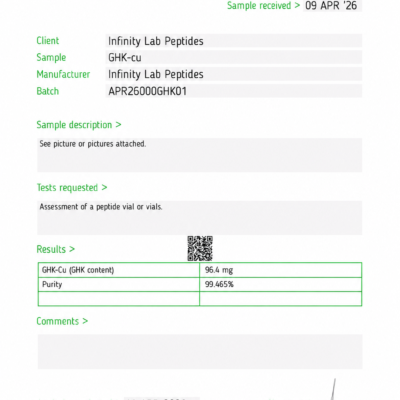
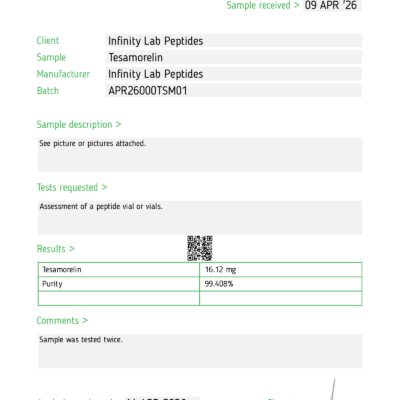
Batch documentation at a glance
These cards repeat only what our COA library shows today.
CJC 1295 + Ipamorelin 10 mg
Purity: not shown on the card
Batch: APR26000129501
Analysis date: 09 APR 2026
Lab: Janoshik
Verification key: 3DPIULXTAV86
Listing: CJC 1295 + Ipamorelin 10 mg (blend, 5 mg + 5 mg)
The card shows no purity figure, so we do not quote one. The listing does not state whether the CJC-1295 portion is the DAC or the no-DAC form; ask us before ordering if your protocol depends on it.
Ipamorelin 10 mg
Purity: not available
Batch: not available
Listing: Ipamorelin 10 mg
No certificate is posted for this product on our COA page at the time of writing. The blend’s report above covers the blend only, not the single-peptide vial.
Identity: two things are sold as “CJC-1295”
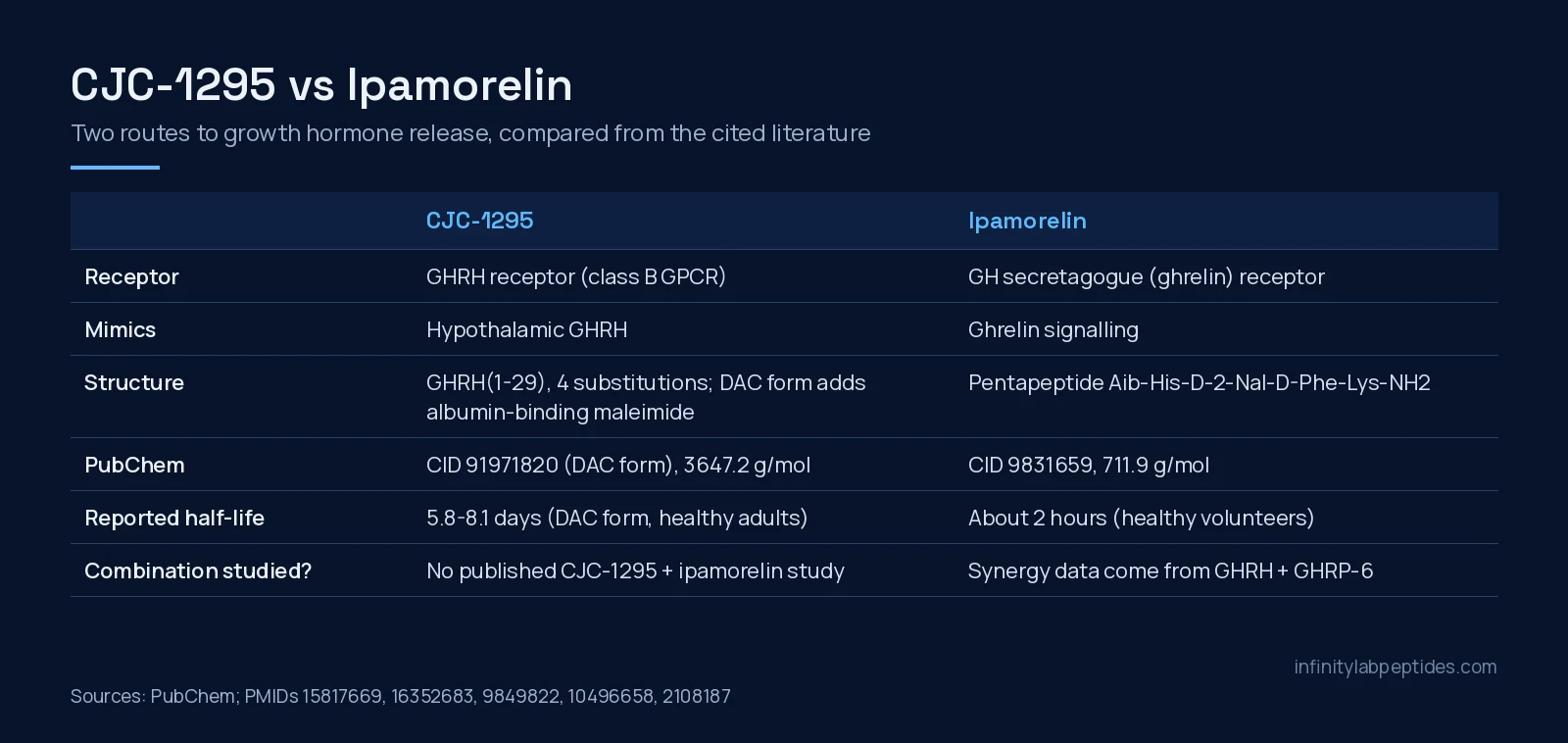
The name CJC-1295 was given to a specific molecule in a 2005 rat study: a tetrasubstituted form of human GHRH(1-29) with an extra lysine at the C-terminus carrying a maleimidopropionamide group, the part that reacts with the free thiol on cysteine-34 of albumin [1]. Reviews of the unregulated market list it as “CJC-1295 with DAC” (drug affinity complex) alongside a separate “CJC-1295 without DAC” [22]. The second form, also sold as “modified GRF(1-29)”, keeps the substituted 29-residue chain but lacks the albumin-binding group. A 2010 forensic report from Norway shows why the labels matter: an unknown preparation submitted for analysis by police and customs contained a 29-amino-acid peptide with a C-terminal amide, consistent with a peptide marketed as CJC-1295 [5]. That is the shorter form, not the albumin-reactive molecule first described under the name.
| Field | CJC-1295 (maleimide / “DAC” form) | CJC-1295 without DAC | Ipamorelin |
|---|---|---|---|
| Class | GHRH(1-29) analogue, albumin-reactive | GHRH(1-29) analogue | Synthetic GH secretagogue (ghrelin-receptor agonist) |
| Length | 29 residues plus a modified C-terminal lysine | 29 residues, C-terminal amide | 5 residues: Aib-His-D-2-Nal-D-Phe-Lys-NH2 |
| Molecular formula (PubChem) | C165H269N47O46 | No PubChem record found under the names we searched | C38H49N9O5 |
| Molecular weight (PubChem) | 3647.2 g/mol | not given | 711.9 g/mol |
| CAS (PubChem synonym) | 446262-90-4 | not given | 170851-70-4 |
| Other names | CJC1295; UNII 62RC32V9N7 | modified GRF(1-29), “mod GRF” | NNC 26-0161 |
| PubChem CID | 91971820 (record titled “Cjc 1295”; its structure carries the maleimide group) | none found | 9831659 |
For comparison, sermorelin, the unmodified GHRH(1-29) amide, sits on PubChem as CID 16132413 (C149H246N44O42S). If an identifier on a label or report does not match the form you expected, treat that as a question to resolve before work starts.
Two receptors, two signals
GHRH acts on the GHRH receptor (GHRHR), a class B G protein-coupled receptor on pituitary somatotrophs. A 2020 cryo-electron microscopy structure of human GHRHR bound to GHRH and its stimulatory G protein showed the helical hormone contacting all extracellular loops, most transmembrane helices and the receptor’s extracellular domain, with the GHRH N-terminus making many of the specific contacts [6]. CJC-1295 keeps the 1-29 stretch that carries this activity.
Ipamorelin works elsewhere. In 1996 a receptor in pituitary and hypothalamus was cloned as the target of small synthetic GH secretagogues [3]; three years later ghrelin, an acylated peptide from the stomach, was identified as its natural ligand [4]. Ipamorelin came out of a Novo Nordisk chemistry programme built around this GHRP-type receptor. In primary rat pituitary cells it released GH with potency and efficacy similar to GHRP-6, and antagonist profiling placed its action at the GHRP-like receptor rather than the GHRH receptor [2].
The detail that made ipamorelin notable was selectivity. In conscious swine, GHRP-6 and GHRP-2 raised ACTH and cortisol, while ipamorelin did not raise them beyond what GHRH did, even at doses far above its GH-releasing range; none of the compounds changed FSH, LH, prolactin or TSH in that model [2]. That is a pig result from one research group, and it is the basis for calling ipamorelin “selective”.
How each molecule was engineered
CJC-1295. Native GHRH is cleared within minutes, partly through cleavage by dipeptidyl peptidase-IV. The 2005 study made three maleimide derivatives of GHRH(1-29), conjugated them to human albumin outside the body, and found all three more stable against that enzyme and still active on cultured rat pituitary cells. Given to rats, the best compound, CJC-1295, produced about four times the GH area under the curve of GHRH(1-29) over two hours and was still detectable in plasma beyond 72 hours, bound to albumin [1]. In two placebo-controlled ascending-dose studies in healthy adults, its estimated half-life was 5.8 to 8.1 days [7]. A follow-up in healthy men found that GH pulses persisted after a single injection: pulse frequency and size were unchanged, while trough GH rose [8].
Ipamorelin. The molecule removes the central Ala-Trp dipeptide of GHRP-1 and uses non-natural residues (Aib, D-2-naphthylalanine, D-phenylalanine) [2]. In male rats, its plasma clearance was about five-fold lower than GHRP-6, it was excreted mainly in urine rather than bile, and 60 to 80% of the dose was recovered as intact peptide [9]. In a dose-escalation study in healthy male volunteers, its terminal half-life was about two hours and each infusion produced a single GH episode that peaked at roughly 40 minutes and then declined [10].
So the time scales differ by orders of magnitude: days of albumin-bound exposure for the DAC form of CJC-1295, versus a short, single GH episode per exposure for ipamorelin. The no-DAC form, lacking the albumin anchor, is not covered by those half-life figures, and we found no comparable pharmacokinetic study for it.
Side by side
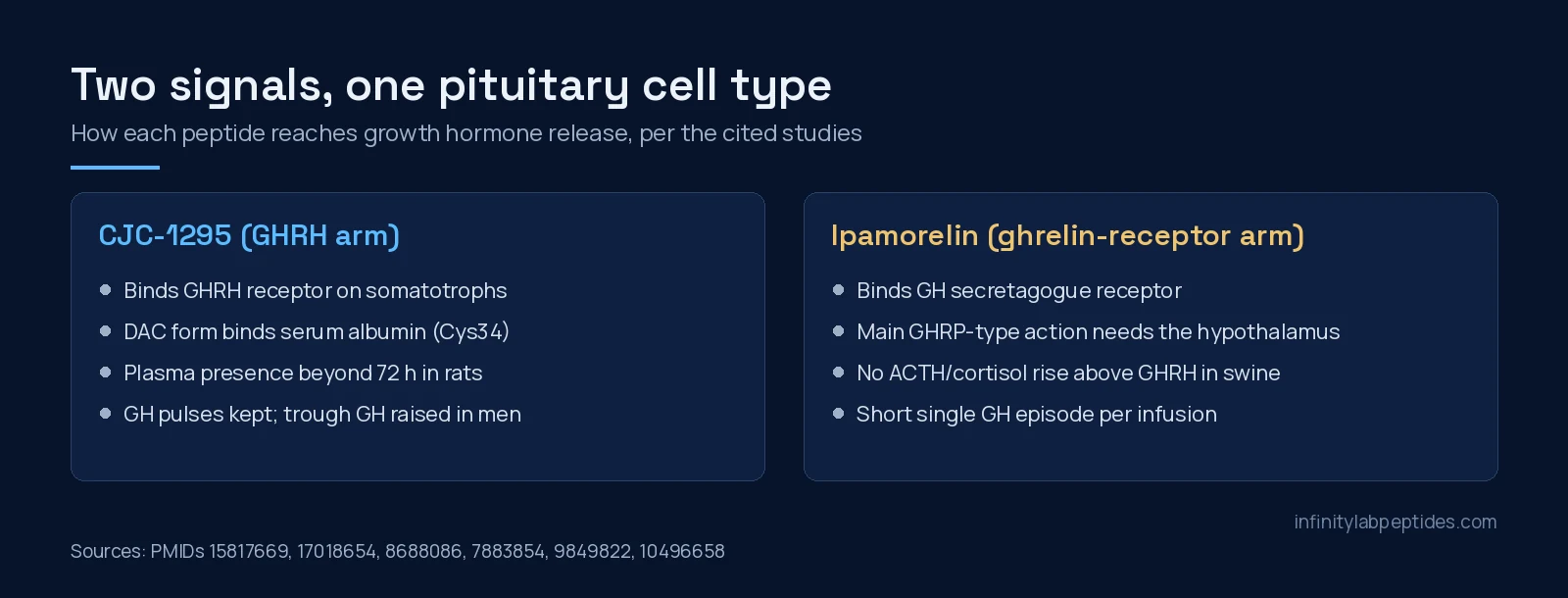
| Question | CJC-1295 | Ipamorelin |
|---|---|---|
| Receptor | GHRH receptor (class B GPCR) [6] | GH secretagogue receptor, the ghrelin receptor [3],[4] |
| Natural signal it mimics | Hypothalamic GHRH | Ghrelin (receptor shared; structure unrelated) |
| Design feature | Four substitutions in GHRH(1-29); DAC form adds an albumin-reactive maleimide [1] | Pentapeptide with non-natural residues; lacks GHRP-1’s Ala-Trp core [2] |
| Reported half-life | 5.8 to 8.1 days for the DAC form in healthy adults [7] | About 2 hours in healthy male volunteers [10] |
| GH pattern reported | Pulses preserved, baseline (trough) raised [8] | Single GH episode per infusion [10] |
| ACTH/cortisol in swine | Not tested in that study | Not raised beyond GHRH levels [2] |
| Regulatory position | Not an approved medicine; WADA-prohibited (S2) [5] | Not an approved medicine; reached phase 2 for postoperative ileus [11] |
| Our COA status | Blend card only (no purity figure shown) | No certificate for the single vial |
Why the two are paired: the GHRH plus GHRP evidence
The logic behind selling a GHRH analogue with a ghrelin-receptor agonist comes from work done with GHRP-6, not ipamorelin or CJC-1295. In 18 normal men in 1990, submaximal GHRP doses given with GHRH released GH synergistically, which the authors read as the two acting through independent mechanisms [12].
Two later studies narrow that picture. In patients with hypothalamopituitary disconnection, GHRP-6 alone released almost no GH, and the GHRH plus GHRP-6 combination gave only about the arithmetic sum of each alone, while controls showed the larger-than-additive response. The authors concluded that GHRP-6 acts mainly at the hypothalamic level [13]. And in dispersed rat pituitary cells, GHRH and GHRP-6 together raised GH secretion further, but the effect was additive rather than synergistic [14]. Put together, the larger-than-additive effect seen in whole people seems to need an intact hypothalamus; it is not a simple property of the two receptors sitting on the same cell.
What animal and human pharmacology work measured
- Bone growth in rats (ipamorelin). Fifteen days of treatment in adult female rats increased longitudinal tibial growth rate and body weight gain in a dose-dependent way, without changing total IGF-I, IGF-binding proteins or bone-turnover markers [15].
- Gut motility in rats (ipamorelin). In a rat postoperative ileus model, a single dose shortened time to first bowel movement, and repeated dosing increased faecal output and food intake [16]. A later phase 2 randomized, placebo-controlled trial in bowel-resection patients used time to tolerating a solid meal as its key endpoint [11]. We describe its design only.
- Serum proteins after CJC-1295. A proteomic study compared sera from 11 healthy young men before and one week after an injection, searching for new markers of GH and IGF-1 action [17]. It was a biomarker-discovery study, not a test of any benefit.
None of this work used the products sold today, and none of it tested a CJC-1295 plus ipamorelin blend.
Identity and quality: what testing labs keep finding
Because GHRH analogues and GHRPs are on the WADA prohibited list, anti-doping labs have studied the material in circulation. Besides the Norwegian case above [5], seized products have contained modified versions such as Gly-ipamorelin, ipamorelin with an extra N-terminal glycine [18]. Metabolism studies have mapped the urinary breakdown products of GHRPs including ipamorelin [19], and in vitro work has characterised metabolites of sermorelin, tesamorelin and both CJC-1295 forms for detection [20]. Albumin-bound CJC-1295 is hard to measure directly; one method confirmed it in equine plasma only after immuno-affinity capture and tryptic digestion [21]. A 2026 review of GH-axis peptides sold as “research compounds” grouped them by evidence tier and pointed to uncertainty about product composition in unregulated supply [22]. The practical lesson for a research buyer is to tie the vial to a batch report and an identifier.
What the evidence does not show
- No head-to-head or combination study of CJC-1295 and ipamorelin. The pairing rationale rests on GHRP-6 data [12],[13].
- No published pharmacokinetics for the no-DAC form; the multi-day half-life belongs to the albumin-reactive molecule [1],[7].
- Ipamorelin’s selectivity for GH over ACTH and cortisol comes from swine and a single programme [2].
- The rat bone-growth result came without a change in total IGF-I, so it does not map neatly onto an IGF-I story [15].
- Nothing here supports any benefit, safety profile or use in people. Neither compound is an approved medicine, and human studies are described here only for their design and pharmacokinetics.
Notes for a research buyer
If your protocol needs one pathway at a time, the single Ipamorelin 10 mg vial isolates the ghrelin-receptor arm; the CJC 1295 + Ipamorelin blend combines both, and its batch report can be checked with the key above. Confirm which CJC-1295 form you need before ordering. For a related comparison on the GHRH side, see Tesamorelin vs Ipamorelin. To browse the rest of the catalogue, you can buy research peptides in Canada through our main research page.
Frequently asked questions
Is CJC-1295 the same as ipamorelin?
No. CJC-1295 is a modified 29-residue GHRH analogue that acts on the GHRH receptor; ipamorelin is a five-residue peptide that acts on the ghrelin (GH secretagogue) receptor.
What is the difference between CJC-1295 with and without DAC?
The original CJC-1295 carries a maleimide group that binds serum albumin, which gave it a multi-day half-life in studies. The no-DAC form keeps the modified 29-residue chain without that group, and we found no published pharmacokinetic data for it.
Has the CJC-1295 and ipamorelin combination been studied?
We found no peer-reviewed study of that pairing. Synergy between the GHRH and ghrelin-receptor pathways was shown with GHRH plus GHRP-6, and it appeared to need an intact hypothalamus.
Why is ipamorelin called a selective secretagogue?
In conscious swine, ipamorelin released GH without raising ACTH or cortisol beyond the levels seen with GHRH, unlike GHRP-6 and GHRP-2. That finding comes from one research programme in pigs.
Does Infinity Lab Peptides post a COA for these products?
The CJC 1295 + Ipamorelin 10 mg blend has a Janoshik card (batch APR26000129501, 09 APR 2026, key 3DPIULXTAV86) with no purity figure shown. No certificate is posted for the single Ipamorelin 10 mg vial at the time of writing.
References
- Jetté L, Léger R, Thibaudeau K et al. (2005). Human growth hormone-releasing factor (hGRF)1-29-albumin bioconjugates activate the GRF receptor on the anterior pituitary in rats: identification of CJC-1295 as a long-lasting GRF analog. Endocrinology. PMID: 15817669. doi: 10.1210/en.2004-1286.
- Raun K, Hansen BS, Johansen NL et al. (1998). Ipamorelin, the first selective growth hormone secretagogue. Eur J Endocrinol. PMID: 9849822. doi: 10.1530/eje.0.1390552.
- Howard AD, Feighner SD, Cully DF et al. (1996). A receptor in pituitary and hypothalamus that functions in growth hormone release. Science. PMID: 8688086. doi: 10.1126/science.273.5277.974.
- Kojima M, Hosoda H, Date Y et al. (1999). Ghrelin is a growth-hormone-releasing acylated peptide from stomach. Nature. PMID: 10604470. doi: 10.1038/45230.
- Henninge J, Pepaj M, Hullstein I et al. (2010). Identification of CJC-1295, a growth-hormone-releasing peptide, in an unknown pharmaceutical preparation. Drug Test Anal. PMID: 21204297. doi: 10.1002/dta.233.
- Zhou F, Zhang H, Cong Z et al. (2020). Structural basis for activation of the growth hormone-releasing hormone receptor. Nat Commun. PMID: 33060564. doi: 10.1038/s41467-020-18945-0.
- Teichman SL, Neale A, Lawrence B et al. (2006). Prolonged stimulation of growth hormone (GH) and insulin-like growth factor I secretion by CJC-1295, a long-acting analog of GH-releasing hormone, in healthy adults. J Clin Endocrinol Metab. PMID: 16352683. doi: 10.1210/jc.2005-1536.
- Ionescu M, Frohman LA (2006). Pulsatile secretion of growth hormone (GH) persists during continuous stimulation by CJC-1295, a long-acting GH-releasing hormone analog. J Clin Endocrinol Metab. PMID: 17018654. doi: 10.1210/jc.2006-1702.
- Johansen PB, Hansen KT, Andersen JV et al. (1998). Pharmacokinetic evaluation of ipamorelin and other peptidyl growth hormone secretagogues with emphasis on nasal absorption. Xenobiotica. PMID: 9879640. doi: 10.1080/004982598238976.
- Gobburu JV, Agersø H, Jusko WJ et al. (1999). Pharmacokinetic-pharmacodynamic modeling of ipamorelin, a growth hormone releasing peptide, in human volunteers. Pharm Res. PMID: 10496658. doi: 10.1023/a:1018955126402.
- Beck DE, Sweeney WB, McCarter MD et al. (2014). Prospective, randomized, controlled, proof-of-concept study of the Ghrelin mimetic ipamorelin for the management of postoperative ileus in bowel resection patients. Int J Colorectal Dis. PMID: 25331030. doi: 10.1007/s00384-014-2030-8.
- Bowers CY, Reynolds GA, Durham D et al. (1990). Growth hormone (GH)-releasing peptide stimulates GH release in normal men and acts synergistically with GH-releasing hormone. J Clin Endocrinol Metab. PMID: 2108187. doi: 10.1210/jcem-70-4-975.
- Popovic V, Damjanovic S, Micic D et al. (1995). Blocked growth hormone-releasing peptide (GHRP-6)-induced GH secretion and absence of the synergic action of GHRP-6 plus GH-releasing hormone in patients with hypothalamopituitary disconnection: evidence that GHRP-6 main action is exerted at the hypothalamic level. J Clin Endocrinol Metab. PMID: 7883854. doi: 10.1210/jcem.80.3.7883854.
- Mitani M, Kaji H, Abe H et al. (1996). Growth hormone (GH)-releasing peptide and GH releasing hormone stimulate GH release from subpopulations of somatotrophs in rats. J Neuroendocrinol. PMID: 8933359. doi: 10.1046/j.1365-2826.1996.05283.x.
- Johansen PB, Nowak J, Skjaerbaek C et al. (1999). Ipamorelin, a new growth-hormone-releasing peptide, induces longitudinal bone growth in rats. Growth Horm IGF Res. PMID: 10373343. doi: 10.1054/ghir.1999.9998.
- Venkova K, Mann W, Nelson R et al. (2009). Efficacy of ipamorelin, a novel ghrelin mimetic, in a rodent model of postoperative ileus. J Pharmacol Exp Ther. PMID: 19289567. doi: 10.1124/jpet.108.149211.
- Sackmann-Sala L, Ding J, Frohman LA et al. (2009). Activation of the GH/IGF-1 axis by CJC-1295, a long-acting GHRH analog, results in serum protein profile changes in normal adult subjects. Growth Horm IGF Res. PMID: 19386527. doi: 10.1016/j.ghir.2009.03.001.
- Krug O, Thomas A, Malerød-Fjeld H et al. (2018). Analysis of new growth promoting black market products. Growth Horm IGF Res. PMID: 29864719. doi: 10.1016/j.ghir.2018.05.001.
- Thomas A, Delahaut P, Krug O et al. (2012). Metabolism of growth hormone releasing peptides. Anal Chem. PMID: 23101768. doi: 10.1021/ac302034w.
- Memdouh S, Gavrilović I, Ng K et al. (2021). Advances in the detection of growth hormone releasing hormone synthetic analogs. Drug Test Anal. PMID: 34665524. doi: 10.1002/dta.3183.
- Timms M, Ganio K, Steel R (2019). A method for confirming CJC-1295 abuse in equine plasma samples by LC-MS/MS. Drug Test Anal. PMID: 30938069. doi: 10.1002/dta.2599.
- Dominikowski A, Rękoś Z, Olejarz M et al. (2026). The emerging landscape of performance-enhancing peptides modulating GH-IGF1 axis: bridging the gap between clinical evidence and patient self-administration. Front Endocrinol (Lausanne). PMID: 42395176. doi: 10.3389/fendo.2026.1822475.