Introduction
Sacroiliac (SI) joint pain is one of the most persistent and difficult-to-treat forms of lower back pain. Located at the junction between the spine and the pelvis, the SI joint bears significant load during daily movement and is prone to both inflammation and degenerative changes.
Conventional treatment options — including physical therapy, corticosteroid injections, and surgical fusion — vary in effectiveness and carry their own limitations.
In recent years, researchers have begun exploring whether certain peptides could play a role in supporting joint recovery and reducing inflammatory signaling. Here is what the research currently suggests.
Understanding SI Joint Pain
The sacroiliac joint connects the sacrum at the base of the spine to the iliac bones of the pelvis. Pain in this joint can stem from several causes, including:
- Inflammatory conditions such as ankylosing spondylitis
- Degenerative joint disease (osteoarthritis)
- Traumatic injury or hypermobility
- Pregnancy-related ligament laxity
- Post-surgical complications following spinal fusion
The complexity of SI joint dysfunction makes it a compelling target for researchers studying tissue repair and anti-inflammatory compounds.
Peptides Being Studied for Joint and Tissue Recovery
Several research peptides have been investigated for their potential effects on inflammation, connective tissue repair, and joint health. The most studied include:
- BPC-157 (Body Protection Compound-157): A 15-amino acid peptide derived from a gastric protection protein. Research in animal models has shown accelerated healing in tendons, ligaments, and muscle tissue, along with reduced inflammatory markers.
- TB-500 (Thymosin Beta-4): A naturally occurring peptide involved in actin regulation and wound healing. Studies suggest it may support tissue repair, reduce inflammation, and promote angiogenesis in injured areas.
- Collagen peptides: Hydrolyzed collagen peptides have been studied in clinical settings for their potential role in supporting cartilage integrity and joint comfort.
- GHK-Cu (Copper peptide): Studied for its tissue-regenerating properties and anti-inflammatory effects in preclinical models.
What the Research Shows
It is important to be precise about the current state of evidence. The majority of promising results for peptides like BPC-157 and TB-500 in joint and connective tissue repair come from animal studies — primarily rodent models.
Human clinical trial data is limited for most of these compounds. While the preclinical evidence is encouraging, it does not automatically translate to confirmed efficacy in human SI joint pain.
Researchers use these compounds to investigate the underlying mechanisms of tissue repair — including cytokine modulation, fibroblast activity, and collagen synthesis — which may eventually contribute to new therapeutic strategies.
The Anti-Inflammatory Angle
Chronic SI joint pain is closely linked to persistent low-grade inflammation. Several research peptides have demonstrated anti-inflammatory properties in laboratory settings, which is a key reason scientists are interested in studying them in joint conditions.
BPC-157, for example, has been shown in animal studies to downregulate pro-inflammatory cytokines — the proteins that drive the inflammatory cascade. Whether these effects translate meaningfully to the SI joint in humans remains an open research question.
This is exactly the kind of question researchers are designed to answer — which is why access to high-quality, documented compounds is so important.
What Researchers Need to Know
If you are conducting research into peptides and joint tissue, there are several important considerations:
- Source purity matters — degraded or contaminated compounds compromise experimental validity
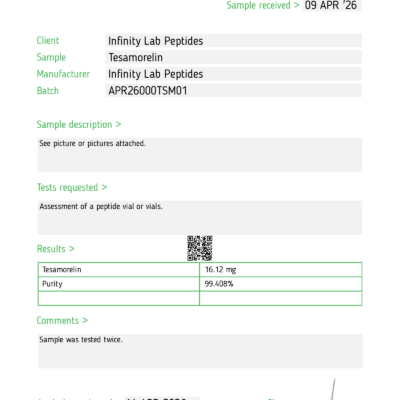
- Certificate of Analysis (COA) documentation is essential for any serious research program
- Dosing protocols in animal models vary significantly and should not be extrapolated to human use without clinical guidance
- Combination protocols (e.g., BPC-157 + TB-500) are being explored in research settings but require careful study design
Conclusion
Peptides represent a compelling frontier in the research of tissue repair and anti-inflammatory signaling. While definitive clinical evidence for their use in SI joint pain is still emerging, preclinical data makes them a subject of serious scientific interest.
For researchers in this space, access to verified, high-purity compounds is the foundation of credible investigation. Infinity Lab Peptides supplies exactly that.
Disclaimer: This content is for informational and research purposes only. Infinity Lab Peptides products are not intended to diagnose, treat, cure, or prevent any condition including SI joint pain or any other medical condition. Always consult a qualified healthcare professional for medical advice.
Source Your Research Peptides with Confidence
Infinity Lab Peptides provides BPC-157, TB-500, and other tissue research compounds with full Certificates of Analysis. Every batch tested. Every order documented.