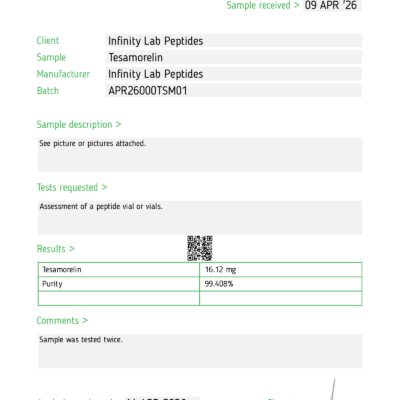
For laboratory research only. Not for human or animal use. This article gives no dosing, administration or therapeutic advice.
Short answer: KPV and BPC-157 often get grouped together as “gut peptides”, but they come from different places and rest on different kinds of evidence. KPV is the three-residue C-terminal end of alpha-melanocyte-stimulating hormone (Lys-Pro-Val). It was singled out because it kept alpha-MSH’s anti-inflammatory activity in experiments without its pigmentary action [1], and cell and mouse work shows it is carried into intestinal cells by the PepT1 transporter [2]. BPC-157 is a 15-residue fragment of a larger protein described in gastric juice in 1993 [3], tested mostly in rat injury models. Neither is an approved medicine, and the human data for both are thin: none that we could find for KPV, and three small, low-quality studies for BPC-157 [4].
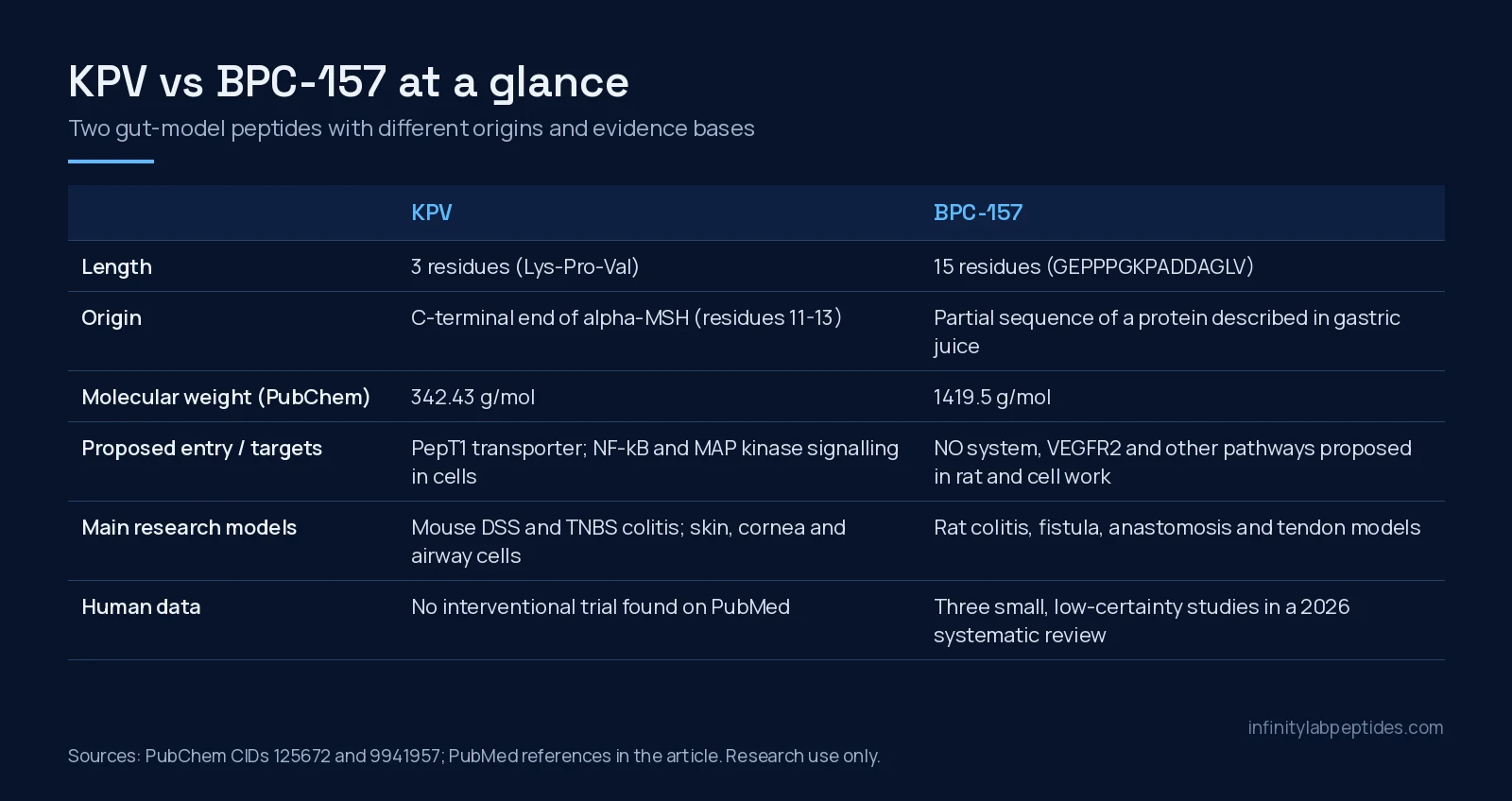
Spec cards from our COA library
Statements below come only from the reports posted on our COA page, read on October 17, 2026.
KPV 10 mg
Purity: not available
Batch: not available
Lab: not available
Listing: KPV 10 mg
No certificate is posted for this product on our COA page at the time of writing.
BPC-157
Purity: 99.943%
Batch: APR2600015701
Analysis date: 14 APR 2026
Lab: Janoshik
Verification key: 6ZLN4DX15H2X
Listing: BPC-157 10 mg
This is one batch result as listed on our COA page, not a test of each vial.
Because no report is posted for KPV, its identity and purity cannot be checked from our library today. For a tripeptide of about 342 g/mol, mass confirmation is simple to build into your own method, and it is worth doing before any comparison.
Identity at a glance
Values below are PubChem’s. The BPC-157 sequence also appears in the papers that describe it [5] [6].
| Property | KPV | BPC-157 |
|---|---|---|
| Class | Tripeptide, C-terminal fragment of alpha-MSH (residues 11-13) | Pentadecapeptide, partial sequence of a gastric juice protein |
| Sequence | Lys-Pro-Val (KPV) | GEPPPGKPADDAGLV |
| Synonyms | MSH (11-13), alpha-MSH (11-13), ACTH (11-13) | Bepecin, PL-10, PLD-116, PL-14736 |
| Molecular formula | C16H30N4O4 | C62H98N16O22 |
| Molecular weight | 342.43 g/mol | 1419.5 g/mol |
| CAS | 67727-97-3 | 137525-51-0 |
| PubChem CID | 125672 | 9941957 |
The size gap matters in the lab. KPV is small enough to be a substrate for a di- and tripeptide transporter, which is how the main KPV papers explain its entry into cells. BPC-157 is five times longer and four times heavier, so the same transport route does not apply, and its papers propose other mechanisms.
Where each peptide came from
KPV grew out of melanocortin research. Alpha-MSH is a 13-residue peptide cut from proopiomelanocortin, with anti-inflammatory effects reported in many animal models. Its pigmentary activity got in the way of that line of work, so researchers looked at the C-terminal tripeptide, which kept anti-inflammatory activity without the pigmentary action [1]. Our KPV vs alpha-MSH comparison covers that parent-fragment relationship in more depth.
BPC-157 came from a stress-and-stomach hypothesis. A 1993 overview described a gastric juice protein of about 40 kDa, named BPC, and a 15-residue fragment thought to carry its activity [3]. A 2006 review by the same research programme lists the codes under which it entered trials for inflammatory bowel disease (PL-10, PLD-116, PL 14736) [6]. We found no published results from those trials on PubMed.
Proposed mechanisms, as the papers describe them
KPV: transporter uptake and inflammatory signalling
Dalmasso and colleagues showed that KPV enters human intestinal epithelial cells and T cells through PepT1. At nanomolar concentrations in those cell lines it reduced NF-kB and MAP kinase activation and lowered pro-inflammatory cytokine release [2]. The receptor question is less settled. In human keratinocytes, KPV did not raise cyclic AMP; it produced intracellular calcium signals under specific test conditions, and it raised calcium in hamster ovary cells engineered to express the MC1 receptor [7]. Yet in mice with a non-functional MC1 receptor, KPV still worked in DSS colitis, which suggests the effect is at least partly MC1R-independent [8].
KPV also appears in host-defence work. In culture, alpha-MSH and KPV reduced Staphylococcus aureus colony formation and the viability of Candida albicans, possibly through raised cyclic AMP in the yeast [9].
BPC-157: NO system and blood vessels
The BPC-157 literature proposes a broad relation with the nitric oxide system. A 2014 review argues that BPC-157 interacts with both L-NAME and L-arginine effects across many injury models [10]. Independent cell and animal work tied it to blood-vessel growth: it increased vessel density in the chick chorioallantoic membrane and endothelial tube assays, raised VEGFR2 (but not VEGF-A) expression in human endothelial cells, and activated VEGFR2-Akt-eNOS signalling [11]. A 2025 systematic review summarised the preclinical picture as effects on growth hormone receptor expression, angiogenesis pathways and inflammatory cytokines [12].
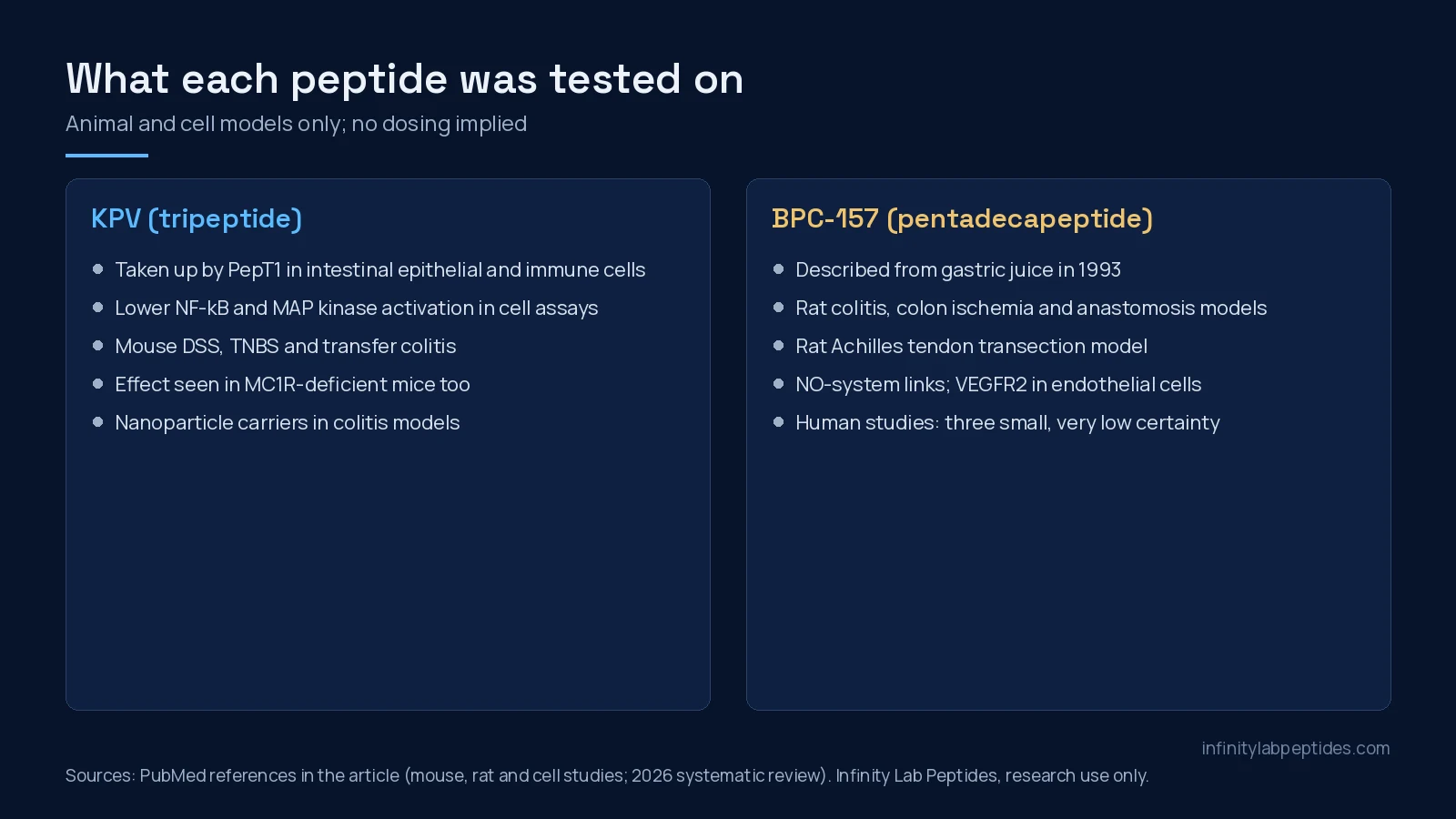
Gut models side by side
Both peptides have been tested in colon inflammation, but in different species, models and labs. The table lists models and what was measured; it is not a ranking.
| Study | Peptide | Model | What was measured |
|---|---|---|---|
| Dalmasso 2008 [2] | KPV | Human intestinal and T-cell lines; mouse DSS and TNBS colitis | NF-kB and MAP kinase signalling, cytokines, PepT1 dependence |
| Kannengiesser 2008 [8] | KPV | Mouse DSS colitis, CD45RB(hi) transfer colitis, MC1R-deficient mice | Weight regain, histology, myeloperoxidase activity, survival |
| Viennois 2016 [13] | KPV | Mouse colitis-associated cancer (AOM/DSS), PepT1 knockout and overexpressing mice | Tumour number and size, inflammation |
| Xiao 2017 [14] | KPV (in nanoparticles) | Mouse ulcerative colitis model | Mucosal damage, TNF-alpha, targeted cell uptake |
| Klicek 2013 [15] | BPC-157 | Rat cysteamine colitis and colon-colon anastomosis | Healing of colitis and anastomosis |
| Duzel 2017 [16] | BPC-157 | Rat ischemic colitis and reperfusion | Vessel presentation, MDA and NO levels in colon tissue |
Two details stand out. First, the KPV work tested its own mechanism: in PepT1-knockout mice, KPV lost the anti-tumour effect it showed in wild-type mice [13]. That is a direct test of the transport route. Second, much of the KPV research has moved on to delivery. The 2017 study loaded KPV into hyaluronic-acid-coated nanoparticles to target colonic epithelial cells and macrophages [14], a sign that getting the tripeptide to the right cells is a research problem in itself.
The BPC-157 colitis papers report healing across several rat lesion types, often within the same experiment [15] [16]. The colitis papers cited here come from the group that first described the peptide (Sikirić and colleagues), so independent replication of the gut findings is the main thing missing.
Beyond the gut
BPC-157 has a large musculoskeletal literature. In rats with a transected Achilles tendon, it improved biomechanical, functional and microscopic healing measures, and it stimulated tendon cell growth in vitro [5]. Of 36 studies in the 2025 systematic review, 35 were preclinical [12]. Our BPC-157 vs GHK-Cu comparison looks at the tissue-repair side in more detail.
KPV’s non-gut work is mostly about skin, host defence and inflammation in cells [7] [9]. Reviews of alpha-MSH-related tripeptides list skin, lung, eye and joint inflammation as possible research areas, but these are listed as prospects, not results [1].
Regulatory status, stated neutrally
BPC-157 lacks US Food and Drug Administration approval, and its use is banned in professional sport, as the 2025 systematic review notes [12]. We found no approved medicine containing KPV. We found no approved medicine containing either peptide.
What the evidence does not show
- No head-to-head study. We found no paper on PubMed that tests KPV against BPC-157 in the same model.
- No human trial for KPV. The KPV evidence is cell lines and mice. We found no interventional human study.
- Very low-certainty human data for BPC-157. A 2026 systematic review found three studies with 30 people in total. All were uncontrolled, two were retrospective, and the overall certainty was rated very low. The authors concluded that BPC-157 should not be used clinically outside regulated, high-quality trials [4].
- No shared mechanism. KPV’s papers centre on PepT1 transport and NF-kB signalling. BPC-157’s centre on the NO system and VEGFR2. The two may share some outcomes in rodent colitis, but that does not mean they act the same way.
- No combination data. Claims that the two “work together” have no support in the papers we found.
What our documentation covers
For BPC-157, the posted Janoshik report (batch APR2600015701, 99.943%, analysed 14 APR 2026, key 6ZLN4DX15H2X) covers the batch listed for BPC-157 10 mg. For KPV, no certificate is posted, so plan your own identity check. Our thymosin alpha-1 vs KPV comparison has more KPV background. Researchers comparing suppliers can buy research peptides in Canada with the batch documentation shown on each listing.
Frequently asked questions
What is the main difference between KPV and BPC-157?
Origin and size. KPV is the three-residue C-terminal end of alpha-MSH (Lys-Pro-Val). BPC-157 is a 15-residue fragment of a protein described in gastric juice. Their papers also propose different mechanisms: PepT1 uptake and NF-kB signalling for KPV, the nitric oxide system and VEGFR2 for BPC-157.
Have KPV and BPC-157 been compared directly?
Not in any study we found on PubMed. Both were tested in rodent colitis models, but in different species, models and labs, so their results cannot be ranked against each other.
Does KPV act through the MC1 receptor?
Not fully, according to the mouse work. KPV still reduced DSS colitis in mice with a non-functional MC1 receptor, and cell studies point to PepT1 transport and changes in inflammatory signalling.
Is there human research on BPC-157?
Very little. A 2026 systematic review found three small, uncontrolled studies with 30 people in total and rated the certainty of evidence as very low.
Is there a certificate for KPV on the Infinity Lab Peptides COA page?
Not at the time of writing. The COA page lists a Janoshik report for BPC-157 (batch APR2600015701, 99.943%) but none for KPV.
Research-use notice
KPV and BPC-157 from Infinity Lab Peptides are sold for laboratory research and analytical use only. They are not for human or animal consumption. This article summarises published research as reported by its authors; it is not medical advice and makes no claim about any product’s effects.
References
- Brzoska T, Luger TA, Maaser C et al. (2008). Alpha-melanocyte-stimulating hormone and related tripeptides: biochemistry, antiinflammatory and protective effects in vitro and in vivo, and future perspectives for the treatment of immune-mediated inflammatory diseases. Endocr Rev. PMID: 18612139. doi: 10.1210/er.2007-0027.
- Dalmasso G, Charrier-Hisamuddin L, Nguyen HT et al. (2008). PepT1-mediated tripeptide KPV uptake reduces intestinal inflammation. Gastroenterology. PMID: 18061177. doi: 10.1053/j.gastro.2007.10.026.
- Sikirić P, Petek M, Rucman R et al. (1993). A new gastric juice peptide, BPC. An overview of the stomach-stress-organoprotection hypothesis and beneficial effects of BPC. J Physiol Paris. PMID: 8298609. doi: 10.1016/0928-4257(93)90038-u.
- Poolton JT, Minett J, Kazmi A (2026). Human evidence for BPC-157 in orthopaedic and regenerative medicine: a systematic review of efficacy and safety. Acta Orthop Belg. PMID: 42885452. doi: 10.52628/92.3.15837.
- Staresinic M, Sebecic B, Patrlj L et al. (2003). Gastric pentadecapeptide BPC 157 accelerates healing of transected rat Achilles tendon and in vitro stimulates tendocytes growth. J Orthop Res. PMID: 14554208. doi: 10.1016/S0736-0266(03)00110-4.
- Sikiric P, Seiwerth S, Brcic L et al. (2006). Stable gastric pentadecapeptide BPC 157 in trials for inflammatory bowel disease (PL-10, PLD-116, PL 14736, Pliva, Croatia). Full and distended stomach, and vascular response. Inflammopharmacology. PMID: 17186181. doi: 10.1007/s10787-006-1531-7.
- Elliott RJ, Szabo M, Wagner MJ et al. (2004). alpha-Melanocyte-stimulating hormone, MSH 11-13 KPV and adrenocorticotropic hormone signalling in human keratinocyte cells. J Invest Dermatol. PMID: 15102092. doi: 10.1111/j.0022-202X.2004.22404.x.
- Kannengiesser K, Maaser C, Heidemann J et al. (2008). Melanocortin-derived tripeptide KPV has anti-inflammatory potential in murine models of inflammatory bowel disease. Inflamm Bowel Dis. PMID: 18092346. doi: 10.1002/ibd.20334.
- Cutuli M, Cristiani S, Lipton JM et al. (2000). Antimicrobial effects of alpha-MSH peptides. J Leukoc Biol. PMID: 10670585. doi: 10.1002/jlb.67.2.233.
- Sikiric P, Seiwerth S, Rucman R et al. (2014). Stable gastric pentadecapeptide BPC 157-NO-system relation. Curr Pharm Des. PMID: 23755725. doi: 10.2174/13816128113190990411.
- Hsieh MJ, Liu HT, Wang CN et al. (2017). Therapeutic potential of pro-angiogenic BPC157 is associated with VEGFR2 activation and up-regulation. J Mol Med (Berl). PMID: 27847966. doi: 10.1007/s00109-016-1488-y.
- Vasireddi N, Hahamyan H, Salata MJ et al. (2025). Emerging Use of BPC-157 in Orthopaedic Sports Medicine: A Systematic Review. HSS J. PMID: 40756949. doi: 10.1177/15563316251355551.
- Viennois E, Ingersoll SA, Ayyadurai S et al. (2016). Critical role of PepT1 in promoting colitis-associated cancer and therapeutic benefits of the anti-inflammatory PepT1-mediated tripeptide KPV in a murine model. Cell Mol Gastroenterol Hepatol. PMID: 27458604. doi: 10.1016/j.jcmgh.2016.01.006.
- Xiao B, Xu Z, Viennois E et al. (2017). Orally Targeted Delivery of Tripeptide KPV via Hyaluronic Acid-Functionalized Nanoparticles Efficiently Alleviates Ulcerative Colitis. Mol Ther. PMID: 28143741. doi: 10.1016/j.ymthe.2016.11.020.
- Klicek R, Kolenc D, Suran J et al. (2013). Stable gastric pentadecapeptide BPC 157 heals cysteamine-colitis and colon-colon-anastomosis and counteracts cuprizone brain injuries and motor disability. J Physiol Pharmacol. PMID: 24304574.
- Duzel A, Vlainic J, Antunovic M et al. (2017). Stable gastric pentadecapeptide BPC 157 in the treatment of colitis and ischemia and reperfusion in rats: New insights. World J Gastroenterol. PMID: 29358856. doi: 10.3748/wjg.v23.i48.8465.