For laboratory research only. Not for human or animal use. This article gives no dosing, administration or therapeutic advice.
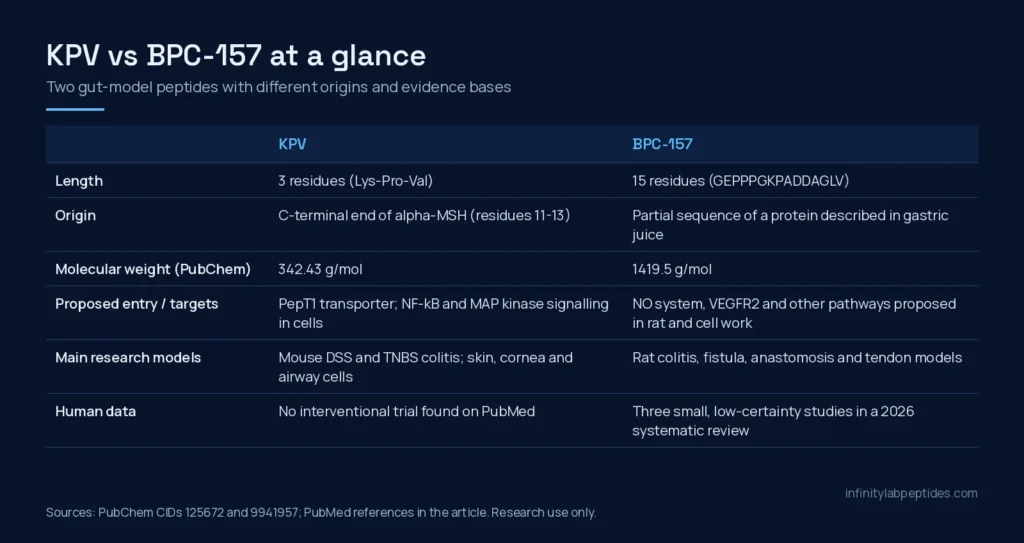
Short answer: KPV is the last three amino acids (Lys-Pro-Val, residues 11-13) of alpha-melanocyte-stimulating hormone (alpha-MSH), the 13-residue hormone SYSMEHFRWGKPV [1]. Alpha-MSH damps inflammation largely through melanocortin receptors, chiefly MC1R and MC3R [2][3]. KPV lacks the sequence motif those receptors are thought to need, yet keeps much of the parent’s anti-inflammatory activity in animal and cell models [4]. How KPV works is still open: one mouse study found it acted without melanocortin receptors [5], while a cell study saw it raise calcium in cells engineered to carry MC1R [6]. Uptake through the gut and immune-cell peptide transporter PepT1 is the best-supported route into cells [7][8]. All of this comes from cell and rodent work; we found no published human trial of KPV on PubMed.
Spec cards
KPV
Purity: not shown
Batch: not shown
Analysis date: not shown
Lab: not shown
Listing: KPV 10 mg
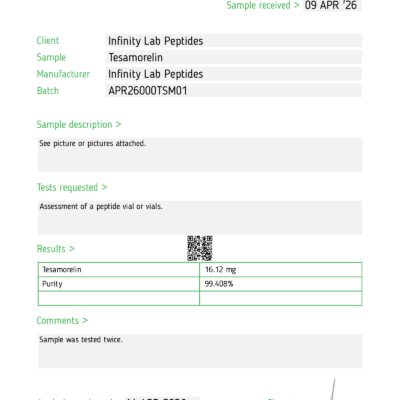
No certificate is posted for this product on our COA page at the time of writing.
Alpha-MSH
Listing: not sold by Infinity Lab Peptides
Role here: the parent hormone KPV is cut from, used as the reference point
Alpha-MSH appears in this article for comparison only. No certificate applies.
We leave the KPV card blank rather than borrow a number from another product. If a certificate is posted for the KPV listing, this section will be updated.
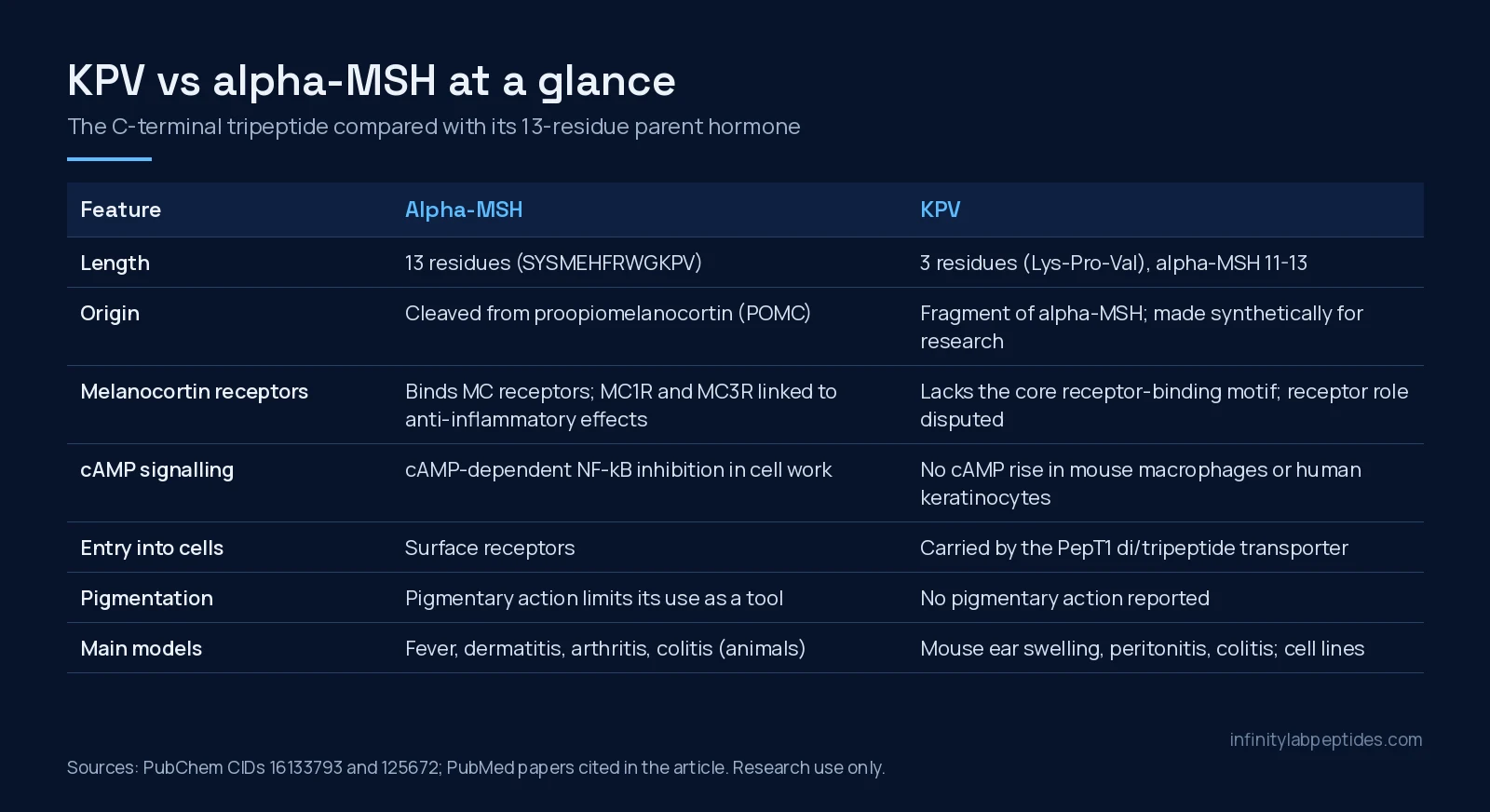
Identity: a 13-mer and its 3-residue tail
| Field | Alpha-MSH | KPV |
|---|---|---|
| Sequence | SYSMEHFRWGKPV (13 residues); studied as Ac-alpha-MSH(1-13)-NH2 | KPV (L-lysyl-L-prolyl-L-valine) |
| Other names (PubChem) | Alpha intermedin, MSH alpha | MSH (11-13), alpha-MSH (11-13), ACTH-(11-13) |
| Molecular formula | C77H109N21O19S | C16H30N4O4 |
| Molecular weight | 1664.9 g/mol | 342.43 g/mol |
| CAS (PubChem synonym) | 581-05-5 | 67727-97-3 |
| PubChem CID | 16133793 | 125672 |
| Natural source | Cleaved from proopiomelanocortin (POMC) | The C-terminal end of alpha-MSH; the research material is synthetic |
One caution on the PubChem record for alpha-MSH: it groups several synonyms, including “desacetyl alpha-MSH”, under a single CID. The formula above is the one PubChem lists for that record. The 1991 structure-activity work used the acetylated, amidated form of both the hormone and the tripeptide [9].
Alpha-MSH: a receptor hormone
Alpha-MSH is a tridecapeptide made from proopiomelanocortin [3]. Its targets were defined when the melanocortin receptor genes were cloned in 1992, a family of G-protein-coupled receptors for MSH and ACTH [10]. Five melanocortin receptors are now known, and reviews point to MC1R and MC3R as the subtypes most tied to anti-inflammatory effects [2].
At the cell level, alpha-MSH blocked activation of the transcription factor NF-kappa B by TNF, LPS and other stimuli, and stopped the breakdown of its inhibitor, I-kappa-B-alpha. Blocking adenylate cyclase or protein kinase A reversed the effect, which places cAMP in the pathway [11]. In mice, the anti-inflammatory action of melanocortin peptides on peritoneal macrophages persisted in recessive yellow (e/e) mice, which carry a non-working MC1R, and pointed to MC3R instead [12].
The hormone also has drawbacks as a research tool. Reviews name its short half-life, its lack of receptor selectivity [2] and its pigmentary action [3] as obstacles. Those limits are part of why interest turned to fragments.
KPV: what a three-residue fragment keeps
By the late 1980s, the hormone’s fever-lowering activity was thought to reside in its C-terminal tripeptide [13]. In 1989, KPV reduced picryl-chloride ear swelling in mice in a dose-related way [13]. Two years later, a set of D-amino-acid analogues showed that L-proline at position 12 was essential, the lysine could be swapped for its D-form, and a D-valine version was roughly four times as active in the same mouse model. Dose-response curves were bell-shaped, a pattern also seen with longer MSH peptides [9].
Later reviews summarise the picture this way: KPV lacks the whole motif needed to bind any known melanocortin receptor, retains most of alpha-MSH’s anti-inflammatory capacity in models, and shows no pigmentary action [4]. Both the hormone and the tripeptide also slowed the growth of Staphylococcus aureus and Candida albicans in culture [1].
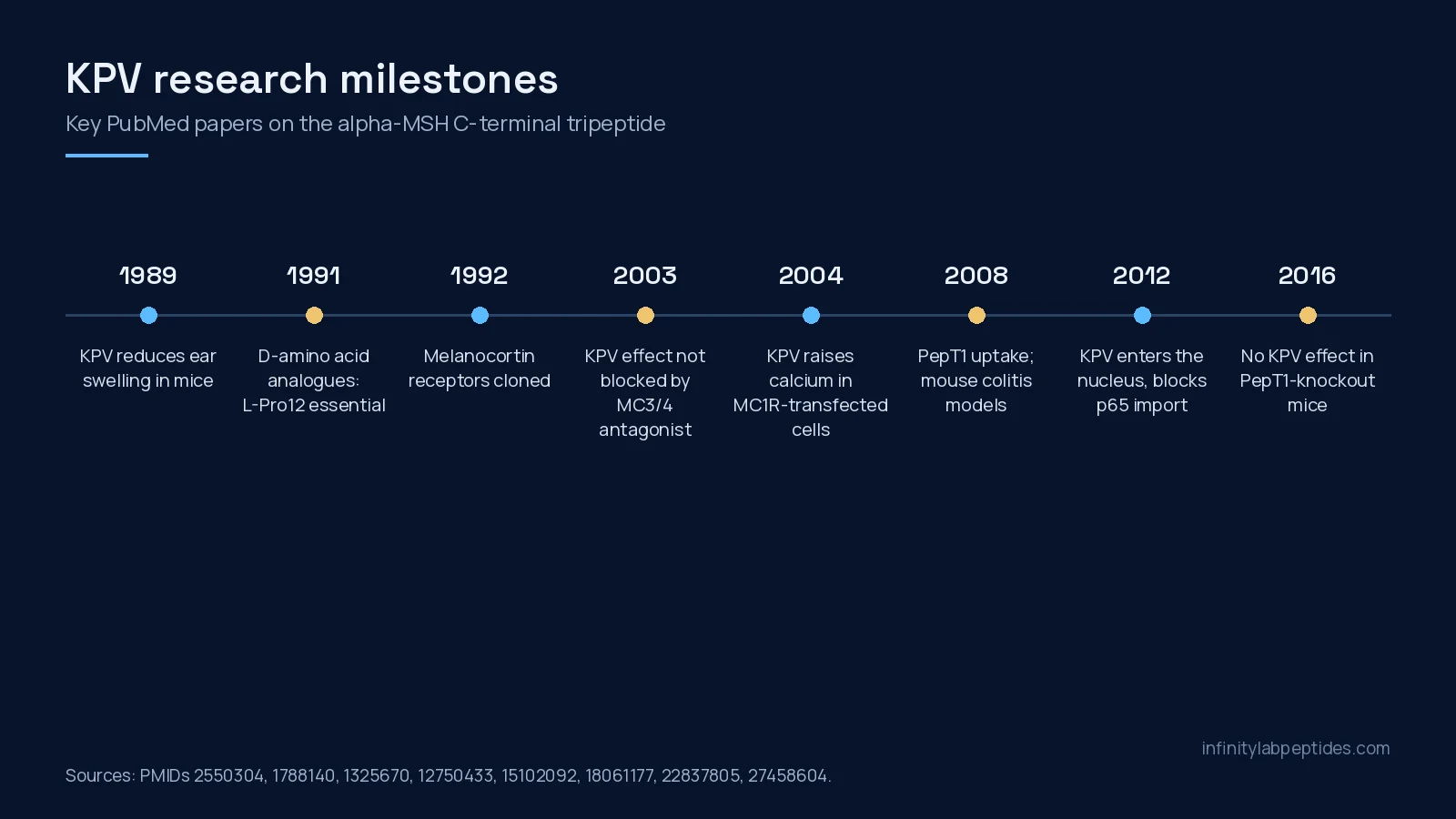
The receptor question: settled less than many pages claim
Many summaries say flatly that KPV does not touch melanocortin receptors. The primary papers point in two directions.
- Evidence against a receptor role (mouse). In crystal-induced peritonitis, KPV cut neutrophil build-up, and the MC3/4 receptor blocker SHU9119 did not stop it. KPV did not raise cAMP in macrophages, did not inhibit their cytokine release in vitro, and still worked in e/e mice. The authors concluded KPV is unlikely to act through melanocortin receptors and more likely interferes with IL-1-beta [5].
- Evidence for some receptor link (cells). In human keratinocytes, neither alpha-MSH nor KPV raised cAMP, but both triggered fast calcium signals under specific conditions. In Chinese hamster ovary cells engineered to carry MC1R, alpha-MSH and the KPV peptides both raised intracellular calcium [6].
- A receptor-free route inside the cell. In human bronchial epithelial cells, KPV entered the nucleus and appeared to block the import of the NF-kappa-B subunit p65 by binding near its importin-alpha site. Gamma-MSH, by contrast, needed MC3R to produce its effect in the same cells [14].
A fair reading: KPV’s anti-inflammatory effect in these models does not depend on the cAMP-coupled receptor signalling that defines alpha-MSH. Whether it has any receptor partner at all is not resolved.
PepT1: how KPV gets into cells
PepT1 is a transporter for di- and tripeptides found in the small intestine and induced in the colon in inflammatory bowel disease. In human intestinal epithelial lines and Jurkat T cells, KPV was taken up through PepT1 and, at nanomolar concentrations, inhibited NF-kappa-B and MAP-kinase signalling. Given orally to mice, it reduced inflammation in DSS and TNBS colitis models [7].
A separate group found KPV sped recovery in DSS colitis and in T-cell transfer colitis, and it worked in MC1R-deficient e/e mice too [15]. The strongest test of the transporter came in 2016: in a colitis-associated cancer model, KPV reduced tumour formation in normal mice but had no such effect in mice lacking PepT1 [8]. Delivery work has since loaded KPV into hyaluronic-acid nanoparticles aimed at colonic cells and macrophages in a mouse ulcerative colitis model [16].
That transporter route is the cleanest mechanistic contrast with the parent hormone. A 13-residue peptide is far longer than anything a di- and tripeptide carrier moves, so alpha-MSH works from the cell surface, while KPV can be moved inside.
KPV vs alpha-MSH side by side
| Question | Alpha-MSH | KPV |
|---|---|---|
| Main receptor story | MC1R and MC3R linked to anti-inflammatory effects [2][12] | Lacks the receptor-binding motif [4]; MC3/4 blocker did not stop it in mice [5] |
| cAMP | NF-kappa-B block reversed by cAMP-pathway inhibitors [11] | No cAMP rise in mouse macrophages [5] or human keratinocytes [6] |
| Route into cells | Acts at surface receptors | PepT1 transporter; effect lost in PepT1-knockout mice [7][8] |
| Inside the cell | Stops I-kappa-B-alpha breakdown and p65 translocation [11] | Nuclear entry; interferes with p65 import [14] |
| Key animal models | Fever, dermatitis, vasculitis, arthritis, colitis and more [3] | Ear swelling [13], peritonitis [5], DSS/TNBS/transfer colitis [7][15] |
| Pigmentation | Pigmentary action noted as a limit [3] | No pigmentary action reported [4] |
| Human trials found on PubMed | Not reviewed here | None found at the time of writing |
What the evidence does not show
- No human data for KPV. Every KPV finding above comes from cell lines, mouse models or engineered cells. Effects in mouse colitis do not tell us what happens in people.
- No agreed mechanism. PepT1 uptake is well supported. What KPV binds once inside, and whether MC1R plays any part, are open questions [6][14].
- No head-to-head potency ranking. Mouse papers tested KPV next to alpha-MSH in single models; they do not establish that one is stronger across systems [5].
- Bell-shaped responses. More is not always more in these models, which makes simple dose-response reading unreliable [9].
- Analogues are not KPV. D-amino-acid versions, acetylated or amidated forms and nanoparticle formulations behaved differently from plain KPV, so results do not transfer automatically [9][16].
Notes for lab buyers
If your work is on the PepT1 route, intestinal epithelial models, or NF-kappa-B signalling without melanocortin receptor activation, KPV is the more targeted tool. If your question is about melanocortin receptor pharmacology itself, the full hormone or a selective receptor ligand is the relevant comparator, and KPV is better treated as a contrast. For a different pairing, our thymosin alpha-1 vs KPV comparison sets the tripeptide against a thymic immune peptide. Whatever you choose, check identity and purity documents before you plan experiments; researchers who want to buy research peptides in Canada can review what is posted on our COA page first.
Frequently asked questions
Is KPV the same as alpha-MSH?
No. KPV is only the last three residues (Lys-Pro-Val) of the 13-residue hormone alpha-MSH. It keeps much of the parent’s anti-inflammatory activity in cell and rodent models but lacks the motif linked to melanocortin receptor binding and shows no pigmentary action in those reports.
Does KPV bind melanocortin receptors?
It is not settled. A 2003 mouse study found KPV worked without melanocortin receptor signalling, while a 2004 cell study saw KPV raise calcium in cells engineered to express MC1R. Most evidence points away from the cAMP-coupled receptor pathway that alpha-MSH uses.
What is PepT1 and why does it matter for KPV?
PepT1 is a transporter that moves di- and tripeptides into cells in the gut and is induced in the inflamed colon. KPV is carried by it, and in a 2016 mouse study KPV lost its effect in mice lacking PepT1, which links its activity to transporter uptake.
Has KPV been tested in humans?
We found no published human trial of KPV on PubMed at the time of writing. The research base is cell lines and mouse models of skin, peritoneal and intestinal inflammation.
Is there a certificate of analysis for Infinity’s KPV?
No certificate is posted for the KPV 10 mg listing on our COA page at the time of writing. If one is added, the spec card in this article will be updated.
References
- Cutuli M, Cristiani S, Lipton JM et al. (2000). Antimicrobial effects of alpha-MSH peptides. J Leukoc Biol. PMID: 10670585. doi: 10.1002/jlb.67.2.233.
- Catania A, Gatti S, Colombo G et al. (2004). Targeting melanocortin receptors as a novel strategy to control inflammation. Pharmacol Rev. PMID: 15001661. doi: 10.1124/pr.56.1.1.
- Brzoska T, Luger TA, Maaser C et al. (2008). Alpha-melanocyte-stimulating hormone and related tripeptides: biochemistry, antiinflammatory and protective effects in vitro and in vivo, and future perspectives for the treatment of immune-mediated inflammatory diseases. Endocr Rev. PMID: 18612139. doi: 10.1210/er.2007-0027.
- Brzoska T, Böhm M, Lügering A et al. (2010). Terminal signal: anti-inflammatory effects of α-melanocyte-stimulating hormone related peptides beyond the pharmacophore. Adv Exp Med Biol. PMID: 21222263. doi: 10.1007/978-1-4419-6354-3_8.
- Getting SJ, Schiöth HB, Perretti M (2003). Dissection of the anti-inflammatory effect of the core and C-terminal (KPV) alpha-melanocyte-stimulating hormone peptides. J Pharmacol Exp Ther. PMID: 12750433. doi: 10.1124/jpet.103.051623.
- Elliott RJ, Szabo M, Wagner MJ et al. (2004). alpha-Melanocyte-stimulating hormone, MSH 11-13 KPV and adrenocorticotropic hormone signalling in human keratinocyte cells. J Invest Dermatol. PMID: 15102092. doi: 10.1111/j.0022-202X.2004.22404.x.
- Dalmasso G, Charrier-Hisamuddin L, Nguyen HT et al. (2008). PepT1-mediated tripeptide KPV uptake reduces intestinal inflammation. Gastroenterology. PMID: 18061177. doi: 10.1053/j.gastro.2007.10.026.
- Viennois E, Ingersoll SA, Ayyadurai S et al. (2016). Critical role of PepT1 in promoting colitis-associated cancer and therapeutic benefits of the anti-inflammatory PepT1-mediated tripeptide KPV in a murine model. Cell Mol Gastroenterol Hepatol. PMID: 27458604. doi: 10.1016/j.jcmgh.2016.01.006.
- Hiltz ME, Catania A, Lipton JM (1991). Anti-inflammatory activity of alpha-MSH(11-13) analogs: influences of alteration in stereochemistry. Peptides. PMID: 1788140. doi: 10.1016/0196-9781(91)90131-8.
- Mountjoy KG, Robbins LS, Mortrud MT et al. (1992). The cloning of a family of genes that encode the melanocortin receptors. Science. PMID: 1325670. doi: 10.1126/science.1325670.
- Manna SK, Aggarwal BB (1998). Alpha-melanocyte-stimulating hormone inhibits the nuclear transcription factor NF-kappa B activation induced by various inflammatory agents. J Immunol. PMID: 9743348.
- Getting SJ, Christian HC, Lam CW et al. (2003). Redundancy of a functional melanocortin 1 receptor in the anti-inflammatory actions of melanocortin peptides: studies in the recessive yellow (e/e) mouse suggest an important role for melanocortin 3 receptor. J Immunol. PMID: 12626592. doi: 10.4049/jimmunol.170.6.3323.
- Hiltz ME, Lipton JM (1989). Antiinflammatory activity of a COOH-terminal fragment of the neuropeptide alpha-MSH. FASEB J. PMID: 2550304.
- Land SC (2012). Inhibition of cellular and systemic inflammation cues in human bronchial epithelial cells by melanocortin-related peptides: mechanism of KPV action and a role for MC3R agonists. Int J Physiol Pathophysiol Pharmacol. PMID: 22837805.
- Kannengiesser K, Maaser C, Heidemann J et al. (2008). Melanocortin-derived tripeptide KPV has anti-inflammatory potential in murine models of inflammatory bowel disease. Inflamm Bowel Dis. PMID: 18092346. doi: 10.1002/ibd.20334.
- Xiao B, Xu Z, Viennois E et al. (2017). Orally Targeted Delivery of Tripeptide KPV via Hyaluronic Acid-Functionalized Nanoparticles Efficiently Alleviates Ulcerative Colitis. Mol Ther. PMID: 28143741. doi: 10.1016/j.ymthe.2016.11.020.