For laboratory research only. Not for human or animal use. This article gives no dosing, administration or therapeutic advice.
Short answer: PT-141 (bremelanotide) and melanotan II are the same cyclic seven-residue alpha-MSH analogue with one difference at the end of the chain: PubChem lists bremelanotide with a free C-terminal carboxylic acid and melanotan II with a C-terminal amide. That small change sits on top of a large difference in how each has been used. Melanotan II is a potent, non-selective melanocortin agonist [1] and a standard tool compound in receptor research [2]. Bremelanotide went through clinical development and was approved in the USA in 2019 for one indication [3]. Melanotan II has no approval, and its medical literature is mostly case reports from unregulated use [4].
Spec cards from our COA library
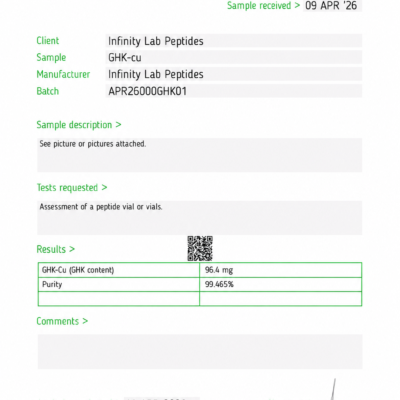
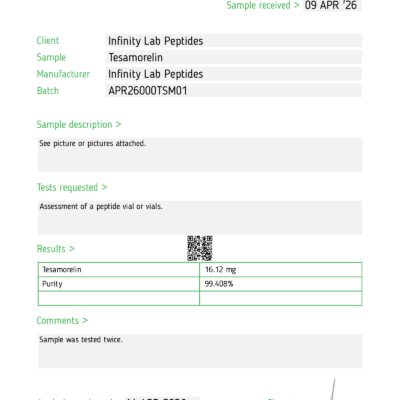
Statements below come only from our COA page, read on October 17, 2026.
PT-141 10 mg
Purity: not available
Batch: not available
Lab: not available
Listing: PT-141 10 mg
No certificate is posted for this product on our COA page at the time of writing.
Melanotan II
Purity: not applicable
Batch: not applicable
Listing: none
Infinity Lab Peptides does not list melanotan II, so there is no certificate for it. It appears here only as the comparison compound.
The missing report matters more than usual for this pair. Bremelanotide (1025.2 g/mol) and melanotan II (1024.2 g/mol) differ by about one mass unit, so only a mass spectrometry result with enough resolution, or a method that separates the acid from the amide, can tell them apart.
Identity at a glance
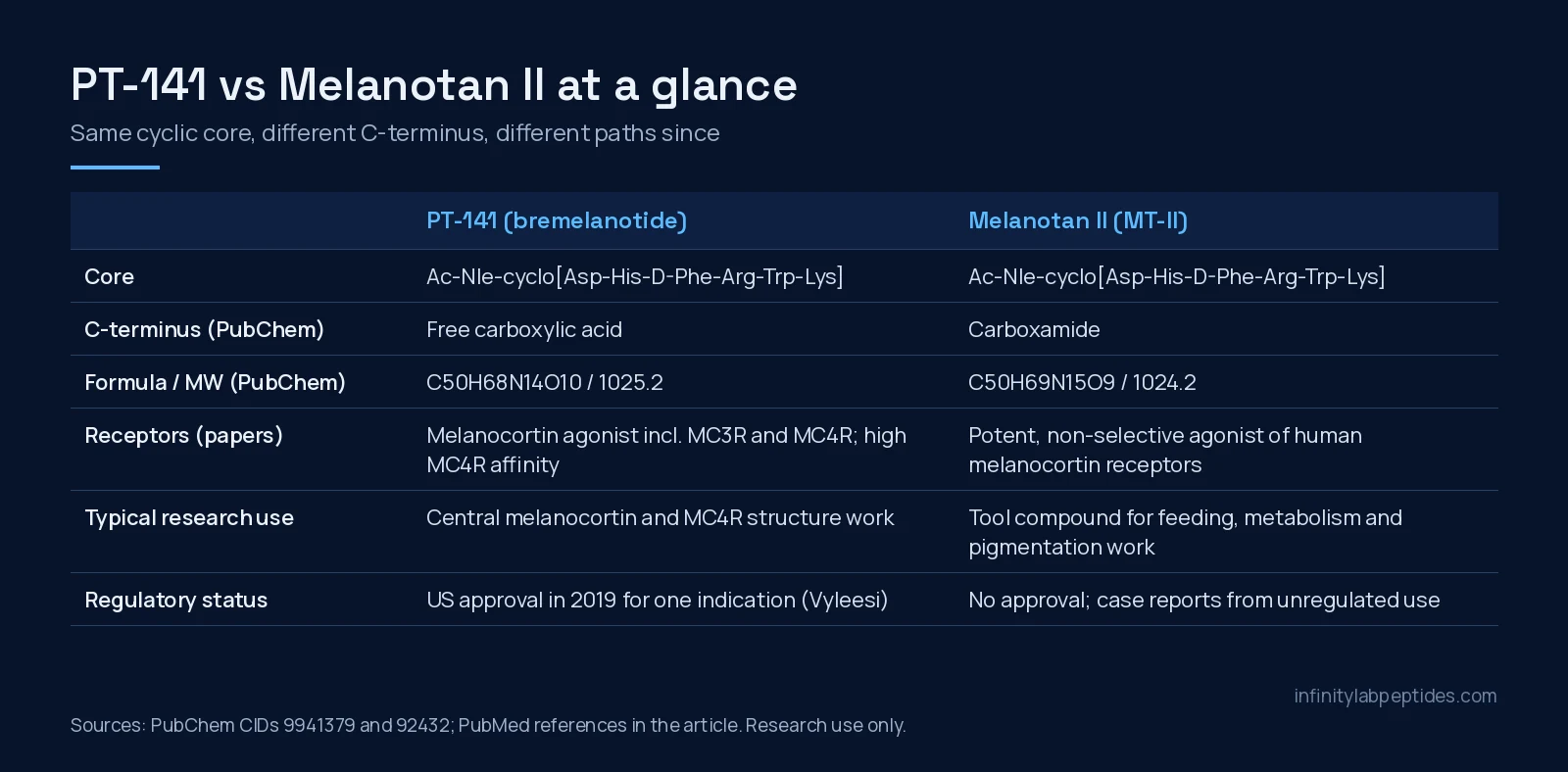
All values are PubChem’s. The two IUPAC names are identical except for the last word: “carboxylic acid” for bremelanotide and “carboxamide” for melanotan II.
| Property | PT-141 (bremelanotide) | Melanotan II |
|---|---|---|
| Class | Cyclic heptapeptide, lactam-bridged alpha-MSH analogue | Cyclic heptapeptide, lactam-bridged alpha-MSH(4-10) analogue [5] |
| Sequence | Ac-Nle-cyclo[Asp-His-D-Phe-Arg-Trp-Lys]-OH | Ac-Nle-cyclo[Asp-His-D-Phe-Arg-Trp-Lys]-NH2 |
| Synonyms | Bremelanotide, PT 141, Vyleesi (product) | MT-II, Melanotan-II |
| Molecular formula | C50H68N14O10 | C50H69N15O9 |
| Molecular weight | 1025.2 g/mol | 1024.2 g/mol |
| CAS | 189691-06-3 | 121062-08-6 |
| PubChem CID | 9941379 | 92432 |
Both keep the His-Phe-Arg-Trp stretch of alpha-MSH, with a D-phenylalanine in place of the natural L-form and a lactam ring closing the chain. The 1996 melanotan II paper described this lactam-bridged design as having “superpotent” melanotropic activity in vitro [5].
Receptor profile
There are five melanocortin receptors. Four of them (MC1R, MC3R, MC4R and MC5R) respond to a shared set of natural agonists, and they cover roles from pigmentation to energy balance [2]. Melanotan II is described as a potent and unselective agonist of the human receptors. That lack of selectivity is the reason chemists keep modifying it: a 2022 study replaced its lactam ring with other linkers and found one analogue with marked MC1R selectivity, unlike the parent peptide [1].
Bremelanotide’s papers emphasise the central receptors. An early report describes it as an agonist at melanocortin receptors including MC3R and MC4R, which are mostly expressed in the central nervous system [6], and the 2019 approval review describes high affinity for MC4R [3]. In 2021, cryo-EM structures showed full-length MC4R bound to alpha-MSH, afamelanotide and bremelanotide, each in complex with the Gs protein. The peptide agonists shared a conserved binding mode [7].
Two caveats apply. First, the sources describe receptor profiles in different assays and years, so they do not give a like-for-like selectivity ratio for the two peptides. Second, given the near-identical structures, any claim that one is “selective” and the other is not should come with numbers from the same assay. We did not find such a head-to-head panel on PubMed.
What the animal research shows
Melanotan II as a tool compound
Melanotan II is one of the reference ligands of melanocortin research, alongside NDP-MSH and the antagonist SHU9119 [2]. Much of its animal literature uses it to probe energy balance:
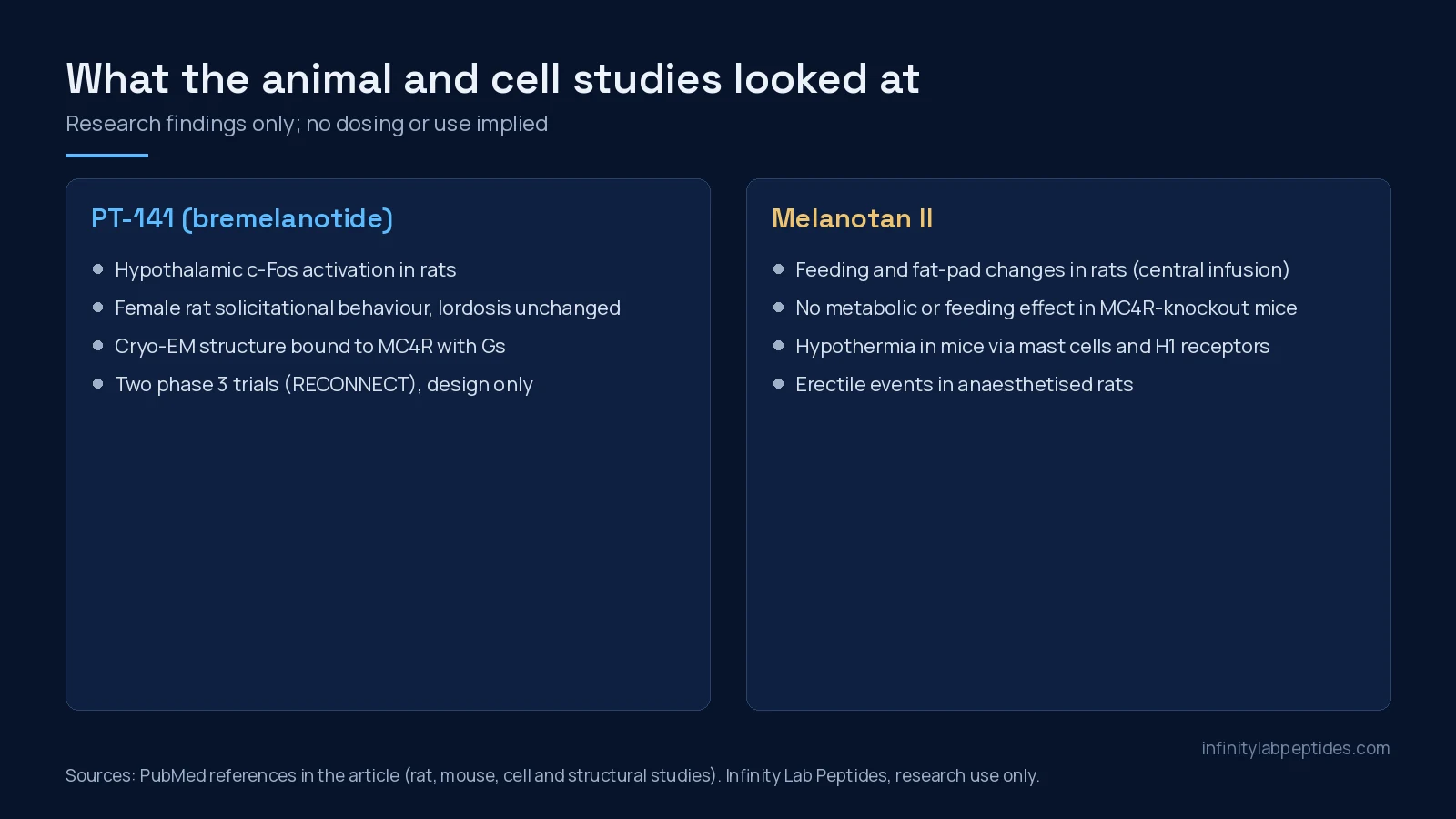
- Feeding and fat in rats. In a seven-day central infusion study, melanotan II caused near-complete loss of feeding for one to two days, after which intake returned to normal. It halved fat pad weight compared with pair-fed rats and blunted the effects of co-infused neuropeptide Y [8].
- MC4R dependence in mice. Melanotan II raised metabolic rate and reduced food intake in wild-type mice, but MC4R-knockout mice did not respond. The authors concluded MC4R can mediate both effects [9].
- An effect outside the melanocortin receptors. In mice, melanotan II caused a sharp, short-lived drop in body temperature that persisted in mice lacking MC1R, MC3R, MC4R or MC5R. It disappeared in mast-cell-deficient mice and depended on histamine H1 receptors [10]. That is a useful reminder that a cationic peptide can act through routes other than its intended receptor.
- Erectile physiology in rats. In anaesthetised rats, melanotan II given systemically or into the paraventricular nucleus of the hypothalamus produced erectile events, with spinal sites also involved [11].
PT-141 in rat and primate work
The early PT-141 report described erections in rats and nonhuman primates after administration, and increased c-Fos in hypothalamic neurons in rats [6]. A 2004 study in female rats found that PT-141 increased solicitational behaviour without changing lordosis or pacing, without general motor activation, and without changing measures of sexual reward [12]. Our kisspeptin-10 vs PT-141 comparison places this work next to the kisspeptin hormone axis.
Regulatory status and trial design
Bremelanotide (Vyleesi) was approved in the USA in 2019 for premenopausal women with acquired, generalised hypoactive sexual desire disorder [3]. The approval rested on two identical phase 3, randomised, double-blind, placebo-controlled trials (RECONNECT), which randomised 1,267 women for 24 weeks with co-primary endpoints on desire and distress questionnaires [13]. We list the design only; outcome figures describe a specific regimen and are not given here.
Melanotan II has no regulatory approval. A 1996 pilot phase I study gave it to three male volunteers. Reported effects included nausea, somnolence and fatigue, a stretching and yawning complex, spontaneous erections, and increased skin pigmentation [5]. No later development programme for melanotan II appears in the papers we found. The one alpha-MSH analogue a 2017 dermatology review describes as approved, for limited indications, is afamelanotide, not melanotan II [4].
Case reports from unregulated use
Most recent melanotan II papers are case reports involving products bought online or in tanning settings. They describe outcomes from unknown products and amounts, so they cannot set risk rates, but they are the main human safety record:
- A 2017 review describes changes in existing moles, new dysplastic naevi and four reported melanomas arising in moles during or soon after melanotan use, while noting that conclusive evidence of a link is lacking. The same review notes that several national health organisations have issued safety warnings about melanotan I and II [4].
- One patient developed several new atypical naevi within a week of two injections [14].
- Other reports describe low-flow priapism managed in a urology centre [15] and systemic toxicity with rhabdomyolysis after an internet-bought product [16].
What the evidence does not show
- No head-to-head receptor panel. We found no study that tests bremelanotide and melanotan II side by side across all melanocortin receptors in one assay.
- No comparative animal study. The feeding, metabolic and temperature work used melanotan II; the behavioural work cited here used PT-141. Results from different models cannot be swapped between the two.
- No controlled human data for melanotan II. Its human record is one three-person pilot and case reports.
- No proof that the C-terminal change alone explains the different histories. Commercial and regulatory choices also shaped which compound was developed.
What our documentation covers
No certificate is posted for PT-141 10 mg on our COA page at the time of writing, and we do not list melanotan II. Given the one-mass-unit gap between the two, build an identity check that can separate acid from amide into your method. Our KPV vs alpha-MSH comparison covers another branch of the melanocortin family. Researchers comparing suppliers can buy research peptides in Canada and review the batch documentation on each listing first.
Frequently asked questions
Is PT-141 the same as melanotan II?
No, but they are very close. Both have the same cyclic seven-residue core. PubChem lists bremelanotide (PT-141) with a free C-terminal acid, C50H68N14O10 at 1025.2 g/mol, and melanotan II with a C-terminal amide, C50H69N15O9 at 1024.2 g/mol.
Which melanocortin receptors does melanotan II activate?
It is described as a potent, non-selective agonist of the human melanocortin receptors, which is why it is used as a reference tool compound and as a starting point for more selective analogues.
Is bremelanotide an approved drug?
Yes, for one use. It was approved in the USA in 2019 as Vyleesi for premenopausal women with acquired, generalised hypoactive sexual desire disorder. Melanotan II has no approval.
Do melanotan II’s effects in mice all go through melanocortin receptors?
No. Its feeding and metabolic-rate effects were absent in MC4R-knockout mice, but the drop in body temperature it causes in mice depended on mast cells and histamine H1 receptors, not on MC1R, MC3R, MC4R or MC5R.
Can a COA tell PT-141 from melanotan II?
Only if it reports a method that resolves them. The two differ by about one mass unit, so identity needs high-resolution mass data or a separation that distinguishes the acid from the amide. No certificate for PT-141 is posted on our COA page at the time of writing.
Research-use notice
PT-141 from Infinity Lab Peptides is sold for laboratory research and analytical use only. It is not for human or animal consumption. This article summarises published research as reported by its authors; it is not medical advice and makes no claim about any product’s effects.
References
- Tomassi S, Dimmito MP, Cai M et al. (2022). CLIPSing Melanotan-II to Discover Multiple Functionally Selective hMCR Agonists. J Med Chem. PMID: 35188390. doi: 10.1021/acs.jmedchem.1c01848.
- Weirath NA, Haskell-Luevano C (2024). Recommended Tool Compounds for the Melanocortin Receptor (MCR) G Protein-Coupled Receptors (GPCRs). ACS Pharmacol Transl Sci. PMID: 39296259. doi: 10.1021/acsptsci.4c00129.
- Dhillon S, Keam SJ (2019). Bremelanotide: First Approval. Drugs. PMID: 31429064. doi: 10.1007/s40265-019-01187-w.
- Habbema L, Halk AB, Neumann M et al. (2017). Risks of unregulated use of alpha-melanocyte-stimulating hormone analogues: a review. Int J Dermatol. PMID: 28266027. doi: 10.1111/ijd.13585.
- Dorr RT, Lines R, Levine N et al. (1996). Evaluation of melanotan-II, a superpotent cyclic melanotropic peptide in a pilot phase-I clinical study. Life Sci. PMID: 8637402. doi: 10.1016/0024-3205(96)00160-9.
- Molinoff PB, Shadiack AM, Earle D et al. (2003). PT-141: a melanocortin agonist for the treatment of sexual dysfunction. Ann N Y Acad Sci. PMID: 12851303. doi: 10.1111/j.1749-6632.2003.tb03167.x.
- Zhang H, Chen LN, Yang D et al. (2021). Structural insights into ligand recognition and activation of the melanocortin-4 receptor. Cell Res. PMID: 34433901. doi: 10.1038/s41422-021-00552-3.
- Raposinho PD, White RB, Aubert ML (2003). The melanocortin agonist Melanotan-II reduces the orexigenic and adipogenic effects of neuropeptide Y (NPY) but does not affect the NPY-driven suppressive effects on the gonadotropic and somatotropic axes in the male rat. J Neuroendocrinol. PMID: 12535159. doi: 10.1046/j.1365-2826.2003.00962.x.
- Chen AS, Metzger JM, Trumbauer ME et al. (2000). Role of the melanocortin-4 receptor in metabolic rate and food intake in mice. Transgenic Res. PMID: 10951699. doi: 10.1023/a:1008983615045.
- Jain S, Panyutin A, Liu N et al. (2018). Melanotan II causes hypothermia in mice by activation of mast cells and stimulation of histamine 1 receptors. Am J Physiol Endocrinol Metab. PMID: 29812984. doi: 10.1152/ajpendo.00024.2018.
- Giuliano F, Clément P, Droupy S et al. (2006). Melanotan-II: Investigation of the inducer and facilitator effects on penile erection in anaesthetized rat. Neuroscience. PMID: 16360286. doi: 10.1016/j.neuroscience.2005.11.008.
- Pfaus JG, Shadiack A, Van Soest T et al. (2004). Selective facilitation of sexual solicitation in the female rat by a melanocortin receptor agonist. Proc Natl Acad Sci U S A. PMID: 15226502. doi: 10.1073/pnas.0400491101.
- Kingsberg SA, Clayton AH, Portman D et al. (2019). Bremelanotide for the Treatment of Hypoactive Sexual Desire Disorder: Two Randomized Phase 3 Trials. Obstet Gynecol. PMID: 31599840. doi: 10.1097/AOG.0000000000003500.
- Reid C, Fitzgerald T, Fabre A et al. (2013). Atypical melanocytic naevi following melanotan injection. Ir Med J. PMID: 23914578.
- Dreyer BA, Amer T, Fraser M (2019). Melanotan-induced priapism: a hard-earned tan. BMJ Case Rep. PMID: 30796078. doi: 10.1136/bcr-2018-227644.
- Nelson ME, Bryant SM, Aks SE (2012). Melanotan II injection resulting in systemic toxicity and rhabdomyolysis. Clin Toxicol (Phila). PMID: 23121206. doi: 10.3109/15563650.2012.740637.