For laboratory research only. Not for human or animal use. This article gives no dosing, administration or therapeutic advice.
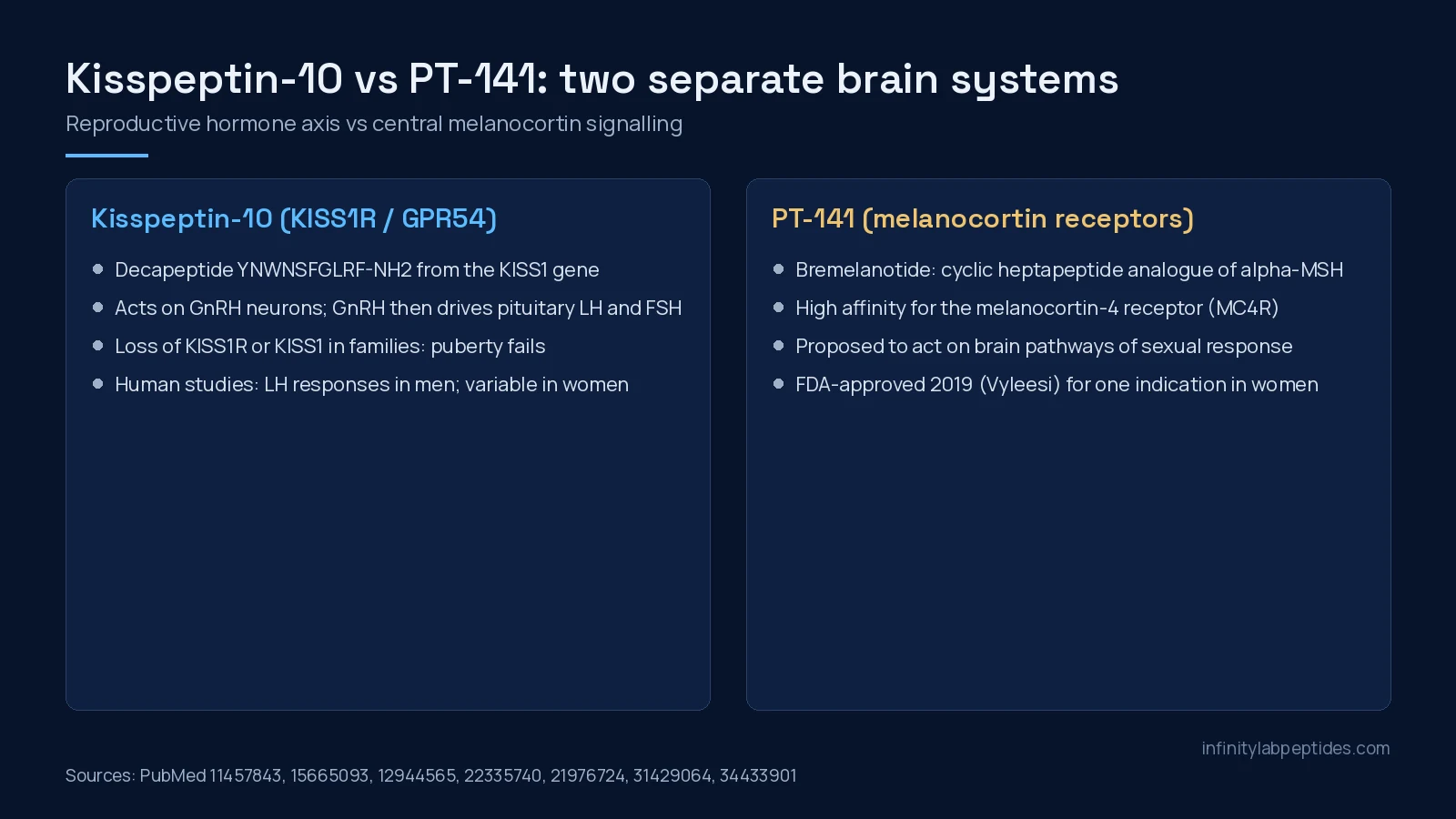
Short answer: kisspeptin-10 and PT-141 both turn up in reproductive and sexual-behaviour research, but they work through unrelated receptors. Kisspeptin-10 is a ten-residue fragment of the KISS1 gene product that activates the kisspeptin receptor (KISS1R, formerly GPR54) on GnRH neurons, which then drive the pituitary’s LH and FSH output[1],[2]. PT-141, bremelanotide, is a cyclic analogue of alpha-melanocyte-stimulating hormone with high affinity for the melanocortin-4 receptor[3],[4]. One is a gatekeeper of the hormone axis; the other acts in melanocortin brain circuits. Bremelanotide is FDA-approved for one indication; kisspeptin-10 is not approved for any[3].
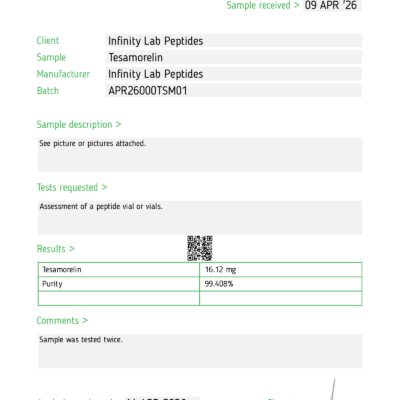
Batch documentation at a glance
Statements below reflect our COA library at the time of writing.
Kisspeptin 10 mg
Listing: Kisspeptin 10 mg vial
Purity: not available
Batch: not available
No certificate is posted for this product on our COA page at the time of writing.
PT-141 10 mg
Listing: PT-141 10 mg vial
Purity: not available
Batch: not available
No certificate is posted for this product on our COA page at the time of writing.
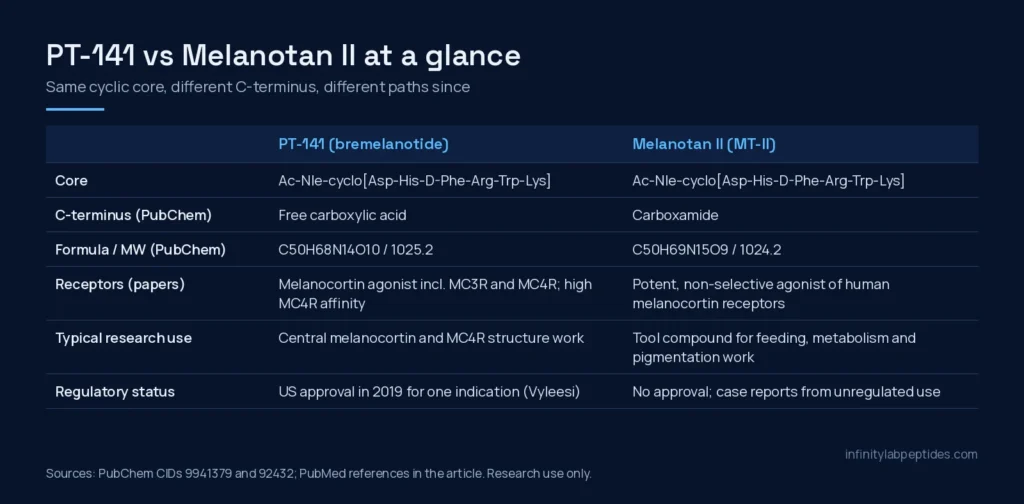
Without a posted report, identity cannot be checked from our library for either listing. That matters more than usual here, because PT-141 and melanotan II differ by a single C-terminal group (see the identity table), and the “kisspeptin” name covers several peptides of different length.
Identity
All identifiers from PubChem.
| Property | Kisspeptin-10 | PT-141 (bremelanotide) | For reference: melanotan II |
|---|---|---|---|
| Class | Linear decapeptide, C-terminal RF-amide[1] | Cyclic heptapeptide (lactam bridge), alpha-MSH analogue[3] | Cyclic heptapeptide, alpha-MSH(4-10) analogue[5] |
| Sequence | YNWNSFGLRF-NH2 (human metastin 45-54) | Ac-Nle-cyclo[Asp-His-D-Phe-Arg-Trp-Lys]-OH | Ac-Nle-cyclo[Asp-His-D-Phe-Arg-Trp-Lys]-NH2[5] |
| Molecular formula | C63H83N17O14 | C50H68N14O10 | C50H69N15O9 |
| Molecular weight | 1302.4 g/mol | 1025.2 g/mol | 1024.2 g/mol |
| CAS | 374675-21-5 | 189691-06-3 | 121062-08-6 |
| PubChem CID | 25240297 | 9941379 | 92432 |
| Receptor | KISS1R (GPR54)[2] | Melanocortin receptors, high MC4R affinity[3],[4] | Melanocortin receptors |
PT-141 and melanotan II share the same cyclic core; PT-141 ends in a free carboxylic acid and melanotan II in an amide, a mass difference of about 1 Da that only a mass-spectrometry report can resolve. Kisspeptin-10 is the shortest of the natural kisspeptins: the 54-, 14- and 13-residue forms were isolated from human placenta and share its C-terminal sequence[1].
Kisspeptin-10: what the research covers
From metastasis gene to puberty gatekeeper
KISS1 was first described as a metastasis suppressor gene; in 2001 two groups showed that its products are the natural ligands of the orphan receptor GPR54[6],[1]. The reproductive role emerged from genetics. In 2003, two families with idiopathic hypogonadotropic hypogonadism, in which puberty does not start, carried loss-of-function mutations in GPR54, and Gpr54-deficient mice reproduced the picture[7],[8]. A 2012 report then described an inactivating mutation in KISS1 itself, with failure of pubertal progression[9].
The site of action was mapped in mice and sheep: GPR54 transcripts sit in GnRH neurons, kisspeptin released LH and FSH in wild-type mice but had no effect in Gpr54 knockouts, and central kisspeptin in sheep released GnRH into cerebrospinal fluid with a parallel rise in LH[2].
Human studies of kisspeptin-10
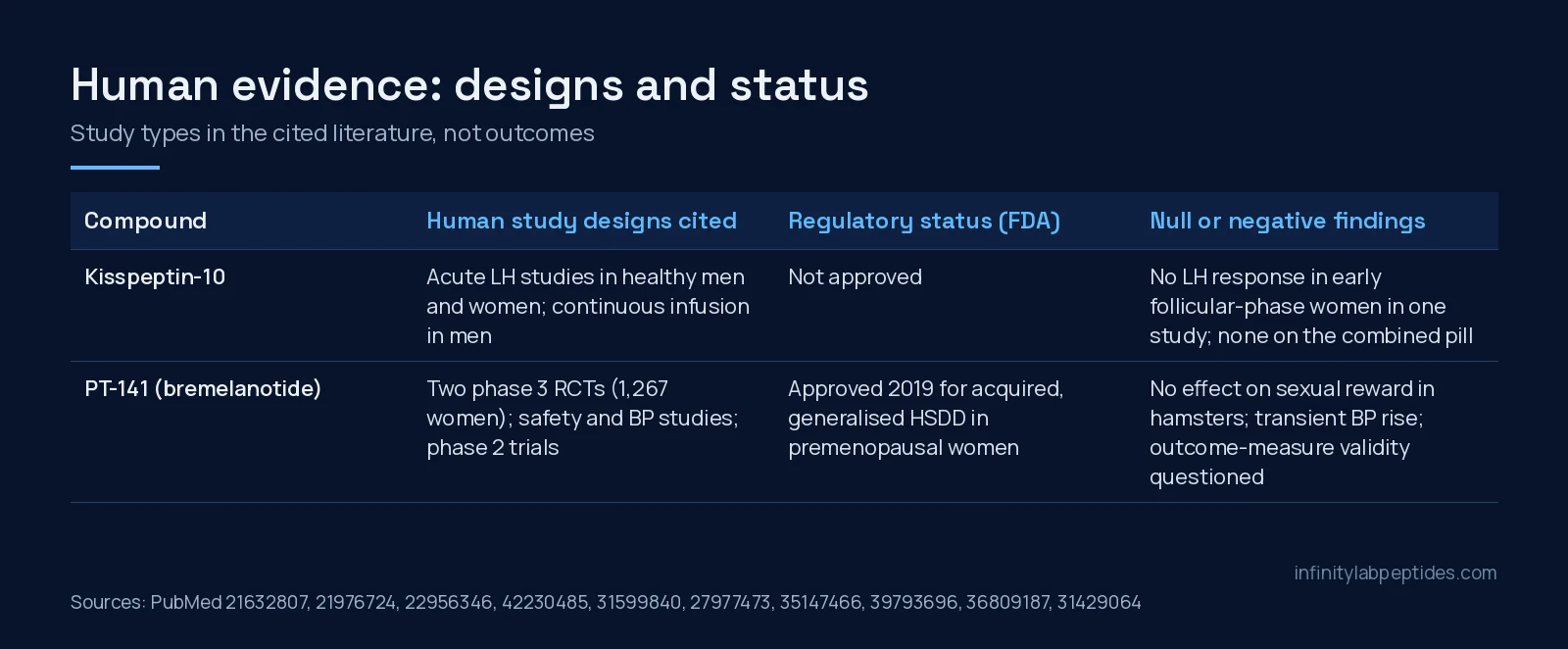
In healthy men, kisspeptin-10 boluses potently raised LH, a higher bolus gave a smaller response than a lower one, and continuous infusion increased LH pulse frequency, pulse size and testosterone[10]. A 2026 report of continuous kisspeptin infusion in healthy men described an LH rise within 12 to 20 hours followed by a partial decline before the end of infusion[11].
Women are a different story. One study found no gonadotropin response to kisspeptin-10 in healthy women in the follicular phase by any of three administration methods tested, while women in the preovulatory phase did respond, which the authors described as sexual dimorphism[12]. A second study did see an LH response in early-follicular women, in post-menopausal women and in women using progestogen implants, but not in women taking the combined pill[13]. Sex-steroid milieu clearly shapes the response.
Beyond hormones, a neuroimaging study in 29 young men found that kisspeptin administration enhanced limbic brain activity in response to sexual and couple-bonding images and attenuated negative mood[14]; the abstract does not specify kisspeptin-10, so it should not be treated as data on this fragment.
PT-141 (bremelanotide): what the research covers
Origin and receptor
Bremelanotide descends from the melanotan programme: melanotan II was tested in a three-man pilot phase I study in 1996, in which spontaneous erections were noted alongside nausea and somnolence[5]. Bremelanotide is described as a synthetic alpha-MSH analogue with high affinity for MC4R, thought to modulate brain pathways involved in sexual response[3]. Cryo-EM structures show bremelanotide, afamelanotide and alpha-MSH binding MC4R in a conserved mode[4].
Regulatory status and trial design
Bremelanotide (Vyleesi) was approved in the USA in 2019 for premenopausal women with acquired, generalised hypoactive sexual desire disorder[3]. The approval rested on two identical phase 3, randomised, double-blind, placebo-controlled trials (RECONNECT) that randomised 1,267 women for 24 weeks, with co-primary endpoints on the Female Sexual Function Index desire domain and a distress item of the Female Sexual Distress Scale[15]. That approval is limited to that population and indication. Earlier, smaller studies looked at women with arousal disorder and men with erectile dysfunction[16],[17].
Safety observations
Across the development programme, nausea was the most common reason for discontinuation, focal hyperpigmentation was rare at labelled use but frequent with prolonged consecutive dosing, and small, transient blood-pressure increases were recorded[18]. A dedicated ambulatory monitoring study had found those increases, typically lasting under 15 minutes, accompanied by reduced heart rate[19].
Side-by-side research comparison
| Question | Kisspeptin-10 | PT-141 (bremelanotide) |
|---|---|---|
| Receptor | KISS1R / GPR54[1] | Melanocortin receptors, MC4R[4] |
| Where it acts | GnRH neurons, upstream of LH/FSH[2] | Melanocortin brain pathways[3] |
| Main measured output | LH, FSH, testosterone[10] | Desire and distress questionnaires[15] |
| Human genetics | Loss of KISS1 or KISS1R blocks puberty[7],[9] | Not applicable |
| Sex differences | Response depends on cycle phase and contraception[12],[13] | Approval limited to premenopausal women[3] |
| Regulatory status | Not approved | FDA-approved 2019 for one indication[3] |
| Our posted COA | None posted | None posted |
Null and negative results
- Kisspeptin-10 in follicular-phase women: no change in gonadotropins after any of the methods tested in one study[12]; no LH response in women on the combined pill in another[13].
- Kisspeptin-10 at higher bolus: a reduced LH response compared with a lower bolus in men[10].
- Kisspeptin-10 in rat testes: intraperitoneal administration to maturing rats lowered LH and testosterone and produced degenerative changes in seminiferous tubules[20].
- Bremelanotide and sexual reward: in female Syrian hamsters it did not change melanocortin receptor expression in the mesolimbic dopamine system and failed to enhance sexual reward in a place-preference test[21].
- Bremelanotide outcome measures: an independent analysis argued that the phase 3 efficacy measures have limited validity evidence and that 8 of 11 registered efficacy outcomes had not been published[22].
What the evidence does not show
- It does not show that kisspeptin-10 and PT-141 act on the same system. Their receptors and measured outputs are unrelated[2],[4].
- It does not show that kisspeptin-10 behaves the same in women as in men[12],[13].
- It does not show that bremelanotide’s approval extends beyond its labelled population and indication[3].
- It does not show that brain-imaging findings with longer kisspeptins apply to kisspeptin-10[14].
- It does not show long-term effects of repeated kisspeptin-10 exposure in humans; the longest cited human studies are infusions over hours[10],[11].
- It does not show that combining the two does anything. We found no study of the pair.
Practical notes for a research plan
If the question is about the reproductive hormone axis, kisspeptin-10 is the tool, and the literature says to record sex, cycle phase and hormonal contraception status in any model where those apply. If the question is about melanocortin signalling, PT-141 is the better-characterised agonist, with published receptor structures and a large safety dataset. For both, the absence of a posted COA means mass-based identity confirmation is worth building into your method, particularly to tell PT-141 from melanotan II. Our research peptides overview covers related compounds, or you can buy research peptides in Canada once the documentation fits your needs.
Frequently asked questions
Do kisspeptin-10 and PT-141 work the same way?
No. Kisspeptin-10 activates the kisspeptin receptor (KISS1R, formerly GPR54) on GnRH neurons, upstream of the pituitary hormones LH and FSH. PT-141 (bremelanotide) is an alpha-MSH analogue that acts on melanocortin receptors, with high affinity for MC4R.
Is PT-141 the same as melanotan II?
No, but they are close. Both share the same cyclic seven-residue core. PubChem lists bremelanotide as C50H68N14O10 (1025.2 g/mol) with a free C-terminal acid, and melanotan II as C50H69N15O9 (1024.2 g/mol) with a C-terminal amide.
Is bremelanotide an approved drug?
Yes, for one use. It was approved in the USA in 2019 (as Vyleesi) for premenopausal women with acquired, generalised hypoactive sexual desire disorder. Kisspeptin-10 is not approved for any use.
Does kisspeptin-10 raise LH in women as it does in men?
Not consistently. One study found no gonadotropin response in follicular-phase women but a response in the preovulatory phase. Another found a response in early-follicular and post-menopausal women but none in women taking the combined pill.
Are COAs posted for Kisspeptin 10 mg and PT-141 10 mg?
No. Our COA page shows no certificate for either listing at the time of writing, so identity and purity cannot be checked from our library for these products.
Research use only. All products referenced on this page are intended for laboratory research and analytical applications. They are not for human or animal consumption, and nothing here is medical advice, dosing guidance or a treatment recommendation.
References
- Kotani M, Detheux M, Vandenbogaerde A et al. (2001). The metastasis suppressor gene KiSS-1 encodes kisspeptins, the natural ligands of the orphan G protein-coupled receptor GPR54. J Biol Chem. PMID: 11457843. doi: 10.1074/jbc.M104847200.
- Messager S, Chatzidaki EE, Ma D et al. (2005). Kisspeptin directly stimulates gonadotropin-releasing hormone release via G protein-coupled receptor 54. Proc Natl Acad Sci U S A. PMID: 15665093. doi: 10.1073/pnas.0409330102.
- Dhillon S, Keam SJ (2019). Bremelanotide: First Approval. Drugs. PMID: 31429064. doi: 10.1007/s40265-019-01187-w.
- Zhang H, Chen LN, Yang D et al. (2021). Structural insights into ligand recognition and activation of the melanocortin-4 receptor. Cell Res. PMID: 34433901. doi: 10.1038/s41422-021-00552-3.
- Dorr RT, Lines R, Levine N et al. (1996). Evaluation of melanotan-II, a superpotent cyclic melanotropic peptide in a pilot phase-I clinical study. Life Sci. PMID: 8637402. doi: 10.1016/0024-3205(96)00160-9.
- Ohtaki T, Shintani Y, Honda S et al. (2001). Metastasis suppressor gene KiSS-1 encodes peptide ligand of a G-protein-coupled receptor. Nature. PMID: 11385580. doi: 10.1038/35079135.
- de Roux N, Genin E, Carel JC et al. (2003). Hypogonadotropic hypogonadism due to loss of function of the KiSS1-derived peptide receptor GPR54. Proc Natl Acad Sci U S A. PMID: 12944565. doi: 10.1073/pnas.1834399100.
- Seminara SB, Messager S, Chatzidaki EE et al. (2003). The GPR54 gene as a regulator of puberty. N Engl J Med. PMID: 14573733. doi: 10.1056/NEJMoa035322.
- Topaloglu AK, Tello JA, Kotan LD et al. (2012). Inactivating KISS1 mutation and hypogonadotropic hypogonadism. N Engl J Med. PMID: 22335740. doi: 10.1056/NEJMoa1111184.
- George JT, Veldhuis JD, Roseweir AK et al. (2011). Kisspeptin-10 is a potent stimulator of LH and increases pulse frequency in men. J Clin Endocrinol Metab. PMID: 21632807. doi: 10.1210/jc.2011-0089.
- Naveed A, Lippincott MF, Stamou M et al. (2026). Dynamic modulation of LH secretion by continuous kisspeptin infusion in healthy men. Hormones (Athens). PMID: 42230485. doi: 10.1007/s42000-026-00795-y.
- Jayasena CN, Nijher GM, Comninos AN et al. (2011). The effects of kisspeptin-10 on reproductive hormone release show sexual dimorphism in humans. J Clin Endocrinol Metab. PMID: 21976724. doi: 10.1210/jc.2011-1408.
- George JT, Anderson RA, Millar RP (2012). Kisspeptin-10 stimulation of gonadotrophin secretion in women is modulated by sex steroid feedback. Hum Reprod. PMID: 22956346. doi: 10.1093/humrep/des326.
- Comninos AN, Wall MB, Demetriou L et al. (2017). Kisspeptin modulates sexual and emotional brain processing in humans. J Clin Invest. PMID: 28112678. doi: 10.1172/JCI89519.
- Kingsberg SA, Clayton AH, Portman D et al. (2019). Bremelanotide for the Treatment of Hypoactive Sexual Desire Disorder: Two Randomized Phase 3 Trials. Obstet Gynecol. PMID: 31599840. doi: 10.1097/AOG.0000000000003500.
- Diamond LE, Earle DC, Heiman JR et al. (2006). An effect on the subjective sexual response in premenopausal women with sexual arousal disorder by bremelanotide (PT-141), a melanocortin receptor agonist. J Sex Med. PMID: 16839319. doi: 10.1111/j.1743-6109.2006.00268.x.
- Safarinejad MR, Hosseini SY (2008). Salvage of sildenafil failures with bremelanotide: a randomized, double-blind, placebo controlled study. J Urol. PMID: 18206919. doi: 10.1016/j.juro.2007.10.063.
- Clayton AH, Kingsberg SA, Portman D et al. (2022). Safety Profile of Bremelanotide Across the Clinical Development Program. J Womens Health (Larchmt). PMID: 35147466. doi: 10.1089/jwh.2021.0191.
- White WB, Myers MG, Jordan R et al. (2017). Usefulness of ambulatory blood pressure monitoring to assess the melanocortin receptor agonist bremelanotide. J Hypertens. PMID: 27977473. doi: 10.1097/HJH.0000000000001221.
- Ramzan F, Qureshi IZ (2011). Intraperitoneal kisspeptin-10 administration induces dose-dependent degenerative changes in maturing rat testes. Life Sci. PMID: 21112339. doi: 10.1016/j.lfs.2010.11.019.
- Borland JM, Kohut-Jackson AL, Peyla AC et al. (2025). Female Syrian hamster analyses of bremelanotide, a US FDA approved drug for the treatment of female hypoactive sexual desire disorder. Neuropharmacology. PMID: 39793696. doi: 10.1016/j.neuropharm.2025.110299.
- Spielmans GI, Ellefson EM (2024). Small Effects, Questionable Outcomes: Bremelanotide for Hypoactive Sexual Desire Disorder. J Sex Res. PMID: 36809187. doi: 10.1080/00224499.2023.2175192.