For laboratory research only. Not for human or animal use. This article gives no dosing, administration or therapeutic advice.
Short answer: MOTS-c and metformin get compared because both end up switching on the same cellular energy sensor, AMP-activated protein kinase (AMPK), but they reach it from different directions and in different tissues. MOTS-c is a 16-amino-acid peptide encoded inside mitochondrial DNA; in mouse work its main target looked like skeletal muscle, where it slows the folate cycle and raises levels of AICAR, an AMP-like metabolite that activates AMPK [1][2]. Metformin is a small synthetic biguanide, a prescription medicine for type 2 diabetes for decades [3], whose best-studied action is in the liver, where it lowers cellular energy state through the mitochondria [4][5]. One is a research peptide with almost no interventional human data; the other is an approved drug with a mechanism that is still argued over.
Below: the spec card from our certificate library, identity data, how each compound reaches AMPK, a side-by-side table, the one study that looked at both together, and the limits of what is known.
Spec cards
MOTS-c
Purity: 99.515%
Batch: APR26000MSC01
Analysis date: 14 APR 2026
Lab: Janoshik
Verification key: 34CJ3CIUKX6L
Listings: MOTS-C 10 mg, MOTS-C 40 mg
On our COA page this one report is listed for several MOTS-C listings (10 mg, 40 mg vial and pen). It is a single batch result, not a per-vial test.
Metformin
Purity: not applicable
Batch: not applicable
Lab: not applicable
Listing: none
Metformin is not part of our catalogue. It is included here only as the reference compound that MOTS-c is most often compared with in the scientific literature.
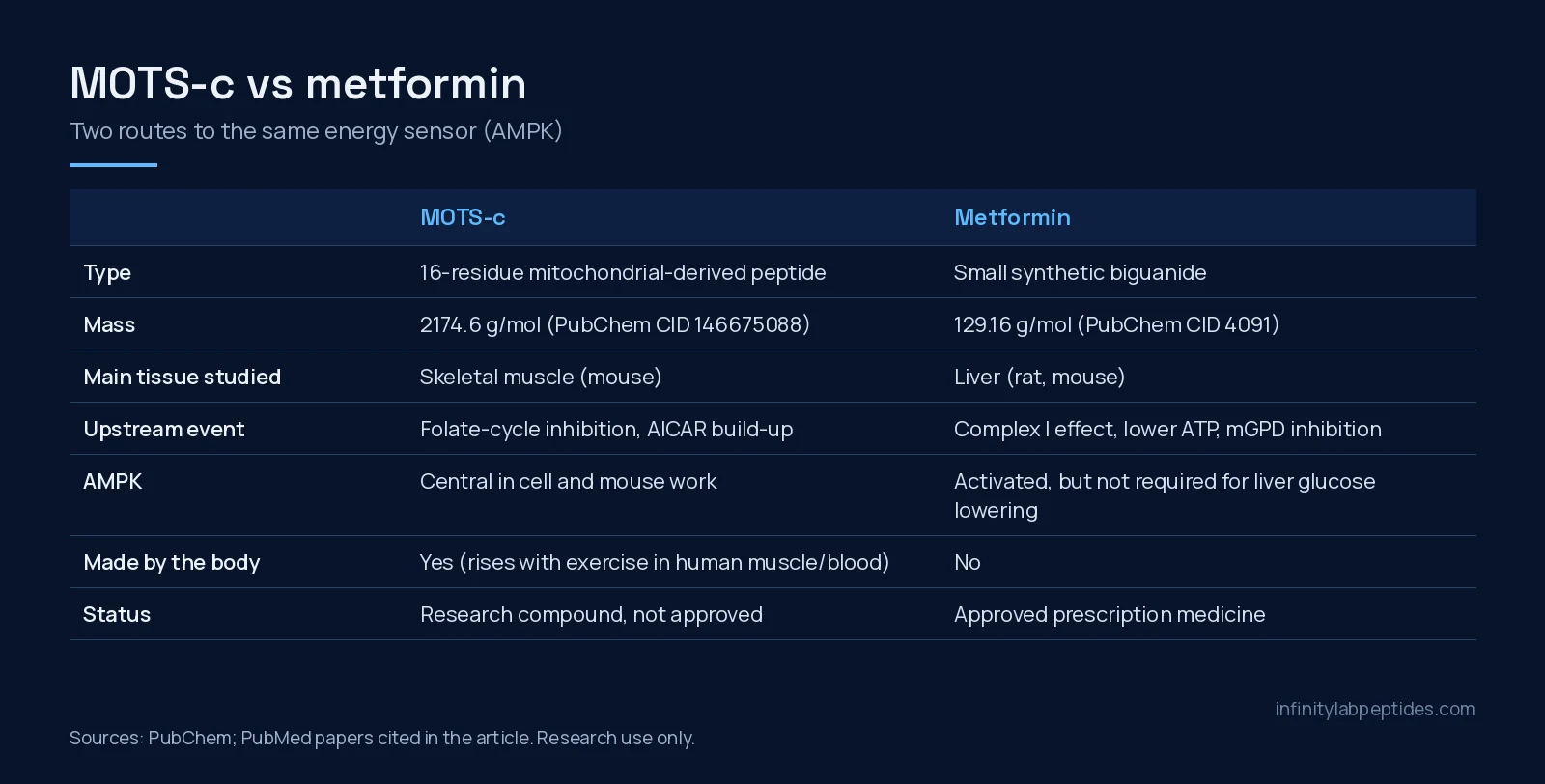
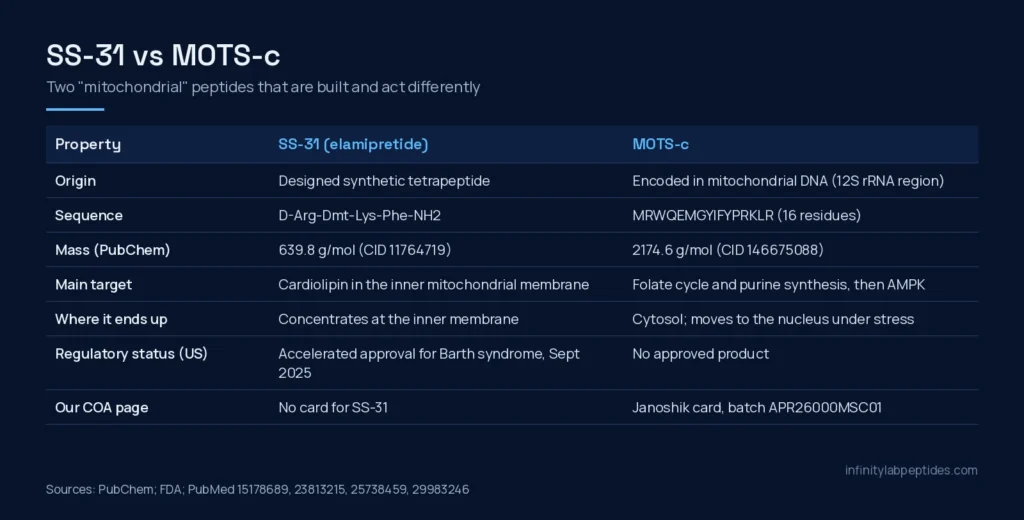
Identity: a 2,175 g/mol peptide and a 129 g/mol drug
| Field | MOTS-c | Metformin |
|---|---|---|
| Class | Mitochondrial-derived peptide (16 residues) | Biguanide (small synthetic molecule) |
| Sequence / structure | MRWQEMGYIFYPRKLR (H-MRWQEMGYIFYPRKLR-OH, PubChem synonym) | 1,1-dimethylbiguanide |
| Molecular formula | C101H152N28O22S2 | C4H11N5 |
| Molecular weight | 2174.6 g/mol | 129.16 g/mol |
| CAS (PubChem synonym) | 1627580-64-6 | 657-24-9 |
| PubChem CID | 146675088 | 4091 |
| Origin | Short open reading frame in the mitochondrial 12S rRNA gene [1] | Synthetic guanidine derivative; traced back to Galega officinalis (goat’s rue) [3] |
| Regulatory status | Not an approved medicine | Approved prescription medicine for type 2 diabetes [3] |
The size gap matters for the lab. Metformin is about one-seventeenth the mass of MOTS-c. As a small, stable salt it is easy to characterise. MOTS-c is a peptide with two methionines and a tryptophan, residues that are prone to oxidation, so identity by mass spectrometry and purity by HPLC are the checks that count.
MOTS-c: a peptide from the mitochondrial genome
MOTS-c was described in 2015 by a group searching mitochondrial DNA for short open reading frames, after humanin had shown that such peptides exist. The sequence sits inside the 12S ribosomal RNA gene. In cultured cells, MOTS-c inhibited the folate cycle and the de novo purine synthesis tied to it, and this led to AMPK activation. In mice, treatment prevented insulin resistance caused by ageing or a high-fat diet, and prevented diet-induced obesity, with skeletal muscle as the main target organ [1]. A commentary in the same journal issue framed the mechanism simply: MOTS-c drives the build-up of AICAR, an endogenous AMP analogue, and AICAR activates AMPK [2].
Later work widened the picture. Under metabolic stress such as glucose restriction, MOTS-c moved from the cytoplasm into the nucleus in an AMPK-dependent way. There it regulated a broad set of nuclear genes, including antioxidant response element genes, and interacted with stress-responsive transcription factors such as NRF2. That makes it a mitochondria-to-nucleus signal, not only an enzyme modulator [6]. In mice of 2, 12 and 22 months, MOTS-c treatment increased measures of physical performance, and the same paper reported that exercise raised endogenous MOTS-c in human skeletal muscle and blood [7]. A 2026 study in two transgenic mouse strains linked MOTS-c’s effects on muscle mitochondrial function to both PGC-1α and AMPK. It found no change in mitochondrial protein content, which suggests changes in efficiency rather than mitochondrial volume [8].
The AMPK link has also been tested with an inhibitor. In mouse cells, compound C, an AMPK inhibitor, blocked MOTS-c’s suppression of osteoclast differentiation, in a study of bone loss after ovary removal in mice [9]. In C2C12 muscle cells, AMPK inhibition lowered MOTS-c expression, and PGC-1α appeared to sit upstream of MOTS-c production. Muscle and plasma MOTS-c fell in obese mice and rose with treadmill training [10].
Metformin: an old drug with a debated mechanism
Metformin’s history runs from a European herbal medicine rich in guanidine, through the first report of its use in diabetes in 1957, to its introduction in the USA in 1995. It is now the most prescribed glucose-lowering medicine worldwide [3]. How it works has been contested for twenty-five years.
- The respiratory chain. In rat hepatocytes, metformin cut oxygen consumption only in intact cells, through an indirect effect on mitochondrial complex I [4].
- AMPK. In 2001, metformin was shown to activate AMPK in rat hepatocytes, reducing acetyl-CoA carboxylase activity and lipogenic gene expression [11].
- Not only AMPK. In mice lacking liver AMPK or its upstream kinase LKB1, metformin still lowered hepatic glucose production. The effect tracked a fall in hepatocyte ATP, meaning lower energy state, not AMPK itself [12].
- A redox shuttle. In rats and knockout mice, metformin non-competitively inhibited mitochondrial glycerophosphate dehydrogenase, shifting the liver’s redox state and reducing conversion of lactate and glycerol to glucose [5].
So AMPK is part of the metformin story, but the liver data show that glucose lowering can happen without it. For MOTS-c, AMPK is closer to the centre of the proposed mechanism, though the nuclear-signalling work shows it is not the whole story either [6].
Side by side
| Question | MOTS-c | Metformin |
|---|---|---|
| Main tissue in the key studies | Skeletal muscle (mouse) [1] | Liver (rat, mouse hepatocytes) [11][12] |
| Upstream event | Folate-cycle inhibition → AICAR build-up [1][2] | Complex I effect, lower ATP, mGPD inhibition [4][12][5] |
| AMPK role | Central in cell and mouse work; inhibitor blocks effects [9] | Activated, but not required for liver glucose lowering in knockout mice [12] |
| Nuclear action | Translocates to nucleus under stress, regulates gene expression [6] | Not described in the sources used here |
| Made by the body? | Yes; endogenous, rises with exercise in human muscle and blood [7] | No; synthetic |
| Human evidence | Observational measurements of endogenous levels; no interventional trial in the sources used here | Decades of clinical use as an approved medicine [3] |
The one study that looked at both
If metformin and MOTS-c share so much mechanism, does one change the other? A 2022 study measured circulating MOTS-c in paired blood samples from a randomised trial in HER2-positive breast cancer. Patients received neoadjuvant chemotherapy and trastuzumab, with or without metformin. Over 24 weeks there was no significant change in circulating MOTS-c with either regimen. The authors suggest one reason: metformin may not reach skeletal muscle, the tissue thought to make most MOTS-c [13]. This is a measurement study, not a test of either compound’s effects, and it used one commercial ELISA kit.
A second reason for caution comes from human exercise work. In a 2026 study, interstitial MOTS-c in muscle rose during one-legged knee-extensor exercise, but there was no arterio-venous difference across the leg. The authors read this as a sign that muscle may not be the source of the circulating MOTS-c seen after exercise [8]. Where blood MOTS-c actually comes from is still open.
What the evidence does not show
- No head-to-head test. We found no study that gave MOTS-c and metformin side by side in the same model and compared their effects.
- No human interventional data for MOTS-c in these sources. The metabolic, bone and physical-capacity findings come from cells and mice [1][7][9]. The human data are measurements of the body’s own MOTS-c [7][13][8].
- Not a substitute. A shared AMPK link says nothing about whether one compound could stand in for the other. Their upstream targets, tissues and pharmacology differ [12][1].
- Circulating levels are hard to read. Blood MOTS-c may not reflect muscle production [8], and the metformin study relied on a single commercial assay [13].
- Mechanism for metformin is unsettled. Complex I, AMPK, energy state and mGPD all have support in rodent models [4][11][12][5]. Any comparison built on “both are AMPK activators” simplifies both.
For the lab
If MOTS-c is your research compound and metformin your reference, the two need different documentation. For metformin, pharmacopoeial-grade material with a standard certificate is the norm. For MOTS-c, ask for HPLC purity and a mass spectrum that matches 2174.6 g/mol; a +16 shift points to oxidised methionine. Our MOTS-C batch APR26000MSC01 was tested by Janoshik at 99.515% (14 APR 2026). You can check the report on our COA page with key 34CJ3CIUKX6L, and the same report covers the 10 mg vial and the 40 mg listings. For MOTS-c’s other common comparison, see MOTS-c vs 5-Amino-1MQ. When you are ready, you can buy research peptides in Canada with each listing’s documentation on its page.
Frequently asked questions
What is the main difference between MOTS-c and metformin?
MOTS-c is a 16-amino-acid peptide encoded in mitochondrial DNA; metformin is a small synthetic biguanide drug. In mouse studies MOTS-c acted mainly in skeletal muscle by slowing the folate cycle and raising AICAR, while metformin’s best-studied actions are in the liver, through mitochondrial energy state and redox effects.
Do MOTS-c and metformin both activate AMPK?
Both have been linked to AMPK activation in cell and rodent studies. For metformin, liver studies in knockout mice showed glucose production still fell without AMPK, so AMPK is not the whole explanation. For MOTS-c, an AMPK inhibitor blocked several of its effects in cell work.
Does metformin change MOTS-c levels in the blood?
In one 2022 study of paired blood samples from a randomised breast cancer trial, 24 weeks of metformin alongside chemotherapy did not significantly change circulating MOTS-c. The authors noted that metformin may not reach skeletal muscle, where much MOTS-c is thought to be made.
Has MOTS-c been tested in human trials like metformin?
Not in the sources used for this article. The human data on MOTS-c are measurements of the body’s own peptide, for example rising in muscle and blood with exercise. Its metabolic findings come from cells and mice. Metformin, by contrast, is an approved prescription medicine.
What should a MOTS-c certificate of analysis show?
HPLC purity plus a mass spectrum consistent with about 2174.6 g/mol. Because MOTS-c contains two methionines and a tryptophan, oxidation is a known risk; a mass 16 units higher than expected is a sign of oxidised methionine.
References
- Lee C, Zeng J, Drew BG et al. (2015). The mitochondrial-derived peptide MOTS-c promotes metabolic homeostasis and reduces obesity and insulin resistance. Cell Metab. PMID: 25738459. doi: 10.1016/j.cmet.2015.02.009.
- Zarse K, Ristow M (2015). A mitochondrially encoded hormone ameliorates obesity and insulin resistance. Cell Metab. PMID: 25738453. doi: 10.1016/j.cmet.2015.02.013.
- Bailey CJ (2017). Metformin: historical overview. Diabetologia. PMID: 28776081. doi: 10.1007/s00125-017-4318-z.
- El-Mir MY, Nogueira V, Fontaine E et al. (2000). Dimethylbiguanide inhibits cell respiration via an indirect effect targeted on the respiratory chain complex I. J Biol Chem. PMID: 10617608. doi: 10.1074/jbc.275.1.223.
- Madiraju AK, Erion DM, Rahimi Y et al. (2014). Metformin suppresses gluconeogenesis by inhibiting mitochondrial glycerophosphate dehydrogenase. Nature. PMID: 24847880. doi: 10.1038/nature13270.
- Kim KH, Son JM, Benayoun BA et al. (2018). The Mitochondrial-Encoded Peptide MOTS-c Translocates to the Nucleus to Regulate Nuclear Gene Expression in Response to Metabolic Stress. Cell Metab. PMID: 29983246. doi: 10.1016/j.cmet.2018.06.008.
- Reynolds JC, Lai RW, Woodhead JST et al. (2021). MOTS-c is an exercise-induced mitochondrial-encoded regulator of age-dependent physical decline and muscle homeostasis. Nat Commun. PMID: 33473109. doi: 10.1038/s41467-020-20790-0.
- Gudiksen A, Hansen CC, van der Stede T et al. (2026). MOTS-c improves intrinsic muscle mitochondrial bioenergetic health and efficiency in a PGC-1α/AMPK-dependent manner. Free Radic Biol Med. PMID: 41520850. doi: 10.1016/j.freeradbiomed.2026.01.002.
- Ming W, Lu G, Xin S et al. (2016). Mitochondria related peptide MOTS-c suppresses ovariectomy-induced bone loss via AMPK activation. Biochem Biophys Res Commun. PMID: 27237975. doi: 10.1016/j.bbrc.2016.05.135.
- Yang B, Yu Q, Chang B et al. (2021). MOTS-c interacts synergistically with exercise intervention to regulate PGC-1α expression, attenuate insulin resistance and enhance glucose metabolism in mice via AMPK signaling pathway. Biochim Biophys Acta Mol Basis Dis. PMID: 33722744. doi: 10.1016/j.bbadis.2021.166126.
- Zhou G, Myers R, Li Y et al. (2001). Role of AMP-activated protein kinase in mechanism of metformin action. J Clin Invest. PMID: 11602624. doi: 10.1172/JCI13505.
- Foretz M, Hébrard S, Leclerc J et al. (2010). Metformin inhibits hepatic gluconeogenesis in mice independently of the LKB1/AMPK pathway via a decrease in hepatic energy state. J Clin Invest. PMID: 20577053. doi: 10.1172/JCI40671.
- Cuyàs E, Verdura S, Martin-Castillo B et al. (2022). Circulating levels of MOTS-c in patients with breast cancer treated with metformin. Aging (Albany NY). PMID: 36490309. doi: 10.18632/aging.204423.