For laboratory research only. Not for human or animal use. This article gives no dosing, administration or therapeutic advice.
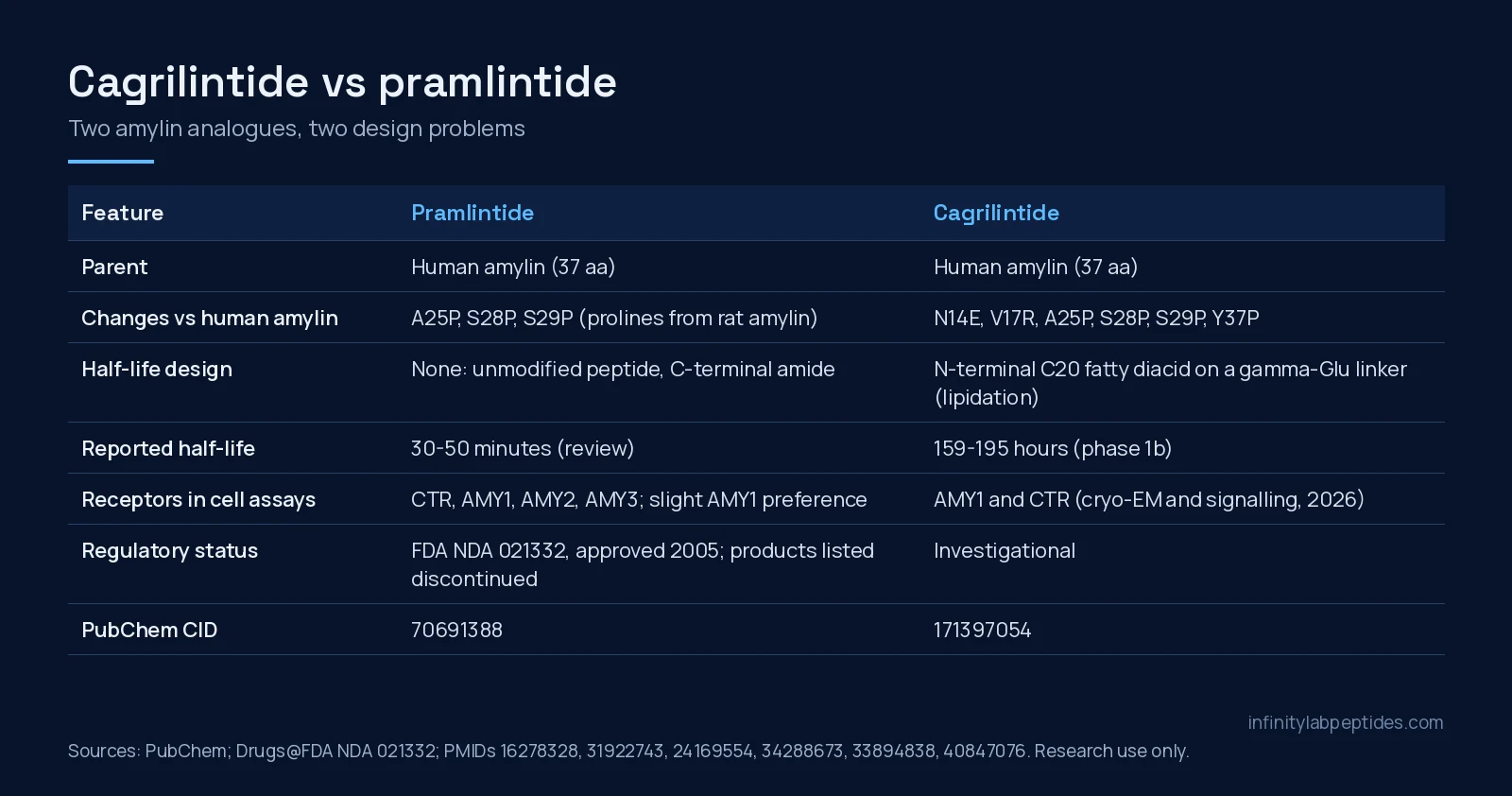
Short answer: pramlintide and cagrilintide are both engineered copies of amylin, the 37-residue hormone that beta cells release alongside insulin. Pramlintide solved amylin’s first problem, its tendency to clump into amyloid fibrils, by borrowing three proline residues from rat amylin [1]; it was approved by the US FDA in March 2005 and has a reported elimination half-life of about 30 to 50 minutes [2]. Cagrilintide keeps those prolines, changes three more positions and adds a fatty-acid chain, which turns a minutes-long peptide into a long-acting one [3], with a half-life of roughly 159 to 195 hours in a phase 1b study [4]. Both act on the same receptor family. The real difference is pharmacokinetic engineering, and that is what this comparison is about.
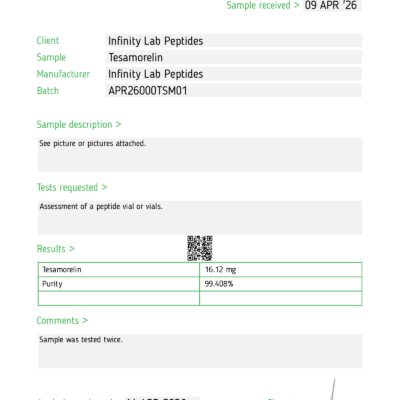
Spec cards from our COA library
Cagrilintide
Purity: not shown
Batch: not shown
Analysis date: not shown
Lab: not shown
Listing: Cagrilintide 10 mg
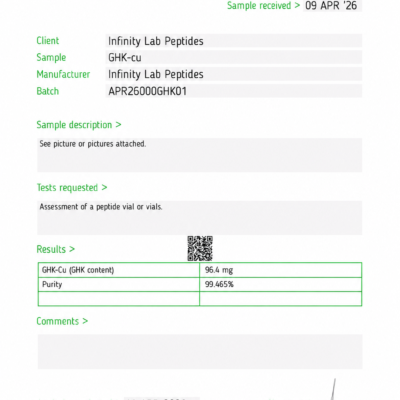
No certificate is posted for this product on our COA page at the time of writing.
Pramlintide
Purity: not applicable
Batch: not applicable
Analysis date: not applicable
Lab: not applicable
Listing: not sold here
We do not list pramlintide. It appears in this article as the reference amylin analogue that cagrilintide was designed to improve on.
We leave cards blank rather than borrow a number from a different product. If a certificate is added for the cagrilintide listing, this section will be updated.
Where both peptides start: amylin and its amyloid problem
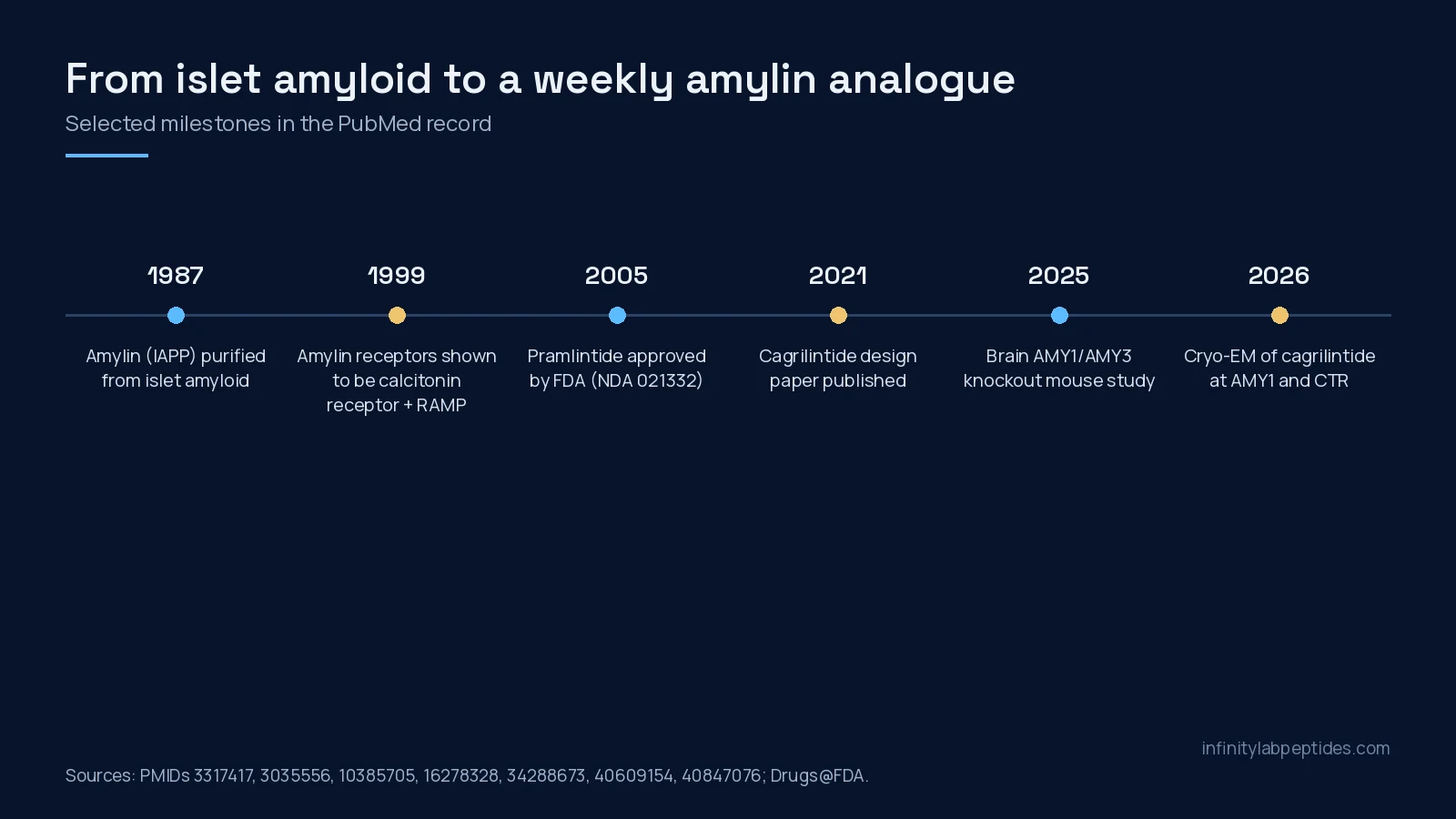
Amylin was characterised in 1987 by two groups working on the same puzzle: the amyloid deposits found in pancreatic islets in type 2 diabetes. Cooper and colleagues purified a 37-amino-acid peptide from amyloid-rich human pancreas and noted that it was about 46% identical to calcitonin gene-related peptide (CGRP) [5]. Westermark’s group isolated the same molecule, which they called islet amyloid polypeptide (IAPP), from a human insulinoma and from the islets of diabetic cats [6]. So the hormone entered the literature as an amyloid protein before anyone treated it as a drug lead.
That history explains the design brief for both analogues. Native human amylin aggregates and is poorly soluble, which has made even basic structure-function work on it difficult [7]. Rat amylin does not form amyloid, and it differs from human amylin at six positions, three of them proline substitutions (A25P, S28P and S29P) [1].
Identity: two 37-residue peptides
| Field | Pramlintide | Cagrilintide |
|---|---|---|
| Other names (PubChem synonyms) | Tripro-amylin, AC137, AC-0137 | Cagrilintide [INN], “analogue 23” in the 2021 design paper |
| Sequence relative to human amylin (KCNTATCATQRLANFLVHSSNNFGAILSSTNVGSNTY-NH2) | Same backbone with A25P, S28P, S29P | KCNTATCATQRLAEFLRHSSNNFGPILPPTNVGSNTP-NH2: N14E, V17R, A25P, S28P, S29P, Y37P |
| Disulfide | Cys2 to Cys7 (as in amylin) | Cys2 to Cys7 (PubChem name: cyclic 3-8 disulfide, counting the linker) |
| Added groups | None; C-terminal amide | N-terminal 19-carboxynonadecanoyl (C20 fatty diacid) on a gamma-glutamyl linker; C-terminal prolinamide |
| Molecular formula | C171H267N51O53S2 | C194H312N54O59S2 |
| Molecular weight (PubChem) | 3949 g/mol | 4409 g/mol |
| CAS (PubChem synonym) | 151126-32-8 | 1415456-99-3 |
| PubChem CID | 70691388 | 171397054 |
The human amylin sequence in the table is PubChem’s entry for islet amyloid polypeptide (CID 16132430). We derived cagrilintide’s substitutions by aligning PubChem’s systematic name for cagrilintide against it; the E14, R17 and P37 residues are the same ones a 2026 cryo-EM study discusses [8].
Design problem one: stopping aggregation (pramlintide)
Pramlintide is human amylin carrying the three rat prolines, and that substitution set produced a non-amyloidogenic analogue suitable for clinical use [1]. A 2020 biophysics study took the prolines one at a time to see which did the work. In human IAPP, S28P on its own sharply reduced amyloid formation and toxicity in vitro, S29P had only modest effects even though it sits one residue away, and A25P fell between the two; double analogues containing S28P were the least amyloidogenic [1]. The authors’ point was how sequence-sensitive amylin aggregation is, not that any one variant is optimal.
What pramlintide did not solve was exposure time. A 2005 pharmacology review reported linear pharmacokinetics, peak serum levels within about 30 minutes, mainly renal elimination and a mean elimination half-life of 30 to 50 minutes [2]. The cagrilintide design paper names this short half-life as the limitation it set out to address [3].
Design problem two: making it last (cagrilintide)
Novo Nordisk chemists described cagrilintide in 2021 as a stable, lipidated, long-acting amylin analogue chosen after structure-activity work on a series of candidates, with obesity as the intended indication [3]. Two kinds of change sit on top of the pramlintide prolines:
- Backbone substitutions. Cagrilintide replaces asparagine 14 with glutamate and valine 17 with arginine. The cryo-EM study reports an intramolecular salt bridge between E14 and R17 that increases helical stability, and a C-terminal P37 that contacts the receptor’s extracellular domain [8].
- Lipidation. PubChem’s structure shows a 20-carbon fatty diacid attached at the N-terminus through a gamma-glutamyl spacer. The design paper describes the molecule as lipidated and long-acting [3].
The result shows up in the pharmacokinetic data. In a phase 1b study that combined cagrilintide with semaglutide, cagrilintide’s half-life was 159 to 195 hours across the doses tested, and its exposure rose in proportion to dose [4]. Measured against the 30 to 50 minutes reported for pramlintide [2], that is a change of more than two orders of magnitude.
Receptor pharmacology: same family, and neither is very selective
Amylin has no single receptor of its own. Its high-affinity receptors are complexes of the calcitonin receptor (CTR) with a receptor activity-modifying protein (RAMP). A 1999 study showed that co-expressing RAMP1 or RAMP3 with the human calcitonin receptor created amylin binding sites with distinct pharmacology, while RAMP2 had little effect in that system [9]. The complexes are now named AMY1, AMY2 and AMY3 after RAMP1, 2 and 3 [10], and the composition of these receptors is one reason amylin pharmacology is hard to pin down [7].
Some product pages describe cagrilintide as more “amylin-selective” than pramlintide. The primary papers we read do not support that:
- Pramlintide. In cAMP assays in HEK293S and Cos7 cells, pramlintide activated the calcitonin receptor and all three AMY receptors, with a slight preference for AMY1 [11].
- Cagrilintide. The 2026 cryo-EM study solved structures of cagrilintide bound to AMY1–Gs and CTR–Gs complexes. It describes a similar “bypass” binding mode in both, and functional data showing non-selective Gs activation through both receptors [8]. Cagrilintide is usually grouped with the dual amylin and calcitonin receptor agonists (DACRAs) for this reason [12].
So both analogues are broad agonists across the CTR/AMY family in cell systems. What differs is how long they stay in circulation, not which receptors they reach.
Side-by-side comparison
| Question | Pramlintide | Cagrilintide | Source |
|---|---|---|---|
| Problem it was built to solve | Amylin aggregation | Pramlintide’s short half-life | [1][3] |
| Key structural change | Three prolines (25, 28, 29) | Same prolines plus E14, R17, P37 and an N-terminal fatty diacid | PubChem; [8] |
| Reported half-life | About 30–50 minutes | About 159–195 hours | [2][4] |
| Receptors activated in cell assays | CTR, AMY1, AMY2, AMY3 | CTR and AMY1 (structures and signalling) | [11][8] |
| Brain-receptor evidence in knockout mice | Not tested in the papers cited here | Potency reduced in RAMP1/3 knockout mice | [12] |
| US regulatory status | FDA approval March 16, 2005 (NDA 021332); Drugs@FDA now lists the products as discontinued | Investigational | Drugs@FDA; [2][3] |
Research models: where each has been studied
Rodent feeding and brainstem models
Amylin acts mainly in the brain’s circumventricular organs, which lack a full blood-brain barrier, and it interacts with other metabolic hormones such as cholecystokinin and leptin [13]. An older rat study found that destroying the area postrema and nucleus of the solitary tract weakened the reduction in food intake produced by injected amylin [14]. In rats offered both chow and a high-fat diet, pramlintide reduced high-fat intake for a few hours when given systemically and for up to 24 hours when given into the brain ventricles. It did not change the rats’ percentage preference for the high-fat diet, and it did not induce pica, a rodent marker of malaise [15].
Receptor knockout mice (cagrilintide)
The most direct test of where cagrilintide works comes from a 2025 study in diet-induced obese mice lacking RAMP1 and RAMP3. Removing those two proteins, and with them AMY1 and AMY3, reduced cagrilintide’s potency, while salmon calcitonin behaved differently. Both peptides activated neurons in the dorsal vagal complex and lateral parabrachial nucleus of normal mice, and cagrilintide’s area postrema signal was lower in the knockouts [12]. This is one mouse study in males only, but it is the clearest evidence that brain amylin receptors, not just the calcitonin receptor, mediate cagrilintide’s effects in rodents.
Other pramlintide models
Because pramlintide was the only amylin analogue available for many years, it has been used as a research tool outside metabolism. In the senescence-accelerated prone mouse, an Alzheimer’s model, long-term pramlintide infusion was associated with better novel-object-recognition performance and changes in hippocampal synaptic and inflammatory markers [16]. That is one mouse model and one research group, and it says nothing about people.
What the human trial programmes measured
Pramlintide was approved for use alongside insulin in type 1 and type 2 diabetes [2]; its US application record is on Drugs@FDA (NDA 021332). Cagrilintide is investigational, and most of its later-stage work pairs it with semaglutide. The table below lists design and endpoints only. It is not a summary of results.
| Trial | Phase | Population | Arms | Primary endpoint |
|---|---|---|---|---|
| Cagrilintide with semaglutide, multiple-dose study [4] | 1b | Adults with overweight or obesity | Cagrilintide dose levels vs placebo, all with semaglutide | Safety and tolerability; pharmacokinetics |
| Cagrilintide dose-finding [17] | 2, 26 weeks | Adults without diabetes, 57 sites in ten countries including Canada | Five cagrilintide dose levels, liraglutide, placebo | Percentage change in body weight |
| CagriSema in type 2 diabetes [18] | 2, 32 weeks | Adults with type 2 diabetes on metformin | Combination vs semaglutide vs cagrilintide | Change in HbA1c |
| REDEFINE 1 [19] | 3a, 68 weeks | Adults without diabetes | Combination, semaglutide, cagrilintide, placebo | Relative change in body weight; share reaching at least 5% reduction |
| REDEFINE 5 [20] | 3a, 68 weeks | East Asian adults with or without type 2 diabetes (Japan, Taiwan) | Combination vs semaglutide | Body-weight endpoints vs semaglutide |
Reviews now place cagrilintide alongside newer amylin receptor agonists in development, such as the KBP-series DACRAs, ZP8396 and amycretin [21].
What the evidence does not show
- No head-to-head study. We found no published trial or animal study comparing cagrilintide and pramlintide directly. The half-life gap comes from separate studies, in different populations, using different methods [2][4].
- Selectivity is not settled. Receptor data for both come from transfected cell lines [11][8]. How AMY and CTR activity divides up in native tissue is still an open question, and the knockout evidence comes from a single study in male mice [12].
- Rodent feeding data do not carry over directly. The pramlintide feeding results come from short rat experiments [15], and the brain-lesion work dates from 1998 [14].
- Combination trials do not isolate cagrilintide. Most phase 3 work tests cagrilintide with semaglutide [19][20], so it says little about cagrilintide’s own pharmacology.
- Aggregation data come from test tubes. The proline-scan findings are in vitro biophysics on human IAPP [1]. They do not describe cagrilintide’s own stability in formulation, which the design paper reports only in summary [3].
For lab buyers
If your work involves the amylin system, the useful questions are about the molecule, not the marketing. Confirm the sequence matches PubChem’s cagrilintide entry, including the N-terminal fatty diacid, and look for a batch-specific certificate. Our Cagrilintide 10 mg listing has no certificate posted at the time of writing. For cagrilintide alongside a triple incretin agonist, see Retatrutide vs Cagrilintide. You can also browse what we stock and buy research peptides in Canada; every product is sold for laboratory research only.
Frequently asked questions
What is the main difference between cagrilintide and pramlintide?
Both are analogues of the 37-residue hormone amylin. Pramlintide adds three prolines to stop the peptide aggregating and has a reported half-life of about 30 to 50 minutes. Cagrilintide keeps those prolines, changes three more residues and adds an N-terminal fatty diacid, giving a half-life of roughly 159 to 195 hours in a phase 1b study.
Is cagrilintide more selective for amylin receptors than pramlintide?
The primary papers we read do not show that. In cell assays pramlintide activated the calcitonin receptor and all three amylin receptors, with a slight preference for AMY1. Cryo-EM and signalling data show cagrilintide activating both AMY1 and the calcitonin receptor, which is why it is classed as a dual amylin and calcitonin receptor agonist.
Why did pramlintide need proline substitutions?
Human amylin readily forms amyloid fibrils. Rat amylin does not, and three of its differences from human amylin are prolines at positions 25, 28 and 29. Putting those prolines into human amylin gave a non-amyloidogenic analogue. In test-tube studies S28P had the largest single effect.
What is the regulatory status of pramlintide and cagrilintide?
Pramlintide (Symlin) received US FDA approval on March 16, 2005 under NDA 021332, and Drugs@FDA currently lists those products as discontinued. Cagrilintide is an investigational compound studied mostly in combination with semaglutide.
Does Infinity Lab Peptides post a COA for cagrilintide?
Not at the time of writing. No certificate is posted for our Cagrilintide 10 mg listing on our COA page, and we do not sell pramlintide.
References
- Ridgway Z, Eldrid C, Zhyvoloup A et al. (2020). Analysis of Proline Substitutions Reveals the Plasticity and Sequence Sensitivity of Human IAPP Amyloidogenicity and Toxicity. Biochemistry. PMID: 31922743. doi: 10.1021/acs.biochem.9b01109.
- McQueen J (2005). Pramlintide acetate. Am J Health Syst Pharm. PMID: 16278328. doi: 10.2146/ajhp050341.
- Kruse T, Hansen JL, Dahl K et al. (2021). Development of Cagrilintide, a Long-Acting Amylin Analogue. J Med Chem. PMID: 34288673. doi: 10.1021/acs.jmedchem.1c00565.
- Enebo LB, Berthelsen KK, Kankam M et al. (2021). Safety, tolerability, pharmacokinetics, and pharmacodynamics of concomitant administration of multiple doses of cagrilintide with semaglutide 2·4 mg for weight management: a randomised, controlled, phase 1b trial. Lancet. PMID: 33894838. doi: 10.1016/S0140-6736(21)00845-X.
- Cooper GJ, Willis AC, Clark A et al. (1987). Purification and characterization of a peptide from amyloid-rich pancreases of type 2 diabetic patients. Proc Natl Acad Sci U S A. PMID: 3317417. doi: 10.1073/pnas.84.23.8628.
- Westermark P, Wernstedt C, Wilander E et al. (1987). Amyloid fibrils in human insulinoma and islets of Langerhans of the diabetic cat are derived from a neuropeptide-like protein also present in normal islet cells. Proc Natl Acad Sci U S A. PMID: 3035556. doi: 10.1073/pnas.84.11.3881.
- Bower RL, Hay DL (2016). Amylin structure-function relationships and receptor pharmacology: implications for amylin mimetic drug development. Br J Pharmacol. PMID: 27061187. doi: 10.1111/bph.13496.
- Gu YM, Yuan QN, Li X et al. (2026). Structural and mechanistic insights into dual activation of cagrilintide in amylin and calcitonin receptors. Acta Pharmacol Sin. PMID: 40847076. doi: 10.1038/s41401-025-01635-2.
- Christopoulos G, Perry KJ, Morfis M et al. (1999). Multiple amylin receptors arise from receptor activity-modifying protein interaction with the calcitonin receptor gene product. Mol Pharmacol. PMID: 10385705. doi: 10.1124/mol.56.1.235.
- Hay DL, Christopoulos G, Christopoulos A et al. (2004). Amylin receptors: molecular composition and pharmacology. Biochem Soc Trans. PMID: 15494035. doi: 10.1042/BST0320865.
- Gingell JJ, Burns ER, Hay DL (2014). Activity of pramlintide, rat and human amylin but not Aβ1-42 at human amylin receptors. Endocrinology. PMID: 24169554. doi: 10.1210/en.2013-1658.
- Carvas AO, Leuthardt A, Kulka P et al. (2025). Cagrilintide lowers bodyweight through brain amylin receptors 1 and 3. EBioMedicine. PMID: 40609154. doi: 10.1016/j.ebiom.2025.105836.
- Hay DL, Chen S, Lutz TA et al. (2015). Amylin: Pharmacology, Physiology, and Clinical Potential. Pharmacol Rev. PMID: 26071095. doi: 10.1124/pr.115.010629.
- Lutz TA, Senn M, Althaus J et al. (1998). Lesion of the area postrema/nucleus of the solitary tract (AP/NTS) attenuates the anorectic effects of amylin and calcitonin gene-related peptide (CGRP) in rats. Peptides. PMID: 9493863. doi: 10.1016/s0196-9781(97)00292-1.
- Kern KA, DiBrog AM, Przybysz JT et al. (2021). Effects of pramlintide on energy intake and food preference in rats given a choice diet. Physiol Behav. PMID: 34332974. doi: 10.1016/j.physbeh.2021.113541.
- Adler BL, Yarchoan M, Hwang HM et al. (2014). Neuroprotective effects of the amylin analogue pramlintide on Alzheimer’s disease pathogenesis and cognition. Neurobiol Aging. PMID: 24239383. doi: 10.1016/j.neurobiolaging.2013.10.076.
- Lau DCW, Erichsen L, Francisco AM et al. (2021). Once-weekly cagrilintide for weight management in people with overweight and obesity: a multicentre, randomised, double-blind, placebo-controlled and active-controlled, dose-finding phase 2 trial. Lancet. PMID: 34798060. doi: 10.1016/S0140-6736(21)01751-7.
- Frias JP, Deenadayalan S, Erichsen L et al. (2023). Efficacy and safety of co-administered once-weekly cagrilintide 2·4 mg with once-weekly semaglutide 2·4 mg in type 2 diabetes: a multicentre, randomised, double-blind, active-controlled, phase 2 trial. Lancet. PMID: 37364590. doi: 10.1016/S0140-6736(23)01163-7.
- Garvey WT, Blüher M, Osorto Contreras CK et al. (2025). Coadministered Cagrilintide and Semaglutide in Adults with Overweight or Obesity. N Engl J Med. PMID: 40544433. doi: 10.1056/NEJMoa2502081.
- Yamauchi T, Becker NP, Hagemann CA et al. (2026). Efficacy and safety of co-administered cagrilintide and semaglutide versus semaglutide alone in adults with overweight or obesity with or without type 2 diabetes in Japan and Taiwan (REDEFINE 5): a multicentre, randomised, active-controlled, phase 3a trial. Lancet Diabetes Endocrinol. PMID: 42009015. doi: 10.1016/S2213-8587(25)00402-4.
- Rejili M, Hussain MS, Khan Y et al. (2026). Amylin receptors as therapeutic targets in obesity: Emerging peptide-based strategies. Vascul Pharmacol. PMID: 41344603. doi: 10.1016/j.vph.2025.107563.