For laboratory research only. Not for human or animal use. This article gives no dosing, administration or therapeutic advice.
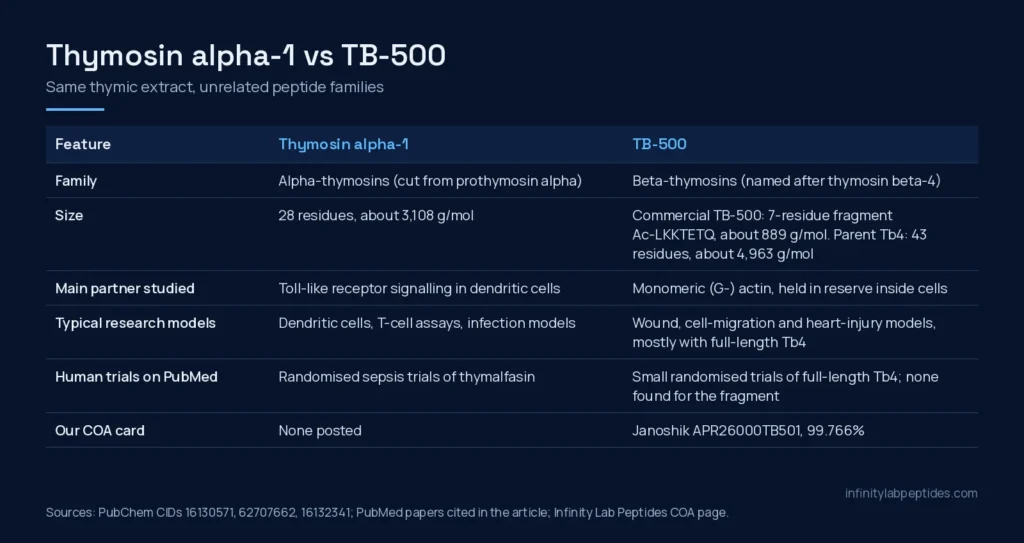
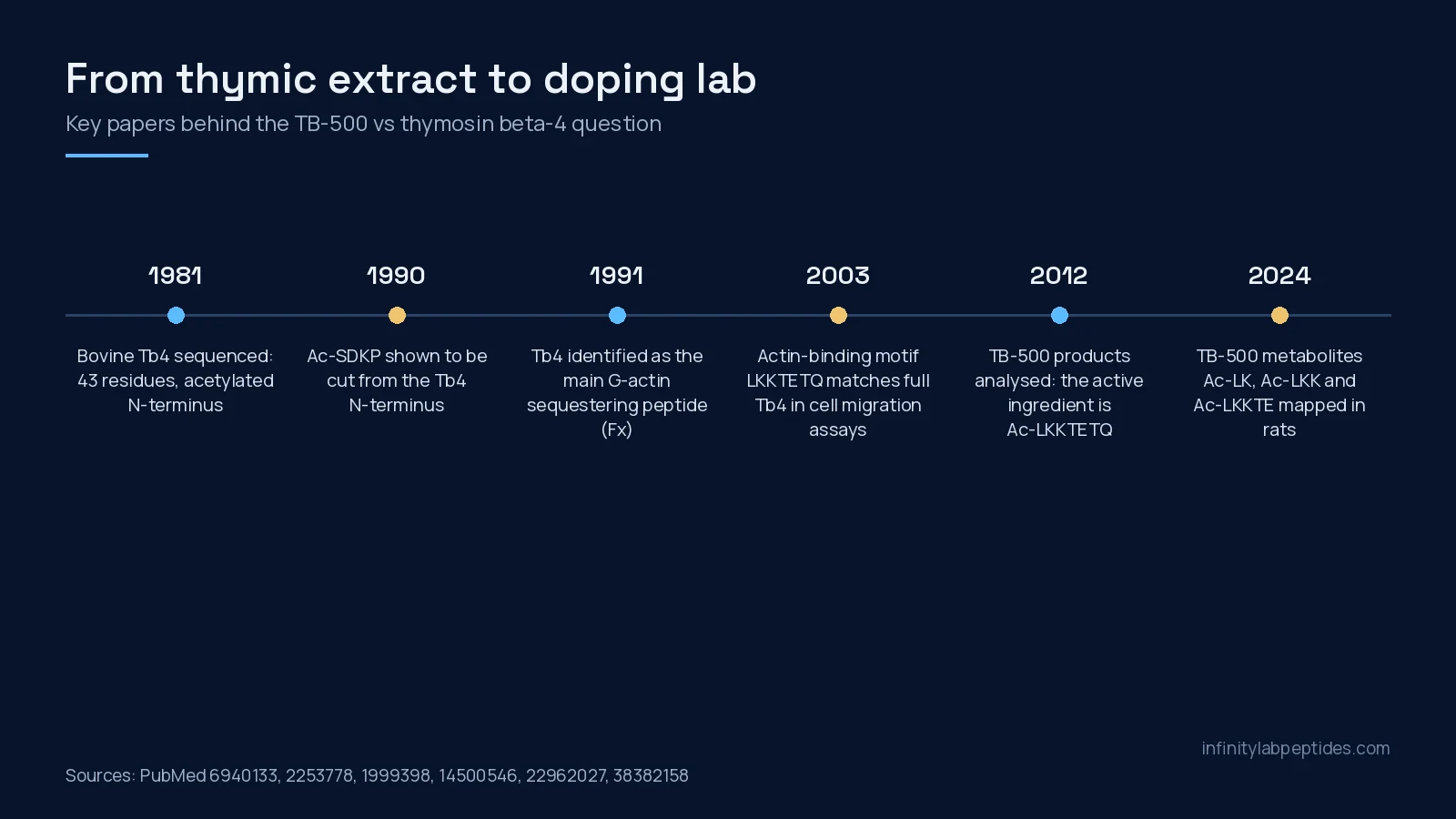
Short answer: “TB-500” and “thymosin beta-4” are often used as if they were the same thing, but in the analytical literature they are not. Thymosin beta-4 (Tβ4) is a natural 43-residue protein with an acetylated N-terminus, first sequenced from calf thymus in 1981 [1], and it is the main peptide that holds monomeric (G-) actin in reserve inside cells [2]. When doping-control chemists analysed products sold as TB-500, the active ingredient they found was a seven-residue synthetic fragment, Ac-LKKTETQ, which matches Tβ4 residues 17–23 [3],[4]. Nearly all of the wound, heart and angiogenesis papers people quote for “TB-500” were run with full-length Tβ4 or with differently sized fragments. That gap between the name on a vial and the molecule in a paper is the real comparison.
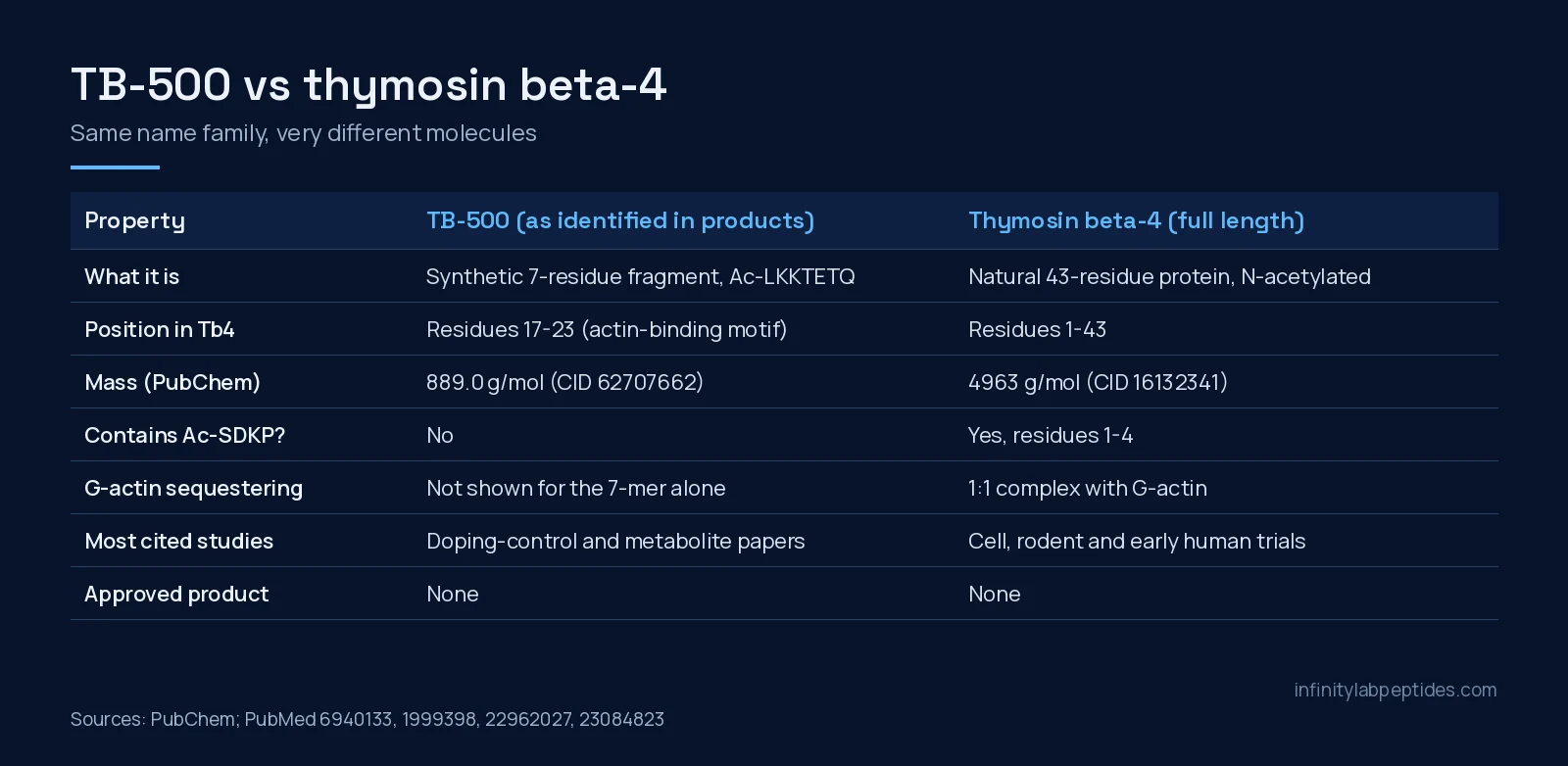
Batch documentation at a glance
Our COA library is the only source for the statements below.
TB-500
Purity: 99.766%
Batch: APR26000TB501
Analysis date: 14 APR 2026
Lab: Janoshik
Verification key: I91213lJ443S
Listing: TB-500 10 mg
The card on our COA page is titled “TB-500”. It reports purity, batch and key; it does not by itself state a sequence or a molecular mass, so open the full report to see which mass the lab identified.
Thymosin beta-4 (full length)
Purity: not applicable
Batch: not applicable
Lab: not applicable
Listing: none
We do not list full-length thymosin beta-4 as a separate product. It appears here as the parent protein that TB-500 is named after and that most of the literature studied.
Because “TB-500” can mean either a 7-residue fragment of about 889 g/mol or, in some catalogues, the 4,963 g/mol full protein, the mass found by the lab is the single most useful number on any TB-500 report.
Identity
Values below are PubChem’s, with the residue positions checked against the published Tβ4 sequence [1].
| Property | TB-500 (Ac-LKKTETQ) | Thymosin beta-4 (Tβ4) |
|---|---|---|
| Class | Synthetic N-acetylated heptapeptide | Natural 43-residue polypeptide, N-acetylated |
| Sequence | Ac-Leu-Lys-Lys-Thr-Glu-Thr-Gln-OH (Tβ4 residues 17–23) | Ac-SDKPDMAEIEKFDKSKLKKTETQEKNPLPSKETIEQEKQAGES |
| Synonyms (PubChem) | TB500, TB-500, TB 500 acetate | Timbetasin, thymosin beta4, Fx peptide |
| Molecular formula | C38H68N10O14 | C212H350N56O78S |
| Molecular weight | 889.0 g/mol | 4963 g/mol |
| CAS | 885340-08-9 | 77591-33-4 |
| PubChem CID | 62707662 | 16132341 |
What full-length thymosin beta-4 is
Tβ4 was isolated from thymosin fraction 5, a calf-thymus extract. Low and colleagues reported 43 residues, a blocked (acetylated) N-terminus and an isoelectric point of 5.1 [1]. Its main known job turned out to be structural rather than hormonal. In 1991, Safer and colleagues showed that “Fx”, the acidic 5-kDa peptide holding most of the unpolymerised actin in resting human platelets, was Tβ4. It binds G-actin one-to-one and blocks salt-induced polymerisation [2]. A later DNase I inhibition study confirmed the 1:1 sequestering ratio. It also found that the fragments Tβ4 13–43 and 24–43 did not sequester actin, so residues before position 13 are needed for that function [5].
Tβ4 also carries a second, separate signal at its N-terminus. The tetrapeptide Ac-SDKP (residues 1–4) can be cut from Tβ4 in bone-marrow cell preparations [6]. In rats, prolyl oligopeptidase was identified as the main enzyme behind Ac-SDKP release, and blocking it lowered Ac-SDKP in plasma, heart and kidney [7]. Because that enzyme only cuts peptides shorter than about 30 residues, a later study showed that meprin-α must first shorten Tβ4 before Ac-SDKP can be freed [8]. TB-500 as identified in products (residues 17–23) contains none of this N-terminal sequence.
The actin-binding motif and what fragment studies showed
The central LKKTETQ stretch is the part of Tβ4 that contacts actin. Philp and colleagues compared natural Tβ4, proteolytic fragments and synthetic peptides in endothelial migration and chick aortic ring assays. They reported that the seven-residue actin-binding motif matched full Tβ4 at around 50 nM, while peptides missing part of the motif were inactive [9]. The same group found that Tβ4, and a synthetic peptide containing its actin-binding domain, increased wound contraction and collagen deposition in diabetic and aged mice [10]. A review from that circle maps the activities onto short sites: Ac-SDKP at the N-terminus (inflammation, fibrosis), a 15-residue N-terminal stretch (cell survival), and LKKTETQ (migration, angiogenesis, wound repair) [11].
Two caveats follow. First, these are cell and rodent studies, and “matched full Tβ4 in this assay” is not the same as “does everything Tβ4 does”. The actin-sequestering data above suggest the 7-mer on its own is not a G-actin buffer. Second, those fragments were made by the authors, so they say nothing about any commercial vial.
Where the name TB-500 comes from in the literature
The clearest peer-reviewed descriptions of TB-500 come from anti-doping chemistry rather than biology. Esposito and colleagues analysed a TB-500 formulation by high-resolution mass spectrometry and identified the N-terminally acetylated 17–23 fragment, Ac-LKKTETQ. They then synthesised it and proposed methods to detect it in plasma and urine [3]. Ho and colleagues, working on equine samples, called TB-500 “a synthetic version of an active region of thymosin β4”. They confirmed Ac-LKKTETQ and its metabolites in horse urine and plasma after administration [4].
Metabolism adds another layer. In a 2024 study combining in-vitro incubations and rats, the main circulating metabolite of TB-500 was the dipeptide Ac-LK, and Ac-LKK persisted longest, detected up to 72 hours. Only the metabolite Ac-LKKTE showed significant activity in their wound-healing assay. The authors suggest that earlier wound activity credited to TB-500 may come from that metabolite rather than the parent [12]. For full Tβ4, a separate study proposed the N-terminal metabolite Ac-Tβ(1–14) as a urine marker in rats, which was absent from control and human blank urine [13]. The two leave different chemical fingerprints.
What the primary literature actually tested
When a source cites “TB-500 research”, it helps to check which molecule each paper used:
- Full-length Tβ4: the rat full-thickness wound study [14], the mouse cardiac-repair work showing Tβ4 activates integrin-linked kinase [15], and the reviews that shaped the field’s view of Tβ4 as an actin-sequestering protein with repair roles [16]. Early human work on Tβ4 itself includes a phase I study of recombinant human Tβ4 in healthy volunteers [17] and a small phase 2 ophthalmic trial [18]. These are described here by design only.
- Synthetic actin-binding fragments: the angiogenesis and wound papers above [9],[10], where the authors made the peptides themselves.
- Material labelled “TB-500”: the doping-control and metabolite studies [3],[4],[12]. A 2026 rat Achilles-tendon study compared BPC-157 and TB-500 and reported histological and biomechanical differences versus controls [19]. Readers should check its methods for which molecule and mass were used before treating it as fragment data.
Side-by-side comparison
| Question | TB-500 (Ac-LKKTETQ) | Thymosin beta-4 |
|---|---|---|
| Origin | Synthetic fragment found in products sold as TB-500 [3] | Natural protein isolated from thymus extract [1] |
| Length | 7 residues | 43 residues |
| G-actin sequestration | Not shown for the 7-mer alone; N-terminal residues needed in fragment tests [5] | 1:1 complex with G-actin [2] |
| Ac-SDKP source | No | Yes, released by meprin-α plus prolyl oligopeptidase [8] |
| Cell-migration data | Motif active in endothelial assays [9] | Active in the same assays [9] |
| Main metabolites | Ac-LK, Ac-LKK, Ac-LKKTE (rat) [12] | Ac-Tβ(1–14) proposed as marker (rat) [13] |
| Human data | None located | Small early-phase trials only [17],[18] |
What the evidence does not show
- It does not show that the 7-residue fragment reproduces the full range of Tβ4 activities. The direct comparisons cover a few cell assays and mouse wound models [9],[10].
- It does not show any human benefit for TB-500. We found no clinical trial of Ac-LKKTETQ, and the human Tβ4 studies used the full protein in specific settings [17],[18].
- It does not establish that every product called TB-500 contains the same molecule. The name is applied to both forms in commerce, which is why identity testing matters.
- The 2024 metabolite work suggests some fragment activity may come from a breakdown product, Ac-LKKTE, rather than the parent peptide [12]. This has not been replicated by an independent group that we could find.
- Animal findings, including the 2026 tendon study [19], come from single labs and small groups. They describe tissue changes under one protocol, not general effects.
Practical notes for lab work
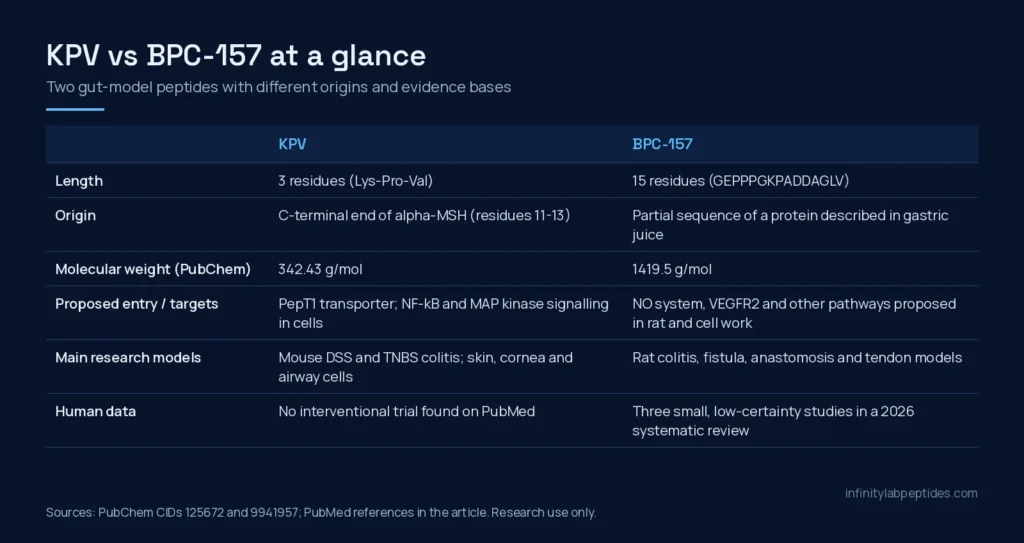
If your protocol is built on a paper, match the molecule to the paper: a study run with full Tβ4 does not validate a fragment, and vice versa. Ask for, or open, the full report behind a batch card and look for the measured mass (about 889 for Ac-LKKTETQ, about 4,963 for full Tβ4). If you also work with BPC-157, our BPC-157 vs TB-500 comparison sets out the documentation for both listings side by side. You can view the TB-500 10 mg listing, read why purity matters in research peptides, or buy research peptides in Canada from our catalogue.
Frequently asked questions
Is TB-500 the same as thymosin beta-4?
Not in the analytical literature. Products sold as TB-500 were found to contain Ac-LKKTETQ, a 7-residue synthetic fragment matching residues 17–23 of thymosin beta-4. Thymosin beta-4 itself is a 43-residue protein of about 4,963 g/mol.
What is the LKKTETQ sequence?
It is the central actin-binding motif of thymosin beta-4, residues 17–23. In cell assays a synthetic version of this motif matched full thymosin beta-4 for endothelial migration, but fragment tests suggest residues before position 13 are needed for G-actin sequestration.
Does TB-500 contain Ac-SDKP?
No. Ac-SDKP is residues 1–4 of thymosin beta-4 and is released by meprin-α and prolyl oligopeptidase. The TB-500 fragment starts at residue 17, so it does not include that sequence.
How do labs tell TB-500 and thymosin beta-4 apart?
By mass spectrometry. The fragment is about 889 g/mol and the full protein about 4,963 g/mol, and each leaves different metabolites. Doping-control studies used these signatures to detect each one in urine and plasma.
Does Infinity Lab Peptides post a COA for TB-500?
Yes. Our COA page shows a Janoshik report titled TB-500, batch APR26000TB501, purity 99.766%, analysis date 14 APR 2026, verification key I91213lJ443S. Open the full report to see the identified mass.
References
- Low TL, Hu SK, Goldstein AL (1981). Complete amino acid sequence of bovine thymosin beta 4: a thymic hormone that induces terminal deoxynucleotidyl transferase activity in thymocyte populations. Proc Natl Acad Sci U S A. PMID: 6940133. doi: 10.1073/pnas.78.2.1162.
- Safer D, Elzinga M, Nachmias VT (1991). Thymosin beta 4 and Fx, an actin-sequestering peptide, are indistinguishable. J Biol Chem. PMID: 1999398.
- Esposito S, Deventer K, Goeman J et al. (2012). Synthesis and characterization of the N-terminal acetylated 17-23 fragment of thymosin beta 4 identified in TB-500, a product suspected to possess doping potential. Drug Test Anal. PMID: 22962027. doi: 10.1002/dta.1402.
- Ho EN, Kwok WH, Lau MY et al. (2012). Doping control analysis of TB-500, a synthetic version of an active region of thymosin β₄, in equine urine and plasma by liquid chromatography-mass spectrometry. J Chromatogr A. PMID: 23084823. doi: 10.1016/j.chroma.2012.09.043.
- Hannappel E, Wartenberg F (1993). Actin-sequestering ability of thymosin beta 4, thymosin beta 4 fragments, and thymosin beta 4-like peptides as assessed by the DNase I inhibition assay. Biol Chem Hoppe Seyler. PMID: 8471179. doi: 10.1515/bchm3.1993.374.1-6.117.
- Grillon C, Rieger K, Bakala J et al. (1990). Involvement of thymosin beta 4 and endoproteinase Asp-N in the biosynthesis of the tetrapeptide AcSerAspLysPro a regulator of the hematopoietic system. FEBS Lett. PMID: 2253778. doi: 10.1016/0014-5793(90)81322-f.
- Cavasin MA, Rhaleb NE, Yang XP et al. (2004). Prolyl oligopeptidase is involved in release of the antifibrotic peptide Ac-SDKP. Hypertension. PMID: 15037553. doi: 10.1161/01.HYP.0000126172.01673.84.
- Kumar N, Nakagawa P, Janic B et al. (2016). The anti-inflammatory peptide Ac-SDKP is released from thymosin-β4 by renal meprin-α and prolyl oligopeptidase. Am J Physiol Renal Physiol. PMID: 26962108. doi: 10.1152/ajprenal.00562.2015.
- Philp D, Huff T, Gho YS et al. (2003). The actin binding site on thymosin beta4 promotes angiogenesis. FASEB J. PMID: 14500546. doi: 10.1096/fj.03-0121fje.
- Philp D, Badamchian M, Scheremeta B et al. (2003). Thymosin beta 4 and a synthetic peptide containing its actin-binding domain promote dermal wound repair in db/db diabetic mice and in aged mice. Wound Repair Regen. PMID: 12581423. doi: 10.1046/j.1524-475x.2003.11105.x.
- Sosne G, Qiu P, Goldstein AL et al. (2010). Biological activities of thymosin beta4 defined by active sites in short peptide sequences. FASEB J. PMID: 20179146. doi: 10.1096/fj.09-142307.
- Rahaman KA, Muresan AR, Min H et al. (2024). Simultaneous quantification of TB-500 and its metabolites in in-vitro experiments and rats by UHPLC-Q-Exactive orbitrap MS/MS and their screening by wound healing activities in-vitro. J Chromatogr B Analyt Technol Biomed Life Sci. PMID: 38382158. doi: 10.1016/j.jchromb.2024.124033.
- Rahaman KA, Muresan AR, Hasan ML et al. (2023). Detection and quantification of the metabolite Ac-Tβ(1-14) in in vitro experiments and urine of rats treated with Ac-Tβ4: A potential biomarker of Ac-Tβ4 for doping tests. Drug Test Anal. PMID: 37515313. doi: 10.1002/dta.3552.
- Malinda KM, Sidhu GS, Mani H et al. (1999). Thymosin beta4 accelerates wound healing. J Invest Dermatol. PMID: 10469335. doi: 10.1046/j.1523-1747.1999.00708.x.
- Bock-Marquette I, Saxena A, White MD et al. (2004). Thymosin beta4 activates integrin-linked kinase and promotes cardiac cell migration, survival and cardiac repair. Nature. PMID: 15565145. doi: 10.1038/nature03000.
- Goldstein AL, Hannappel E, Kleinman HK (2005). Thymosin beta4: actin-sequestering protein moonlights to repair injured tissues. Trends Mol Med. PMID: 16099219. doi: 10.1016/j.molmed.2005.07.004.
- Wang X, Liu L, Qi L et al. (2021). A first-in-human, randomized, double-blind, single- and multiple-dose, phase I study of recombinant human thymosin β4 in healthy Chinese volunteers. J Cell Mol Med. PMID: 34346165. doi: 10.1111/jcmm.16693.
- Sosne G, Dunn SP, Kim C (2015). Thymosin β4 significantly improves signs and symptoms of severe dry eye in a phase 2 randomized trial. Cornea. PMID: 25826322. doi: 10.1097/ICO.0000000000000379.
- Biçer O, Adanir O, Güleryüz Y et al. (2026). Effects of BPC-157 and TB-500 on Achilles tendon healing in rats: A histopathological and biomechanical study. Jt Dis Relat Surg. PMID: 42542926. doi: 10.52312/jdrs.2026.2951.
Research use only. All products referenced on this page are intended for laboratory research and analytical use. They are not drugs, supplements or cosmetics and are not for human or animal consumption.