For laboratory research only. Not for human or animal use. This article gives no dosing, administration or therapeutic advice.
Short answer: retatrutide and survodutide both add glucagon-receptor activity to GLP-1-receptor activity, but they differ by one receptor. Retatrutide (LY3437943) is a single peptide that activates three receptors: the glucagon receptor (GCGR), the GIP receptor (GIPR) and the GLP-1 receptor (GLP-1R) [1]. Survodutide (BI 456906) is a dual GCGR/GLP-1R agonist with no GIP component, which its developers introduced with reference to oxyntomodulin, a gut peptide that activates both receptors [2]. Both are investigational and both are in phase 3 programmes, but those programmes emphasise different questions: retatrutide’s published phase 3 work so far centres on type 2 diabetes and obesity, while survodutide’s includes a dedicated liver (MASLD) trial and a cardiovascular outcomes trial [3],[4],[5],[6].
Below: the batch documentation we post, then identity, receptor profiles, half-life engineering, what the preclinical mechanism work measured, and how the two trial programmes are built. We report trial design and endpoints only, not results.
Batch documentation at a glance
These cards repeat only what our COA library shows today.
Retatrutide (GLP-3)
Purity: 99.479%
Batch: APR260001010
Analysis date: 14 APR 2026
Lab: Janoshik
Verification key: 38J43C11UNXY
Listings: GLP-3, Retatrutide (Pen)
One report is listed for both entries; it documents one batch, not each format separately.
Survodutide
Purity: not applicable
Batch: not applicable
We do not list survodutide, so there is no certificate for it on our COA page. It is covered here for comparison only.
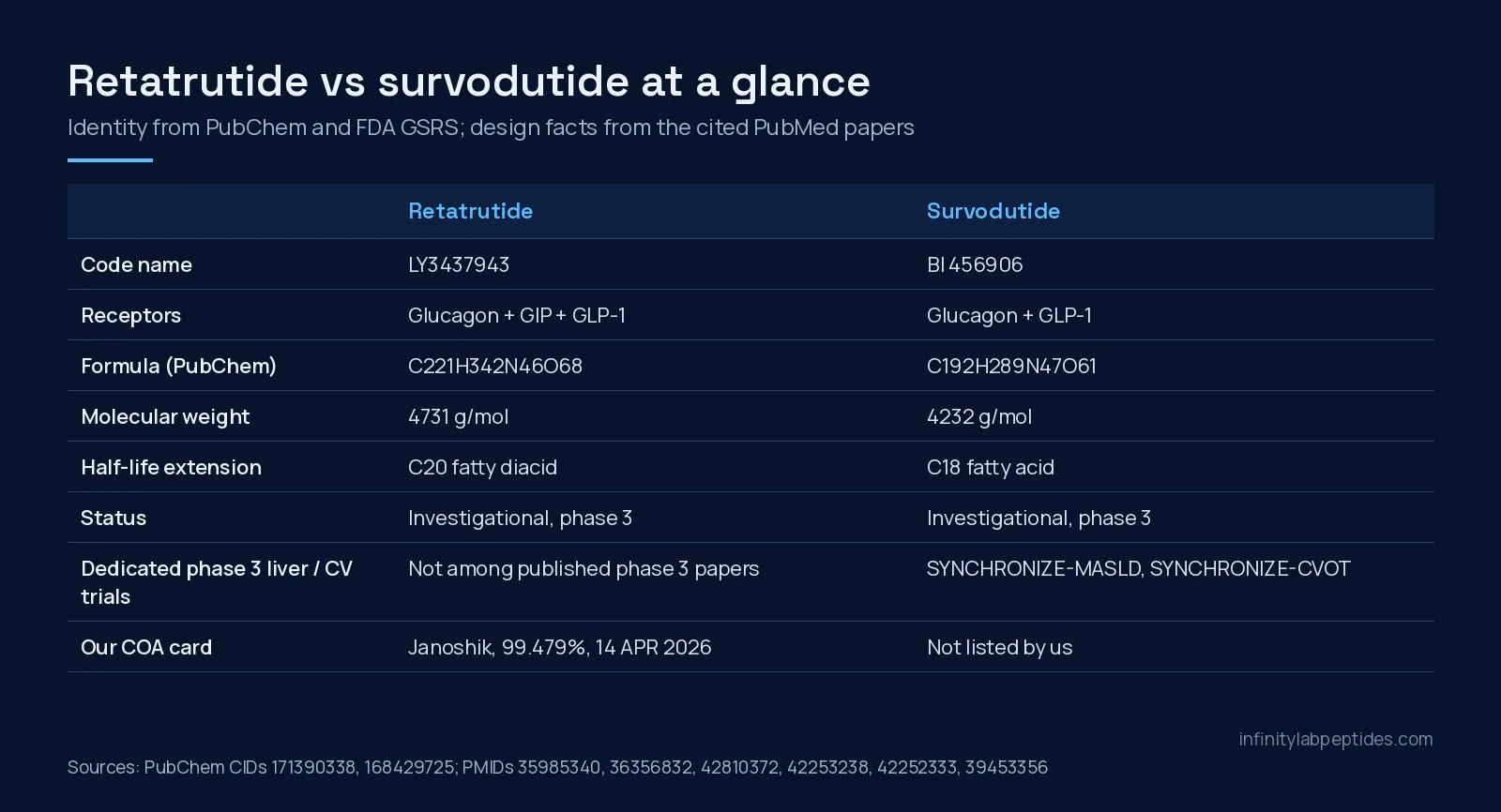
Identity
Values come from PubChem and, for retatrutide’s sequence, the FDA Global Substance Registration System (GSRS).
| Field | Retatrutide | Survodutide |
|---|---|---|
| Code names | LY3437943 | BI 456906 |
| Receptor targets | GCGR, GIPR, GLP-1R | GCGR, GLP-1R |
| Peptide chain | 39 residues (GSRS: YAQGTFTSDYSILLDKKAQAAFIEYLLEGGPSSGAPPPS) with non-standard residues and a C-terminal amide | Acylated peptide; sequence not reproduced here because the records we used do not give it |
| Half-life extension | C20 fatty diacid on a lysine side chain via a linker (GSRS) | C18 fatty acid, described by its developers as the half-life extending principle |
| Molecular formula (PubChem) | C221H342N46O68 | C192H289N47O61 |
| Molecular weight (PubChem) | 4731 g/mol | 4232 g/mol |
| CAS (PubChem synonym) | not listed on the compound record | 2805997-46-8 |
| PubChem CID | 171390338 (record titled “Triple G”) | 168429725; PubChem also holds records 171378821 and 171934786 with the same formula |
A practical note: neither compound has a single tidy PubChem entry, so check identifiers against the code name rather than the record title.
Receptor profiles: what the GIP arm changes
In cell assays, retatrutide showed balanced GCGR and GLP-1R activity with relatively more GIPR activity. In obese mice, its developers attributed part of its effect to GCGR-driven increases in energy expenditure added to GIPR- and GLP-1R-driven reductions in food intake [1]. A 2024 structural study has since examined how one peptide engages all three receptors [7], and a 2023 paper reports that retatrutide delays gastric emptying [8].
Survodutide was characterised in cell lines expressing human GCGR and GLP-1R and in cells with endogenous receptors, then checked in vivo with receptor-specific readouts: oral glucose tolerance, food intake and gastric emptying for the GLP-1R, and liver nicotinamide N-methyltransferase (NNMT) mRNA and plasma FGF21 and amino acids for the GCGR. Its dual activity was supported with GLP-1R knockout and reporter mice [2]. In a candidate-selection study of 19 dual agonists, these in vivo biomarkers correlated with the in vitro GCGR and GLP-1R potencies, and survodutide was one of three selected for in-depth profiling on the basis of its acute glucose-tolerance response, with the three candidates differing in how strongly they engaged the GCGR [9].
That biomarker approach is the part most comparison pages skip. “Dual” and “triple” describe which receptors a peptide can hit, not how hard. Reviews of glucagon co-agonism point out that the balance between GCGR and GLP-1R potency differs between compounds and may explain differences in effects such as heart rate, and that clinical data on GCGR agonism specifically remain limited [10],[11].
Where they act: liver and brain
The glucagon receptor is the shared, newer element, and the liver is where its activity is easiest to measure, hence the hepatic NNMT and FGF21 readouts used for survodutide [2]. A 2026 mouse study mapped survodutide’s central sites of action: GCGR was barely detectable at single-cell level in two appetite-related brain regions (area postrema and arcuate nucleus), where GLP-1R is expressed; fluorescently labelled survodutide reached the circumventricular organs and nearby nuclei without uniformly crossing the blood-brain barrier; and a long-acting GCGR-only agonist did not activate satiety-related neurons. The authors read this as support for a dual mode of action in which the effect on food intake runs through the GLP-1R [12].
For retatrutide, preclinical liver work in diet-induced obese MASH mouse and hamster models measured insulin resistance, liver fat content, plasma lipids and histology. Hepatic triglyceride fell in hamsters, but histopathology scores did not change [13].
Half-life engineering
Both molecules carry a fatty-acid chain to extend their half-life. Survodutide’s developers describe its C18 fatty acid as the half-life extending principle [2]. For retatrutide, the phase 1b study in people with type 2 diabetes found dose-proportional pharmacokinetics and a half-life of about 6 days [14]. A separate phase 1 study of survodutide compared exposure in people with cirrhosis and matched healthy volunteers, a design that matters for a compound aimed partly at liver disease [15]. If you want the same structural comparison against an amylin analogue, see our retatrutide vs cagrilintide article.
How the trial programmes are built
The table lists design and endpoints only. Outcome numbers from these trials are not presented here.
| Trial | Compound | Phase and design | Population | Primary endpoint(s) |
|---|---|---|---|---|
| Phase 1b, NCT04143802 [14] | Retatrutide | Multiple-ascending dose, placebo and active comparator, 12 weeks | Type 2 diabetes | Safety and tolerability (PK and PD secondary) |
| Phase 2 obesity [16] | Retatrutide | Double-blind, placebo-controlled, 48 weeks | Obesity or overweight with a related condition | Percent change in body weight at 24 weeks |
| Phase 2a liver substudy [17] | Retatrutide | Double-blind, placebo-controlled | MASLD with at least 10% liver fat | Relative change in liver fat at 24 weeks |
| TRANSCEND-T2D-1 [3] | Retatrutide | Phase 3, double-blind, placebo-controlled, 40 weeks | Type 2 diabetes on diet and exercise alone | Change in HbA1c at week 40 |
| TRIUMPH-2 [4] | Retatrutide | Phase 3, double-blind, placebo-controlled | Obesity or overweight with type 2 diabetes | Percent change in body weight at week 80 |
| Phase 2 type 2 diabetes [18] | Survodutide | Double-blind, placebo-controlled, with an open-label semaglutide arm | Type 2 diabetes on metformin | Change in HbA1c at 16 weeks |
| Phase 2 obesity [19] | Survodutide | Double-blind, placebo-controlled, dose-finding, 46 weeks | BMI 27 or higher, no diabetes | Percent change in body weight at week 46 |
| Phase 2 MASH [20] | Survodutide | Randomised, placebo-controlled, 48 weeks | Biopsy-confirmed MASH, fibrosis F1 to F3 | Histologic improvement in MASH with no worsening of fibrosis |
| SYNCHRONIZE-1 and -2 [21],[22],[23] | Survodutide | Phase 3, double-blind, placebo-controlled, with lifestyle counselling | Obesity without (1) or with (2) type 2 diabetes | Percent change in body weight and share reaching at least 5% reduction, week 76 |
| SYNCHRONIZE-MASLD [5] | Survodutide | Phase 3, double-blind, placebo-controlled | Obesity with MASLD plus signs of liver inflammation or fibrosis, or biopsy-confirmed MASH | At least 30% reduction in MRI liver fat, and percent change in body weight, week 48 |
| SYNCHRONIZE-CVOT [6] | Survodutide | Phase 3, event-driven cardiovascular safety trial | BMI 27 or higher with cardiovascular disease, kidney disease or risk factors | Time to first 5-point major adverse cardiovascular event |
The shape of each programme says something about the scientific question. Survodutide’s has a liver track from phase 2 onward and a dedicated cardiovascular outcomes trial, consistent with the open questions reviewers raise about glucagon signalling and the heart [10],[6]. Retatrutide’s published phase 3 work so far tests glycaemic and body-weight endpoints, with its liver data coming from a phase 2a substudy [3],[4],[17].
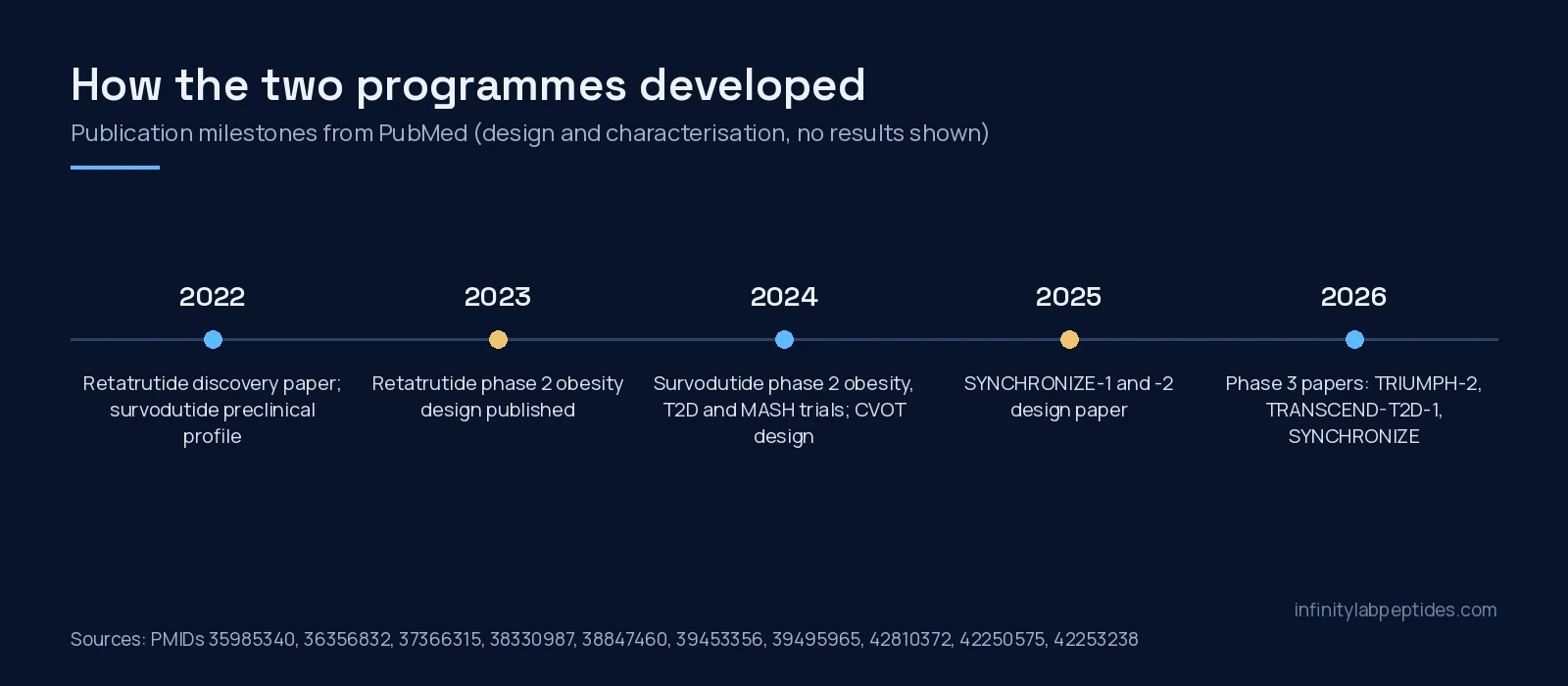
Regulatory status
Both are investigational. The 2026 phase 3 papers describe survodutide as an investigational dual agonist and retatrutide as under investigation [22],[4]. Neither should be described as an approved medicine, and nothing here suggests otherwise.
What the evidence does not show
- A head-to-head trial. We found no study comparing retatrutide and survodutide directly, so any ranking between them rests on cross-trial comparison with different populations, durations and endpoints.
- Whether the GIP arm or the glucagon-to-GLP-1 balance explains differences between them. Reviewers note that clinical data on glucagon-receptor agonism itself are limited [11].
- Long-term cardiovascular outcomes for either compound; for survodutide the dedicated trial was still enrolling when its design was published [6].
- That mouse and hamster findings translate directly. The survodutide brain study and the retatrutide MASH models were rodent work, and in the hamster model liver histology did not change [12],[13].
- Anything about products bought outside clinical supply. A 2026 Australian study examined the composition and labelling accuracy of products sold as retatrutide, which is why batch documentation matters [24].
Notes for a research buyer
If your work needs the three-receptor profile, retatrutide is the only one of the two we stock, and its batch report can be checked with the key above. If your question is specifically about GCGR plus GLP-1R without GIP, survodutide is the literature reference point, but we do not list it. For other compounds in our catalogue and their documentation, see where to buy research peptides in Canada.
Frequently asked questions
What is the main difference between retatrutide and survodutide?
Retatrutide activates three receptors (glucagon, GIP and GLP-1). Survodutide activates two (glucagon and GLP-1) and has no GIP component.
Are retatrutide and survodutide approved drugs?
No. Both are investigational. Their 2026 phase 3 publications describe survodutide as investigational and retatrutide as under investigation.
How are their half-lives extended?
Both carry a fatty-acid chain. Retatrutide has a C20 diacid on a lysine side chain (FDA GSRS) and showed a half-life of about 6 days in a phase 1b study; survodutide’s developers describe a C18 fatty acid as its half-life extending principle.
Has survodutide been tested against retatrutide?
We found no head-to-head study. Survodutide has been compared with placebo and, in one phase 2 trial, an open-label semaglutide arm.
Does Infinity Lab Peptides post a COA for retatrutide?
Yes. GLP-3 and Retatrutide (Pen) share one Janoshik report: batch APR260001010, purity 99.479%, analysed 14 APR 2026, verification key 38J43C11UNXY. We do not list survodutide.
References
- Coskun T, Urva S, Roell WC et al. (2022). LY3437943, a novel triple glucagon, GIP, and GLP-1 receptor agonist for glycemic control and weight loss: From discovery to clinical proof of concept. Cell Metab. PMID: 35985340. doi: 10.1016/j.cmet.2022.07.013.
- Zimmermann T, Thomas L, Baader-Pagler T et al. (2022). BI 456906: Discovery and preclinical pharmacology of a novel GCGR/GLP-1R dual agonist with robust anti-obesity efficacy. Mol Metab. PMID: 36356832. doi: 10.1016/j.molmet.2022.101633.
- Bajaj HS, Welch M, Shah P et al. (2026). Efficacy and safety of retatrutide, a GIP, GLP-1, and glucagon receptor agonist, in people with type 2 diabetes and inadequate glycaemic control with diet and exercise (TRANSCEND-T2D-1): a double-blind, randomised, phase 3 trial. Lancet. PMID: 42250575. doi: 10.1016/S0140-6736(26)00967-0.
- Bellido V, le Roux CW, Ekinci EI et al. (2026). Retatrutide in adults with obesity and type 2 diabetes (TRIUMPH-2): a double-blind, parallel-group, randomised, placebo-controlled, phase 3 trial. Lancet. PMID: 42810372. doi: 10.1016/S0140-6736(26)01861-1.
- Kaplan LM, Startseva E, le Roux CW et al. (2026). Survodutide in adults with obesity and metabolic dysfunction-associated steatotic liver disease: SYNCHRONIZE-MASLD, a randomized, double-blind, placebo-controlled phase 3 trial. Nat Med. PMID: 42252333. doi: 10.1038/s41591-026-04479-3.
- Kosiborod MN, Platz E, Wharton S et al. (2024). Survodutide for the Treatment of Obesity: Rationale and Design of the SYNCHRONIZE Cardiovascular Outcomes Trial. JACC Heart Fail. PMID: 39453356. doi: 10.1016/j.jchf.2024.09.004.
- Li W, Zhou Q, Cong Z et al. (2024). Structural insights into the triple agonism at GLP-1R, GIPR and GCGR manifested by retatrutide. Cell Discov. PMID: 39019866. doi: 10.1038/s41421-024-00700-0.
- Urva S, O’Farrell L, Du Y et al. (2023). The novel GIP, GLP-1 and glucagon receptor agonist retatrutide delays gastric emptying. Diabetes Obes Metab. PMID: 37311727. doi: 10.1111/dom.15167.
- Thomas L, Martel E, Rist W et al. (2024). The dual GCGR/GLP-1R agonist survodutide: Biomarkers and pharmacological profiling for clinical candidate selection. Diabetes Obes Metab. PMID: 38560764. doi: 10.1111/dom.15551.
- Kushner PR, Michos ED (2026). Cardiovascular Effects of Glucagon Receptor Signaling Alone and Combined With Glucagon-Like Peptide-1 Receptor Signaling in Multiagonists: A Narrative Review With a Translational Focus. J Am Heart Assoc. PMID: 42535526. doi: 10.1161/JAHA.126.049727.
- Elmendorf AJ, Yousefian M, Kim IM et al. (2026). IUPHAR review: From foe to friend: Repurposing glucagon to treat obesity and type 2 diabetes. Pharmacol Res. PMID: 41478576. doi: 10.1016/j.phrs.2025.108077.
- Zimmermann T, Bleymehl K, Haebel P et al. (2026). Survodutide acts through circumventricular organs in the brain and activates neuronal regions associated with appetite regulation. Mol Metab. PMID: 41638399. doi: 10.1016/j.molmet.2026.102326.
- Briand F, Le Cudennec C, Grasset E et al. (2026). Retatrutide Shows Multiple Metabolic Benefits in Diet-Induced Obese MASH Mouse and Hamster Models. Obesity (Silver Spring). PMID: 41741376. doi: 10.1002/oby.70155.
- Urva S, Coskun T, Loh MT et al. (2022). LY3437943, a novel triple GIP, GLP-1, and glucagon receptor agonist in people with type 2 diabetes: a phase 1b, multicentre, double-blind, placebo-controlled, randomised, multiple-ascending dose trial. Lancet. PMID: 36354040. doi: 10.1016/S0140-6736(22)02033-5.
- Lawitz EJ, Fraessdorf M, Neff GW et al. (2024). Efficacy, tolerability and pharmacokinetics of survodutide, a glucagon/glucagon-like peptide-1 receptor dual agonist, in cirrhosis. J Hepatol. PMID: 38857788. doi: 10.1016/j.jhep.2024.06.003.
- Jastreboff AM, Kaplan LM, Frías JP et al. (2023). Triple-Hormone-Receptor Agonist Retatrutide for Obesity – A Phase 2 Trial. N Engl J Med. PMID: 37366315. doi: 10.1056/NEJMoa2301972.
- Sanyal AJ, Kaplan LM, Frias JP et al. (2024). Triple hormone receptor agonist retatrutide for metabolic dysfunction-associated steatotic liver disease: a randomized phase 2a trial. Nat Med. PMID: 38858523. doi: 10.1038/s41591-024-03018-2.
- Blüher M, Rosenstock J, Hoefler J et al. (2024). Dose-response effects on HbA(1c) and bodyweight reduction of survodutide, a dual glucagon/GLP-1 receptor agonist, compared with placebo and open-label semaglutide in people with type 2 diabetes: a randomised clinical trial. Diabetologia. PMID: 38095657. doi: 10.1007/s00125-023-06053-9.
- le Roux CW, Steen O, Lucas KJ et al. (2024). Glucagon and GLP-1 receptor dual agonist survodutide for obesity: a randomised, double-blind, placebo-controlled, dose-finding phase 2 trial. Lancet Diabetes Endocrinol. PMID: 38330987. doi: 10.1016/S2213-8587(23)00356-X.
- Sanyal AJ, Bedossa P, Fraessdorf M et al. (2024). A Phase 2 Randomized Trial of Survodutide in MASH and Fibrosis. N Engl J Med. PMID: 38847460. doi: 10.1056/NEJMoa2401755.
- Wharton S, le Roux CW, Kosiborod MN et al. (2025). Survodutide for treatment of obesity: rationale and design of two randomized phase 3 clinical trials (SYNCHRONIZE™-1 and -2). Obesity (Silver Spring). PMID: 39495965. doi: 10.1002/oby.24184.
- le Roux CW, Wharton S, Startseva E et al. (2026). Survodutide Once Weekly for the Treatment of Adults with Obesity. N Engl J Med. PMID: 42253238. doi: 10.1056/NEJMoa2600751.
- Wharton S, le Roux CW, Startseva E et al. (2026). Survodutide Once Weekly in Adults with Obesity and Type 2 Diabetes. N Engl J Med. PMID: 42820639. doi: 10.1056/NEJMoa2607219.
- Piatkowski T, Craven A, Cornell S et al. (2026). Composition and Labelling Accuracy of Products Sold as Retatrutide in Australia. Drug Alcohol Rev. PMID: 42559975. doi: 10.1111/dar.70231.