For laboratory research only. Not for human or animal use. This article gives no dosing, administration or therapeutic advice.
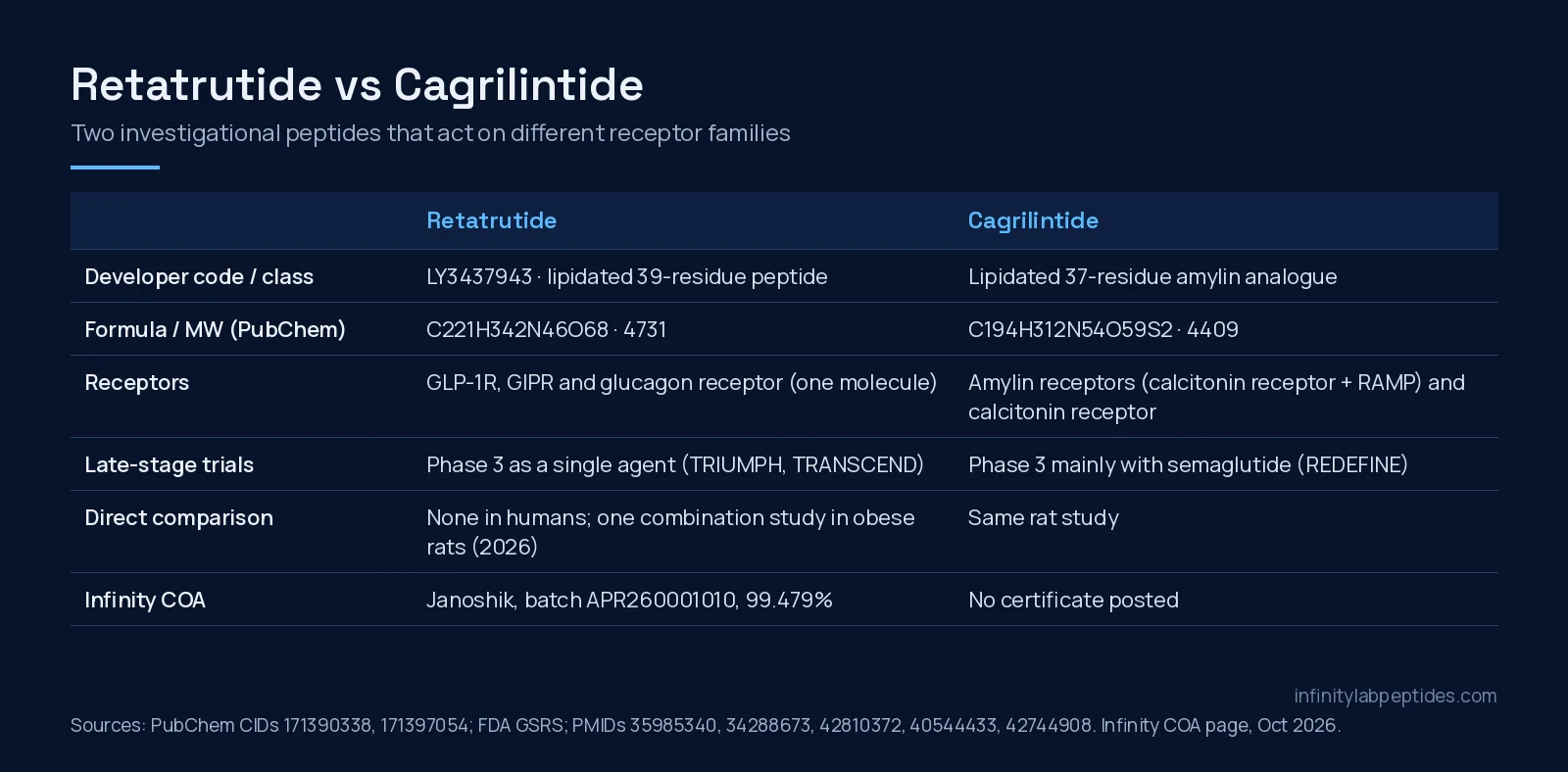
Short answer: retatrutide and cagrilintide are both long-acting, fatty-acid-modified peptides in metabolic research, and both are investigational. They act on different receptor families. Retatrutide (LY3437943) is one molecule that activates three receptors, those for GLP-1, GIP and glucagon [1]. Cagrilintide is an amylin analogue that acts at amylin receptors and the calcitonin receptor [3][12]. Retatrutide’s late-stage trials test it on its own [9][8]; cagrilintide’s test it mostly in combination with semaglutide [15][16]. The only study we found that put the two together was in obese rats [2].
Spec cards from our COA library
Retatrutide (GLP-3)
Purity: 99.479%
Batch: APR260001010
Analysis date: 14 APR 2026
Lab: Janoshik
Verification key: 38J43C11UNXY
Listings: GLP-3, Retatrutide pen
The same report is listed for both entries on our COA page; it documents one batch, not each format separately.
Cagrilintide
Purity: not shown
Batch: not shown
Analysis date: not shown
Lab: not shown
Listing: Cagrilintide 10 mg
No certificate is posted for this product on our COA page at the time of writing.
Identity at a glance
Values come from PubChem and the FDA Global Substance Registration System (GSRS), not from certificates. PubChem’s compound record for retatrutide carries the title “Triple G”; substance records deposited under the name retatrutide map to that same compound.
| Field | Retatrutide | Cagrilintide |
|---|---|---|
| Other names | LY3437943, LY-3437943 | Long-acting amylin analogue (“analogue 23” in its development paper) |
| Peptide backbone (GSRS) | 39 residues: YAQGTFTSDYSILLDKKAQAAFIEYLLEGGPSSGAPPPS, with non-standard residues (2-methylalanine, alpha-methyl-leucine) and a C-terminal serinamide | 37 residues: KCNTATCATQRLAEFLRHSSNNFGPILPPTNVGSNTP, C-terminal prolinamide, one disulfide bridge |
| Fatty-acid modification | C20 diacid (19-carboxy-1-oxononadecyl) on a lysine side chain via a gamma-glutamyl and linker spacer | C20 diacid (19-carboxy-1-oxononadecyl) via gamma-glutamyl on the N-terminus |
| Molecular formula (PubChem) | C221H342N46O68 | C194H312N54O59S2 |
| Molecular weight (PubChem) | 4731 g/mol | 4409 g/mol |
| CAS (PubChem synonym) | not listed on the compound record | 1415456-99-3 |
| PubChem CID | 171390338 | 171397054 |
| FDA UNII | NOP2Y096GV | AO43BIF1U8 |
Both molecules carry the same kind of C20 fatty diacid side chain, the lipidation that cagrilintide’s developers tied to its long-acting profile [3]. What differs is the peptide underneath, and therefore which receptors it reaches.
Retatrutide: one peptide, three receptors
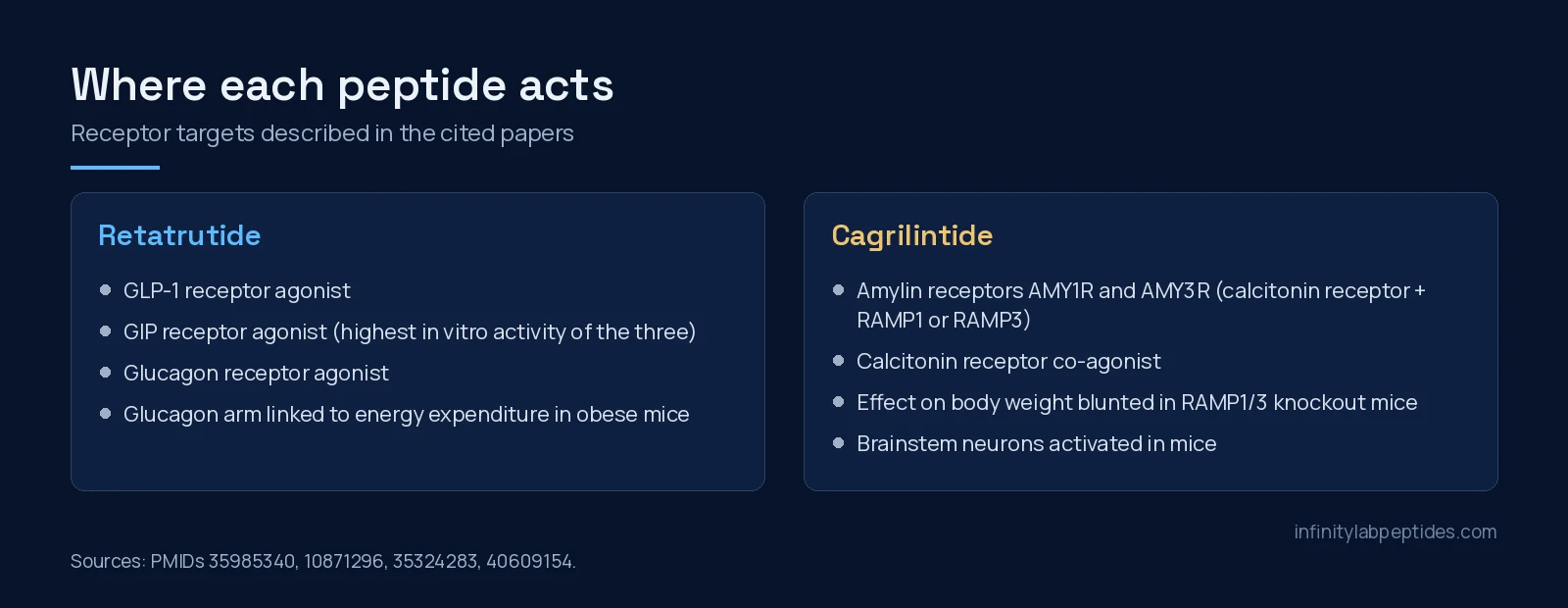
Retatrutide was described in 2022 as a triple agonist at the glucagon receptor (GCGR), the GIP receptor (GIPR) and the GLP-1 receptor (GLP-1R). In cell assays it showed balanced GCGR and GLP-1R activity with more GIPR activity. In obese mice it decreased body weight and improved glycaemic control, and the authors attributed part of the weight effect to glucagon-receptor-driven increases in energy expenditure, on top of GIPR- and GLP-1R-driven reductions in calorie intake [1]. A phase 1b multiple-ascending-dose study in people with type 2 diabetes then examined safety, pharmacokinetics and pharmacodynamics over 12 weeks [4].
Phase 2 trials followed in obesity [5] and in type 2 diabetes, the latter with placebo and dulaglutide as comparators [6], plus a liver-fat substudy in participants with metabolic dysfunction-associated steatotic liver disease [7]. Phase 3 results began appearing in 2026, including a 40-week monotherapy trial in type 2 diabetes [8] and an 80-week trial in adults with obesity and type 2 diabetes [9]. The TRIUMPH-2 report describes retatrutide as still under investigation for obesity, type 2 diabetes and other conditions [9].
Cagrilintide: a long-acting amylin analogue
Amylin is a pancreatic hormone that is hard to turn into a research tool because it readily forms amyloid fibrils. The earlier analogue pramlintide has a short half-life. Cagrilintide was developed as a stable, lipidated, long-acting amylin analogue and selected for clinical development with obesity as the indication [3].
Its receptors are more complicated than retatrutide’s. Amylin does not have one dedicated receptor gene; the calcitonin receptor (CTR) becomes a high-affinity amylin receptor when it pairs with receptor activity-modifying protein 1 or 3 (RAMP1 or RAMP3), as shown in transfected cell lines [10]. Cryo-EM structures later showed that amylin and calcitonin-based peptides engage these receptor complexes in distinct ways [11]. Cagrilintide is described as a dual amylin and calcitonin receptor agonist. In high-fat-fed mice lacking RAMP1 and RAMP3, its effect on body weight was blunted, which points to the AMY1 and AMY3 receptors as the route for that effect in mice [12].
In people, the program moved from a phase 1b study of cagrilintide combined with semaglutide [13] to a phase 2 dose-finding trial of cagrilintide alone, with liraglutide and placebo as comparators, across 57 sites in ten countries including Canada [14]. The phase 3 REDEFINE trials test the fixed combination with semaglutide in adults with obesity [15], adults with obesity and type 2 diabetes [16], and an East Asian population against semaglutide alone [17].
The only direct comparison: obese rats, 2026
We found one paper that studied the two compounds together. In diet-induced obese male rats, combining retatrutide with cagrilintide reduced body weight and food intake in a dose-dependent way, more than equimolar monotherapy with either and more than matched combinations built on semaglutide or tirzepatide. Pair-feeding and weight-matching experiments indicated that reduced food intake alone did not explain the added weight loss [2]. This is a single preclinical study in male rats, published in September 2026. It does not tell us how the combination behaves in people, and no human trial of the pair appears on PubMed.
Trial designs side by side (design and endpoints only)
This table lists how the main human studies were built and what they set out to measure. It deliberately leaves out results: efficacy figures from trials of investigational drugs are not product claims, and the studies tested specific clinical formulations under medical supervision, not research materials.
| Study | Compound(s) | Design | Population | Primary endpoint |
|---|---|---|---|---|
| Phase 1b, 2022 [4] | Retatrutide | Randomised, double-blind, placebo-controlled, multiple ascending dose; 12 weeks; dulaglutide arm | Adults with type 2 diabetes, 4 US centres | Safety and tolerability |
| Phase 2 obesity, 2023 [5] | Retatrutide | Randomised, double-blind, placebo-controlled; 48 weeks | 338 adults with obesity, or overweight plus a weight-related condition | Percentage change in body weight at 24 weeks |
| Phase 2 T2D, 2023 [6] | Retatrutide | Randomised, double-blind, placebo- and dulaglutide-controlled; 36 weeks | 281 adults with type 2 diabetes, 42 US centres | Change in HbA1c at 24 weeks |
| TRANSCEND-T2D-1, 2026 [8] | Retatrutide | Phase 3, randomised, double-blind, placebo-controlled; 40 weeks | 537 adults with type 2 diabetes on diet and exercise alone (USA, Mexico, India) | Change in HbA1c at week 40 |
| TRIUMPH-2, 2026 [9] | Retatrutide | Phase 3, randomised, double-blind, placebo-controlled; 80 weeks; 92 centres in eight countries | 1,152 adults with obesity and type 2 diabetes | Percentage change in body weight at week 80 |
| Phase 1b, 2021 [13] | Cagrilintide with semaglutide | Randomised, placebo-controlled, multiple ascending dose; six sequential cohorts | 96 otherwise healthy adults with overweight or obesity, one US centre | Safety and tolerability |
| Phase 2, 2021 [14] | Cagrilintide alone | Randomised, double-blind, placebo- and liraglutide-controlled dose-finding; 26 weeks | 706 adults without diabetes, 57 sites in 10 countries incl. Canada | Percentage change in body weight at week 26 |
| REDEFINE 1, 2025 [15] | Cagrilintide with semaglutide | Phase 3a, double-blind, placebo- and active-controlled (each component alone); 68 weeks | 3,417 adults without diabetes with obesity, or overweight plus a complication | Co-primary: change in body weight and reaching a 5% reduction, week 68 |
| REDEFINE 2, 2025 [16] | Cagrilintide with semaglutide | Phase 3a, double-blind, placebo-controlled; 68 weeks; 12 countries | 1,206 adults with type 2 diabetes and overweight or obesity | Co-primary: change in body weight and reaching a 5% reduction |
| REDEFINE 5, 2026 [17] | Cagrilintide with semaglutide vs semaglutide | Phase 3a, double-blind, active-controlled; 68 weeks | 331 adults in Japan and Taiwan with or without type 2 diabetes | Relative change in body weight at week 68 |
Two things stand out. First, no trial compares retatrutide with cagrilintide. Second, almost everything known about cagrilintide in people at phase 3 comes from studies where it was given with semaglutide, so its separate contribution has to be read from the trial arms that gave it alone [14][15].
Mixed and null findings
- Not every retatrutide arm separated from placebo or the comparator. In the phase 2 type 2 diabetes trial, the HbA1c change in the lowest-dose retatrutide group was not significantly different from placebo, and only the two highest-dose groups showed a significantly greater HbA1c change than dulaglutide [6].
- Cagrilintide depends on specific amylin receptors in mice. Without RAMP1 and RAMP3 its potency on body weight fell, and after three weeks of treatment neither cagrilintide nor salmon calcitonin significantly changed gene expression in two brainstem regions of normal mice [12].
- Calcitonin-type agonists are not interchangeable. In the same knockout study, salmon calcitonin increased body weight in wild-type mice over the treatment period, while cagrilintide reduced it [12]; structural work also shows amylin- and calcitonin-based peptides activate these receptors differently [11].
- Adding cagrilintide did not change the adverse-event picture in phase 1b. Every participant in that study received semaglutide; the proportion with at least one adverse event was similar whether cagrilintide or placebo was added, most events were mild to moderate, gastrointestinal disorders were the largest category, and cagrilintide did not affect semaglutide exposure or elimination [13].
- Retatrutide tolerability in phase 2. Mild-to-moderate gastrointestinal adverse events such as nausea, diarrhoea, vomiting and constipation were the main events reported in the type 2 diabetes trial [6].
What the evidence does not show
- No human head-to-head data. No trial on PubMed compares retatrutide with cagrilintide or tests them together in people. The one combination study used male rats [2].
- No approval for either as a standalone medicine in the papers cited. The 2026 phase 3 reports still describe retatrutide as under investigation or clinical development [9][8], and cagrilintide’s development paper and phase 2 trial describe it as investigational [3][14]. Regulatory status changes; check the regulator directly rather than relying on any vendor page, including ours.
- Combination results are not cagrilintide results. REDEFINE outcomes describe cagrilintide given with semaglutide [15][16]. They cannot be assigned to cagrilintide alone, and still less to a combination with retatrutide.
- Receptor maps are not mechanisms in people. The glucagon-receptor link to energy expenditure comes from mouse work [1]; the AMY1/AMY3 dependence comes from knockout mice [12].
- Trial outcomes do not transfer to research materials. The trials used manufacturer-made clinical formulations under medical oversight. A research-grade vial with a purity certificate is a different thing, and a certificate says nothing about biological activity.
What our documentation covers
For two lipidated peptides of roughly 4.4 to 4.7 kDa, a useful certificate should report chromatographic purity and a mass consistent with the expected molecular weight, because a missing fatty-acid chain or a truncated sequence would change that mass. Our COA page lists Janoshik batch APR260001010 for the GLP-3 and retatrutide pen entries (99.479%, analysed 14 APR 2026, verification key 38J43C11UNXY). No certificate is posted for Cagrilintide 10 mg at the time of writing. Our metabolic research peptides page groups the related listings, and researchers comparing suppliers can buy research peptides in Canada with the documentation status of each product stated on its page.
Frequently asked questions
What is the main difference between retatrutide and cagrilintide?
Retatrutide is a single peptide that activates GLP-1, GIP and glucagon receptors. Cagrilintide is a long-acting amylin analogue that acts at amylin receptors, which are calcitonin receptor and RAMP complexes, and at the calcitonin receptor. They belong to different hormone families.
Are retatrutide and cagrilintide approved drugs?
The papers we cite describe both as investigational. Retatrutide’s 2026 phase 3 reports describe it as under clinical development, and cagrilintide’s late-stage trials test it mainly in combination with semaglutide. Check a regulator’s own database for current status.
Has retatrutide been compared directly with cagrilintide?
Not in people. The only study we found that tested them together was a 2026 study in diet-induced obese male rats, which examined the combination against each compound alone and against semaglutide- or tirzepatide-based combinations.
Why are most cagrilintide trials combined with semaglutide?
Its phase 3 REDEFINE program was built around the fixed combination known as CagriSema. Cagrilintide alone was tested in a phase 2 dose-finding trial against placebo and liraglutide, so separate data on it come mainly from that trial and from single-agent arms.
Does Infinity Lab Peptides post a COA for retatrutide and cagrilintide?
Our COA page lists one Janoshik report for the GLP-3 and retatrutide pen entries: batch APR260001010, 99.479%, analysed 14 APR 2026. No certificate is posted for Cagrilintide 10 mg at the time of writing.
Research-use notice
Retatrutide (GLP-3) and cagrilintide from Infinity Lab Peptides are sold for laboratory research and analytical use only. They are not for human or animal consumption. This article summarises published research as reported by its authors; it is not medical advice and makes no claim about any product’s effects.
References
- Coskun T, Urva S, Roell WC et al. (2022). LY3437943, a novel triple glucagon, GIP, and GLP-1 receptor agonist for glycemic control and weight loss: From discovery to clinical proof of concept. Cell Metab. PMID: 35985340. doi: 10.1016/j.cmet.2022.07.013.
- Petersen J, Merrild C, Holm SK et al. (2026). Cagrilintide and retatrutide combination therapy enhances weight loss and metabolic outcomes in obese male rats. Nat Metab. PMID: 42744908. doi: 10.1038/s42255-026-01603-y.
- Kruse T, Hansen JL, Dahl K et al. (2021). Development of Cagrilintide, a Long-Acting Amylin Analogue. J Med Chem. PMID: 34288673. doi: 10.1021/acs.jmedchem.1c00565.
- Urva S, Coskun T, Loh MT et al. (2022). LY3437943, a novel triple GIP, GLP-1, and glucagon receptor agonist in people with type 2 diabetes: a phase 1b, multicentre, double-blind, placebo-controlled, randomised, multiple-ascending dose trial. Lancet. PMID: 36354040. doi: 10.1016/S0140-6736(22)02033-5.
- Jastreboff AM, Kaplan LM, Frías JP et al. (2023). Triple-Hormone-Receptor Agonist Retatrutide for Obesity – A Phase 2 Trial. N Engl J Med. PMID: 37366315. doi: 10.1056/NEJMoa2301972.
- Rosenstock J, Frias J, Jastreboff AM et al. (2023). Retatrutide, a GIP, GLP-1 and glucagon receptor agonist, for people with type 2 diabetes: a randomised, double-blind, placebo and active-controlled, parallel-group, phase 2 trial conducted in the USA. Lancet. PMID: 37385280. doi: 10.1016/S0140-6736(23)01053-X.
- Sanyal AJ, Kaplan LM, Frias JP et al. (2024). Triple hormone receptor agonist retatrutide for metabolic dysfunction-associated steatotic liver disease: a randomized phase 2a trial. Nat Med. PMID: 38858523. doi: 10.1038/s41591-024-03018-2.
- Bajaj HS, Welch M, Shah P et al. (2026). Efficacy and safety of retatrutide, a GIP, GLP-1, and glucagon receptor agonist, in people with type 2 diabetes and inadequate glycaemic control with diet and exercise (TRANSCEND-T2D-1): a double-blind, randomised, phase 3 trial. Lancet. PMID: 42250575. doi: 10.1016/S0140-6736(26)00967-0.
- Bellido V, le Roux CW, Ekinci EI et al. (2026). Retatrutide in adults with obesity and type 2 diabetes (TRIUMPH-2): a double-blind, parallel-group, randomised, placebo-controlled, phase 3 trial. Lancet. PMID: 42810372. doi: 10.1016/S0140-6736(26)01861-1.
- Tilakaratne N, Christopoulos G, Zumpe ET et al. (2000). Amylin receptor phenotypes derived from human calcitonin receptor/RAMP coexpression exhibit pharmacological differences dependent on receptor isoform and host cell environment. J Pharmacol Exp Ther. PMID: 10871296.
- Cao J, Belousoff MJ, Liang YL et al. (2022). A structural basis for amylin receptor phenotype. Science. PMID: 35324283. doi: 10.1126/science.abm9609.
- Carvas AO, Leuthardt A, Kulka P et al. (2025). Cagrilintide lowers bodyweight through brain amylin receptors 1 and 3. EBioMedicine. PMID: 40609154. doi: 10.1016/j.ebiom.2025.105836.
- Enebo LB, Berthelsen KK, Kankam M et al. (2021). Safety, tolerability, pharmacokinetics, and pharmacodynamics of concomitant administration of multiple doses of cagrilintide with semaglutide 2·4 mg for weight management: a randomised, controlled, phase 1b trial. Lancet. PMID: 33894838. doi: 10.1016/S0140-6736(21)00845-X.
- Lau DCW, Erichsen L, Francisco AM et al. (2021). Once-weekly cagrilintide for weight management in people with overweight and obesity: a multicentre, randomised, double-blind, placebo-controlled and active-controlled, dose-finding phase 2 trial. Lancet. PMID: 34798060. doi: 10.1016/S0140-6736(21)01751-7.
- Garvey WT, Blüher M, Osorto Contreras CK et al. (2025). Coadministered Cagrilintide and Semaglutide in Adults with Overweight or Obesity. N Engl J Med. PMID: 40544433. doi: 10.1056/NEJMoa2502081.
- Davies MJ, Bajaj HS, Broholm C et al. (2025). Cagrilintide-Semaglutide in Adults with Overweight or Obesity and Type 2 Diabetes. N Engl J Med. PMID: 40544432. doi: 10.1056/NEJMoa2502082.
- Yamauchi T, Becker NP, Hagemann CA et al. (2026). Efficacy and safety of co-administered cagrilintide and semaglutide versus semaglutide alone in adults with overweight or obesity with or without type 2 diabetes in Japan and Taiwan (REDEFINE 5): a multicentre, randomised, active-controlled, phase 3a trial. Lancet Diabetes Endocrinol. PMID: 42009015. doi: 10.1016/S2213-8587(25)00402-4.