For laboratory research only. Not for human or animal use. This article gives no dosing, administration or therapeutic advice.
Short answer: thymosin alpha-1 and TB-500 share a word and a source, not a family. Both trace back to calf “thymosin fraction 5”, a thymus extract that turned out to be a mixture of unrelated small peptides [1][2]. Thymosin alpha-1 is a highly acidic 28-residue peptide cut from the front end of prothymosin alpha [3], and most of its literature is about immune signalling. TB-500 is named after thymosin beta-4, a 43-residue protein whose best-known job is holding actin monomers in reserve inside cells [4][5]; when doping chemists analysed products sold as TB-500, the active ingredient was a seven-residue fragment of that protein [6][7]. The handful of studies that put alpha-1 and beta-4 into the same assay found they did not always push immune cells in the same direction [8].
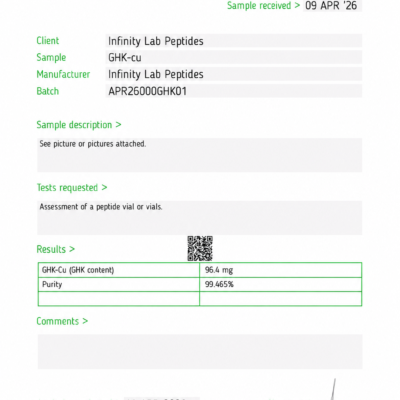
Spec cards from our COA library
Thymosin Alpha-1
Purity: not shown
Batch: not shown
Analysis date: not shown
Lab: not shown
Listing: Thymosin Alpha-1 10 mg
No certificate is posted for this product on our COA page at the time of writing.
TB-500
Purity: 99.766%
Batch: APR26000TB501
Analysis date: 14 APR 2026
Lab: Janoshik
Verification key: I91213lJ443S
Listing: TB-500 10 mg
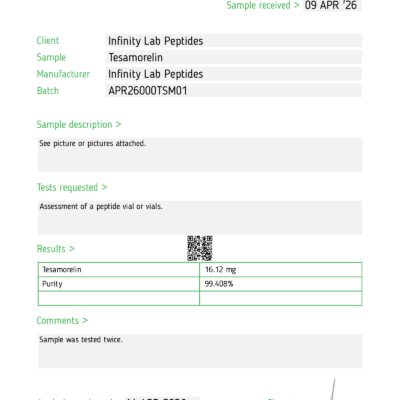
The library card reports purity, batch and key. It does not state a mass, so open the full report to see which molecule the lab identified.
We leave the alpha-1 card blank rather than borrow a number from another product. If a certificate is added, this section will be updated.
Identity: three molecules behind two names
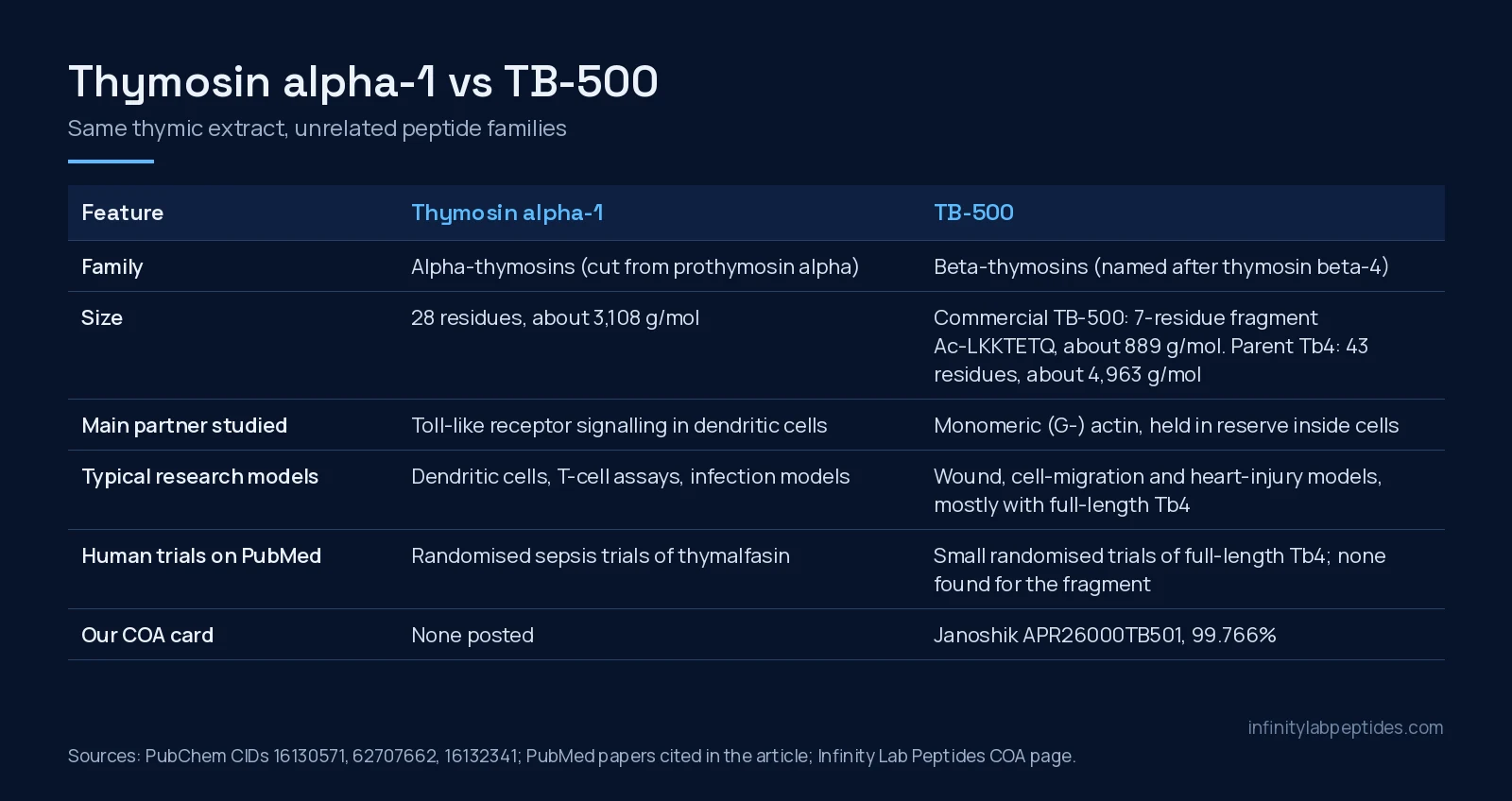
“TB-500” needs two columns, because the name is used for a short synthetic fragment while most of the biology was done on the full protein it comes from. Values are PubChem’s; the beta-4 sequence is the mature human chain.
| Field | Thymosin alpha-1 | TB-500 (fragment) | Thymosin beta-4 (parent) |
|---|---|---|---|
| Other names (PubChem) | Thymalfasin, thymosin alpha1 (human), Zadaxin | TB500, TB 500 acetate, Ac-Leu-Lys-Lys-Thr-Glu-Thr-Gln-OH | Timbetasin, thymosin beta4, Fx peptide |
| Length | 28 residues, N-acetylated | 7 residues, N-acetylated | 43 residues, N-acetylated |
| Sequence | Ac-SDAAVDTSSEITTKDLKEKKEVVEEAEN | Ac-LKKTETQ (beta-4 residues 17 to 23) | Ac-SDKPDMAEIEKFDKSKLKKTETQEKNPLPSKETIEQEKQAGES |
| Molecular formula | C129H215N33O55 | C38H68N10O14 | C212H350N56O78S |
| Molecular weight | 3108.3 g/mol | 889.0 g/mol | 4963 g/mol |
| CAS (PubChem synonym) | 62304-98-7 | 885340-08-9 | 77591-33-4 |
| PubChem CID | 16130571 | 62707662 | 16132341 |
| FDA UNII | W0B22ISQ1C | QHK6Z47GTG | 2D5MRE3SSY |
| Precursor in the body | Prothymosin alpha | None; a synthetic segment | Not cut from a larger precursor |
Put the sequences next to each other and there is nothing to line up: alpha-1 is packed with glutamate and aspartate, while the beta-4 chain carries the lysine-rich LKKTETQ motif in its middle. The shared word “thymosin” is a label from the 1970s, not a structural relationship.
One extract, two unrelated families
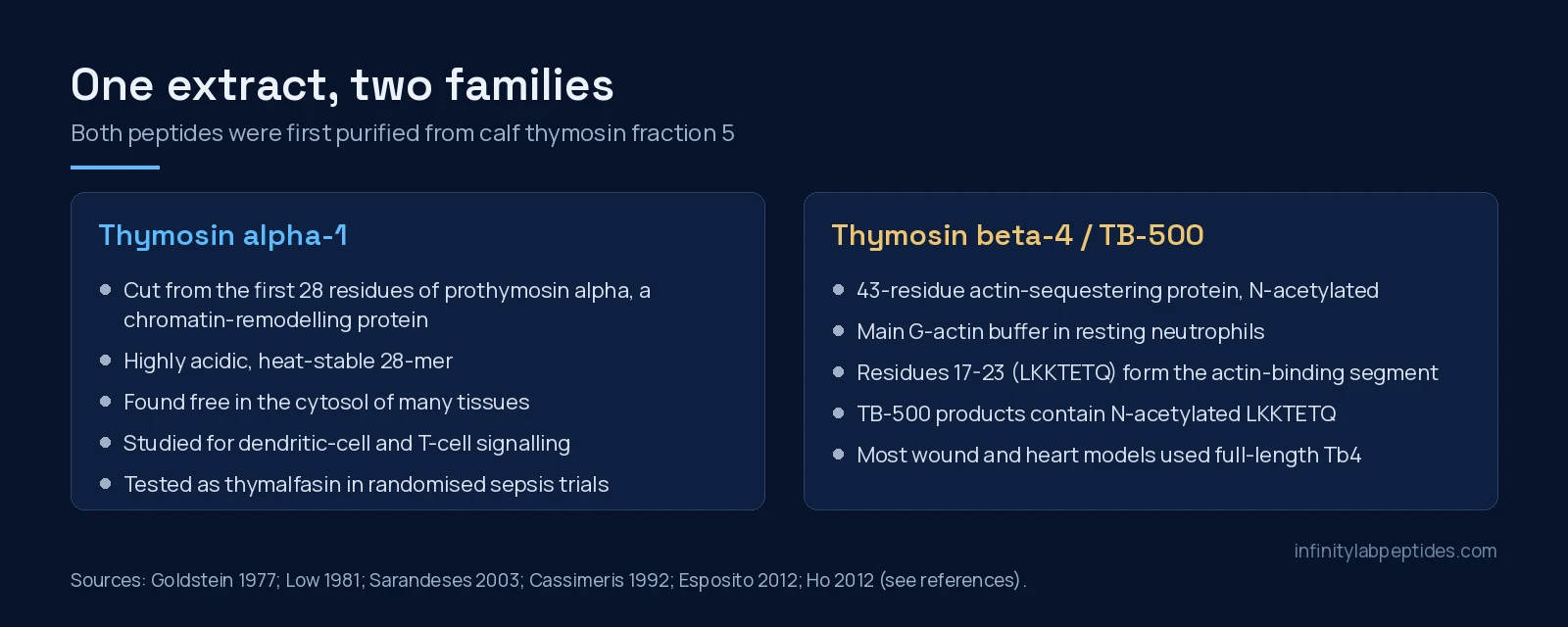
The thymosin story began in 1965, when A. White’s group went looking for thymic factors and prepared a standardised bovine thymus extract called thymosin fraction 5. Later work separated that extract into several distinct peptides, among them thymosin alpha-1, prothymosin alpha, parathymosin and thymosin beta-4. A 2003 review of that work concluded that none of the isolated peptides is really a thymic hormone, but that they are biologically important molecules with diverse jobs inside and outside cells [2].
The 1977 paper that sequenced thymosin alpha-1 described it as heat-stable and highly acidic, one of several fraction 5 peptides that might take part in T-cell differentiation, and it proposed a naming scheme for the whole fraction 5 family [1]. Four years later the same laboratory sequenced bovine thymosin beta-4: 43 residues, an acetylated N-terminus and an isoelectric point of 5.1 [4]. Shared origin, shared lab, shared surname, but two separate molecules.
Their origins in the cell differ too. Thymosin alpha-1 corresponds to the first 28 residues of prothymosin alpha, a protein involved in chromatin remodelling. For years it was suspected to be an extraction artefact; a 2003 study showed that the lysosomal protease legumain cuts prothymosin alpha at an asparagine-glycine bond to release it, and that alpha-1 is found free in the cytosol of many mammalian tissues [3]. Thymosin beta-4, by contrast, binds monomeric actin and stops it from polymerising. In resting human neutrophils it was the main G-actin sequestering protein, and the authors’ data fit a model in which it lets go of actin as filaments form after chemoattractant stimulation [5].
Thymosin alpha-1: an immune-signalling peptide
Most mechanistic work on alpha-1 looks at dendritic cells. In a 2004 study, it drove maturation and interleukin-12 production in fungus-pulsed dendritic cells through p38 MAP kinase and NF-kappaB, via the MyD88-dependent Toll-like-receptor pathway. In mice given haematopoietic transplants, the synthetic peptide activated Th1-dependent antifungal immunity, sped up myeloid recovery and protected against aspergillosis [9].
Alpha-1 is also one of the few research peptides with large randomised human trials, run with the drug thymalfasin rather than research material. The ETASS trial in 361 patients with severe sepsis saw lower 28-day mortality in the treated group, but the difference was marginal and missed conventional significance in its non-stratified analysis [10]. The larger double-blind, placebo-controlled TESTS trial randomised 1,106 adults with sepsis and found no difference in 28-day all-cause mortality, and no secondary or safety outcome differed significantly [11].
TB-500 and thymosin beta-4: an actin-binding protein and its fragment
The beta-4 literature is mostly about cell movement and tissue repair, and most of it used the full 43-residue protein:
- Skin wounds in rats (1999). Topical or intraperitoneal beta-4 increased re-epithelialisation and wound contraction in a full-thickness wound model, with more collagen deposition and angiogenesis; it also stimulated keratinocyte migration in a chamber assay [12].
- Heart injury in mice (2004). Beta-4 formed a complex with PINCH and integrin-linked kinase, activating the survival kinase Akt; after coronary artery ligation, treated mice showed better early cardiomyocyte survival and cardiac function [13].
- The fragment itself (2003). In aged mice with delayed healing, a synthetic seven-residue LKKTETQ peptide, the actin-binding domain of beta-4, promoted wound repair comparably to the parent molecule [14]. Note that this was the unacetylated segment, not the N-acetylated form found in TB-500 products.
Where does the name TB-500 come from? Doping-control papers. A 2012 study identified the N-terminally acetylated 17-23 fragment (Ac-LKKTETQ) in a TB-500 formulation by high-resolution mass spectrometry and synthesised it as a reference [6]. A second 2012 study described TB-500 as a veterinary preparation built on that peptide, called LKKTETQ the segment of beta-4 responsible for actin binding, cell migration and wound healing, and developed a method to detect it and its metabolites in horse urine and plasma [7].
Human work on full-length beta-4 consists of small trials: a European randomised, placebo-controlled, dose-escalation study of topical beta-4 in venous ulcers [15], and a nine-patient phase 2 trial of beta-4 eye drops in severe dry eye that reported statistically significant sign and symptom differences at several time points [16]. We found no human trial of the seven-residue fragment on PubMed.
The studies that tested both side by side
Because both peptides came out of fraction 5, immunologists in the late 1980s sometimes ran them in the same experiment. These are the only direct comparisons we found. All three used full-length beta-4, not the TB-500 fragment.
| Study | Model | Thymosin alpha-1 | Thymosin beta-4 |
|---|---|---|---|
| Mixed lymphocyte reaction, 1987 [8] | Human lymphocytes, allogeneic and autologous reactions | Enhanced proliferation, driven by T4+ (helper) cells | Suppressed proliferation; in co-culture it activated T8+ cells to suppress T4+ responses |
| Antigen presentation, 1989 [17] | Mouse macrophages pulsed with a test antigen, then T-cell readout | Increased antigen-presenting capacity, IL-2 secretion and IL-2 receptor expression | Same direction as alpha-1; neither raised IL-4 |
| Colonic lymphocytes, 1990 [18] | Lamina propria lymphocytes from 18 human colon specimens | Suppressed thymidine incorporation | Suppressed thymidine incorporation; neither changed responses to phorbol ester plus ionomycin |
The pattern is not “one boosts, one calms”. In the lymphocyte reaction the two pulled in opposite directions; in macrophage antigen presentation and in gut lymphocytes they moved the same way. What the comparison does show is that both peptides were biologically active in immune assays decades before beta-4 became known mainly as a repair molecule.
Regulatory status
Thymalfasin, the drug form of thymosin alpha-1, has been tested in randomised clinical trials [10][11]. Approval differs by country and changes over time, so check the regulator in the jurisdiction you care about, such as Health Canada’s Drug Product Database. Full-length thymosin beta-4 has reached only small clinical trials [15][16], and doping chemists describe TB-500 as a product suspected of doping potential [6]. Nothing here describes the research materials we sell, which are not medicines.
What the evidence does not show
- No study compares alpha-1 with the TB-500 fragment. The side-by-side papers are in-vitro immune assays from 1987 to 1990, and all used full-length beta-4 [8][17][18].
- Beta-4 results do not automatically transfer to the fragment. One mouse study tested unacetylated LKKTETQ [14]; the wound, heart and eye results above used the 43-residue protein.
- A shared name is not a shared mechanism. Alpha-1 is studied through Toll-like-receptor signalling [9]; beta-4 is defined by actin binding [5].
- The largest alpha-1 trial was neutral. TESTS found no mortality difference in sepsis [11], and those trials used manufacturer-made drug, not research material.
- A certificate documents a batch, not biology. Purity and mass tell you what is in the vial, not what it does.
What our documentation covers
For TB-500, the most useful number on any report is the identified mass: about 889 Da points to the acetylated seven-residue fragment, about 4,963 Da to full-length thymosin beta-4. Our COA page lists Janoshik batch APR26000TB501 for TB-500 10 mg (99.766%, analysed 14 APR 2026, verification key I91213lJ443S); open the full report for the mass. No certificate is posted yet for Thymosin Alpha-1 10 mg. For a longer look at the naming problem, see our TB-500 vs thymosin beta-4 comparison; researchers comparing suppliers can buy research peptides in Canada with the documentation status of each product stated on its page.
Frequently asked questions
Is thymosin alpha-1 the same as TB-500?
No. Thymosin alpha-1 is a 28-residue acidic peptide cut from prothymosin alpha. TB-500 is named after thymosin beta-4, a 43-residue actin-binding protein, and products sold as TB-500 were found to contain its seven-residue fragment Ac-LKKTETQ. The sequences are unrelated.
Why are both called thymosins?
Both were first purified from thymosin fraction 5, a calf thymus extract, and the 1977 alpha-1 paper proposed a naming scheme for the peptides in that extract. The shared name reflects where they were found, not a shared structure or mechanism.
What does each peptide mainly do in research models?
Thymosin alpha-1 is mostly studied for immune signalling, such as dendritic-cell maturation through Toll-like-receptor pathways. Thymosin beta-4 is defined by binding monomeric actin, and its studies focus on cell migration and wound and heart repair models.
Have thymosin alpha-1 and thymosin beta-4 been tested together?
Yes, in a few in-vitro immune studies from 1987 to 1990. In a human lymphocyte reaction alpha-1 enhanced proliferation while beta-4 suppressed it; in macrophage antigen presentation and colonic lymphocytes they acted in the same direction. None of these used the TB-500 fragment.
Does Infinity Lab Peptides post a COA for both?
Our COA page lists a Janoshik report for TB-500 (batch APR26000TB501, 99.766%, analysed 14 APR 2026, key I91213lJ443S). No certificate is posted yet for Thymosin Alpha-1 10 mg.
Research-use notice
Thymosin Alpha-1 and TB-500 from Infinity Lab Peptides are sold for laboratory research and analytical use only. They are not for human or animal consumption. This article summarises published research as reported by its authors; it is not medical advice and makes no claim about any product’s effects.
References
- Goldstein AL, Low TL, McAdoo M et al. (1977). Thymosin alpha1: isolation and sequence analysis of an immunologically active thymic polypeptide. Proc Natl Acad Sci U S A. PMID: 265536. doi: 10.1073/pnas.74.2.725.
- Hannappel E, Huff T (2003). The thymosins. Prothymosin alpha, parathymosin, and beta-thymosins: structure and function. Vitam Horm. PMID: 12852257. doi: 10.1016/s0083-6729(03)01007-0.
- Sarandeses CS, Covelo G, Díaz-Jullien C et al. (2003). Prothymosin alpha is processed to thymosin alpha 1 and thymosin alpha 11 by a lysosomal asparaginyl endopeptidase. J Biol Chem. PMID: 12554742. doi: 10.1074/jbc.M213005200.
- Low TL, Hu SK, Goldstein AL (1981). Complete amino acid sequence of bovine thymosin beta 4: a thymic hormone that induces terminal deoxynucleotidyl transferase activity in thymocyte populations. Proc Natl Acad Sci U S A. PMID: 6940133. doi: 10.1073/pnas.78.2.1162.
- Cassimeris L, Safer D, Nachmias VT et al. (1992). Thymosin beta 4 sequesters the majority of G-actin in resting human polymorphonuclear leukocytes. J Cell Biol. PMID: 1447300. doi: 10.1083/jcb.119.5.1261.
- Esposito S, Deventer K, Goeman J et al. (2012). Synthesis and characterization of the N-terminal acetylated 17-23 fragment of thymosin beta 4 identified in TB-500, a product suspected to possess doping potential. Drug Test Anal. PMID: 22962027. doi: 10.1002/dta.1402.
- Ho EN, Kwok WH, Lau MY et al. (2012). Doping control analysis of TB-500, a synthetic version of an active region of thymosin β₄, in equine urine and plasma by liquid chromatography-mass spectrometry. J Chromatogr A. PMID: 23084823. doi: 10.1016/j.chroma.2012.09.043.
- Baxevanis CN, Reclos GJ, Perez S et al. (1987). Immunoregulatory effects of fraction 5 thymus peptides. I. Thymosin alpha 1 enhances while thymosin beta 4 suppresses the human autologous and allogeneic mixed lymphocyte reaction. Immunopharmacology. PMID: 2954929. doi: 10.1016/0162-3109(87)90050-6.
- Romani L, Bistoni F, Gaziano R et al. (2004). Thymosin alpha 1 activates dendritic cells for antifungal Th1 resistance through toll-like receptor signaling. Blood. PMID: 14982877. doi: 10.1182/blood-2003-11-4036.
- Wu J, Zhou L, Liu J et al. (2013). The efficacy of thymosin alpha 1 for severe sepsis (ETASS): a multicenter, single-blind, randomized and controlled trial. Crit Care. PMID: 23327199. doi: 10.1186/cc11932.
- Wu J, Pei F, Zhou L et al. (2025). The efficacy and safety of thymosin α1 for sepsis (TESTS): multicentre, double blinded, randomised, placebo controlled, phase 3 trial. BMJ. PMID: 39814420. doi: 10.1136/bmj-2024-082583.
- Malinda KM, Sidhu GS, Mani H et al. (1999). Thymosin beta4 accelerates wound healing. J Invest Dermatol. PMID: 10469335. doi: 10.1046/j.1523-1747.1999.00708.x.
- Bock-Marquette I, Saxena A, White MD et al. (2004). Thymosin beta4 activates integrin-linked kinase and promotes cardiac cell migration, survival and cardiac repair. Nature. PMID: 15565145. doi: 10.1038/nature03000.
- Philp D, Badamchian M, Scheremeta B et al. (2003). Thymosin beta 4 and a synthetic peptide containing its actin-binding domain promote dermal wound repair in db/db diabetic mice and in aged mice. Wound Repair Regen. PMID: 12581423. doi: 10.1046/j.1524-475x.2003.11105.x.
- Guarnera G, DE Rosa A, Camerini R (2007). Thymosin beta-4 and venous ulcers: clinical remarks on a European prospective, randomized study on safety, tolerability, and enhancement on healing. Ann N Y Acad Sci. PMID: 17495250. doi: 10.1196/annals.1415.003.
- Sosne G, Dunn SP, Kim C (2015). Thymosin β4 significantly improves signs and symptoms of severe dry eye in a phase 2 randomized trial. Cornea. PMID: 25826322. doi: 10.1097/ICO.0000000000000379.
- Tzehoval E, Sztein MB, Goldstein AL (1989). Thymosins alpha 1 and beta 4 potentiate the antigen-presenting capacity of macrophages. Immunopharmacology. PMID: 2807872. doi: 10.1016/0162-3109(89)90063-5.
- Elitsur Y, Mutchnick MG, Sakr WA et al. (1990). Thymosin alpha 1 and thymosin beta 4 modulate human colonic lamina propria lymphocyte function. Immunopharmacology. PMID: 2266003. doi: 10.1016/0162-3109(90)90011-3.