For laboratory research only. Not for human or animal use. This article gives no dosing, administration or therapeutic advice.
Short answer: retatrutide and tirzepatide come from the same peptide design programme and look alike on paper: both are 39-residue, lipidated, long-acting peptides with a GIP-like backbone. The difference is one receptor. Tirzepatide (LY3298176) activates the GIP and GLP-1 receptors [1]. Retatrutide (LY3437943) activates those two plus the glucagon receptor [2]. Tirzepatide is an approved prescription medicine in the United States and Canada; retatrutide is still investigational [3]. No published trial has compared the two directly in people.
Spec cards from our COA library
Retatrutide (GLP-3)
Purity: 99.479%
Batch: APR260001010
Analysis date: 14 APR 2026
Lab: Janoshik
Verification key: 38J43C11UNXY
Listings: GLP-3, Retatrutide pen
One report is listed for both entries on our COA page; it documents one batch, not each format separately.
Tirzepatide
Purity: not applicable
Batch: not applicable
Listing: none
Infinity Lab Peptides does not sell tirzepatide, so there is no certificate for it on our COA page. It is covered here only as the comparison compound.
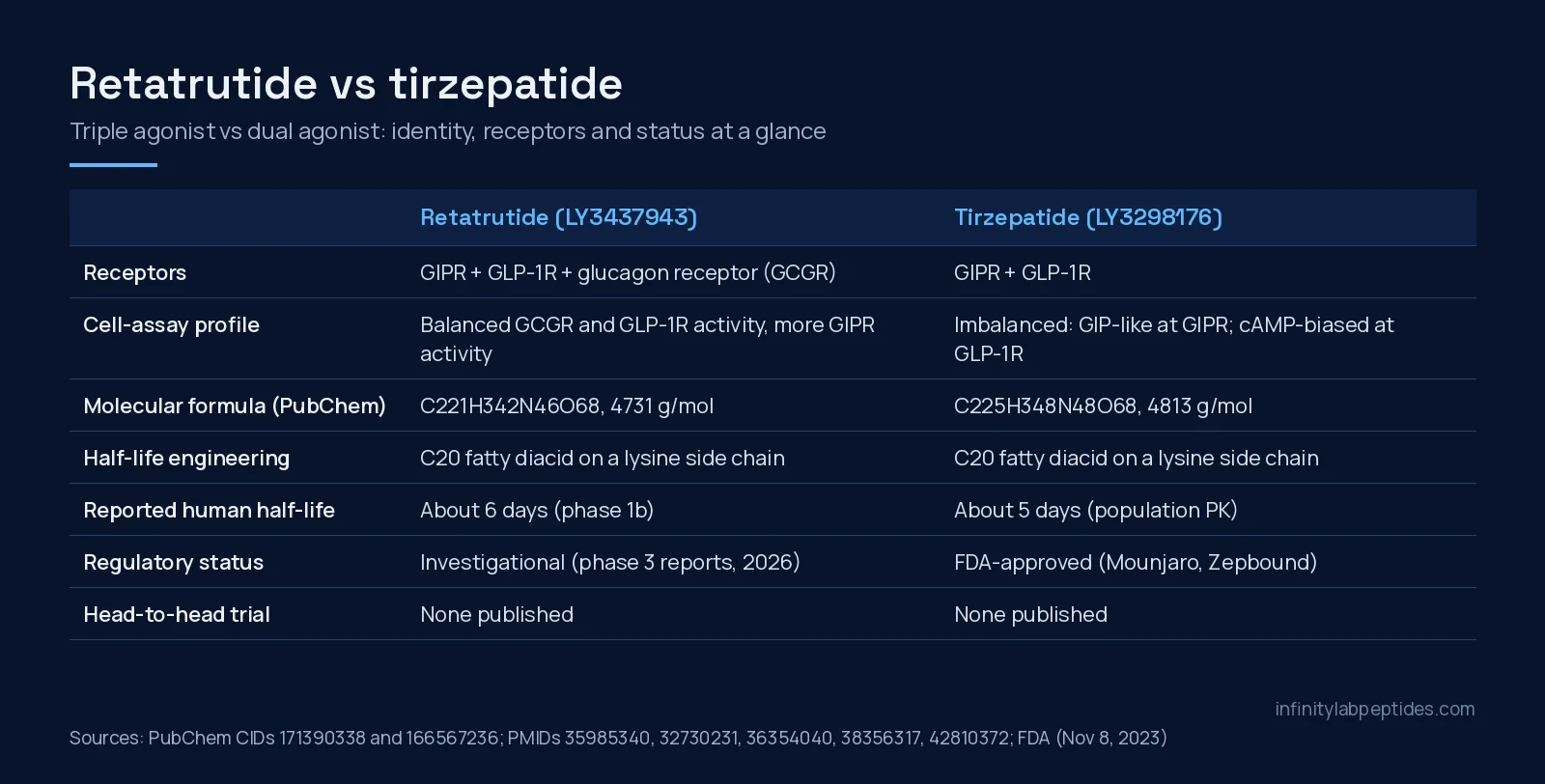
Identity at a glance
Values come from PubChem and the FDA Global Substance Registration System (GSRS), not from certificates. PubChem’s compound record for retatrutide carries the title “Triple G”; the record for tirzepatide lists the CAS number and the brand names as synonyms.
| Field | Retatrutide | Tirzepatide |
|---|---|---|
| Code name | LY3437943 | LY3298176 |
| Length and C-terminus (GSRS) | 39 residues, C-terminal serinamide | 39 residues, C-terminal serinamide |
| Non-standard residues (GSRS) | 2-methylalanine (Aib) at positions 2 and 20, alpha-methyl-leucine at 13 | 2-methylalanine (Aib) at positions 2 and 13 |
| Lipidated residue (GSRS) | Lysine 17 | Lysine 20 |
| Side chain | C20 fatty diacid joined through a gamma-glutamyl and two aminoethoxy-ethoxy-acetyl spacers | C20 fatty diacid joined through a gamma-glutamyl and two aminoethoxy-ethoxy-acetyl spacers |
| Molecular formula (PubChem) | C221H342N46O68 | C225H348N48O68 |
| Molecular weight (PubChem) | 4731 g/mol | 4813 g/mol |
| CAS (PubChem synonym) | not listed on the compound record | 2023788-19-2 |
| PubChem CID | 171390338 | 166567236 |
| FDA UNII | NOP2Y096GV | OYN3CCI6QE |
The two chains share their first residues (Tyr, Aib) and the same proline-rich C-terminal tail, and they use the same lipid chemistry. The roughly 80 Da gap in mass is the sequence, not the side chain.
Receptor potency and signalling in cell assays
The discovery papers describe each molecule’s receptor profile from signalling assays in cell lines expressing the human receptors.
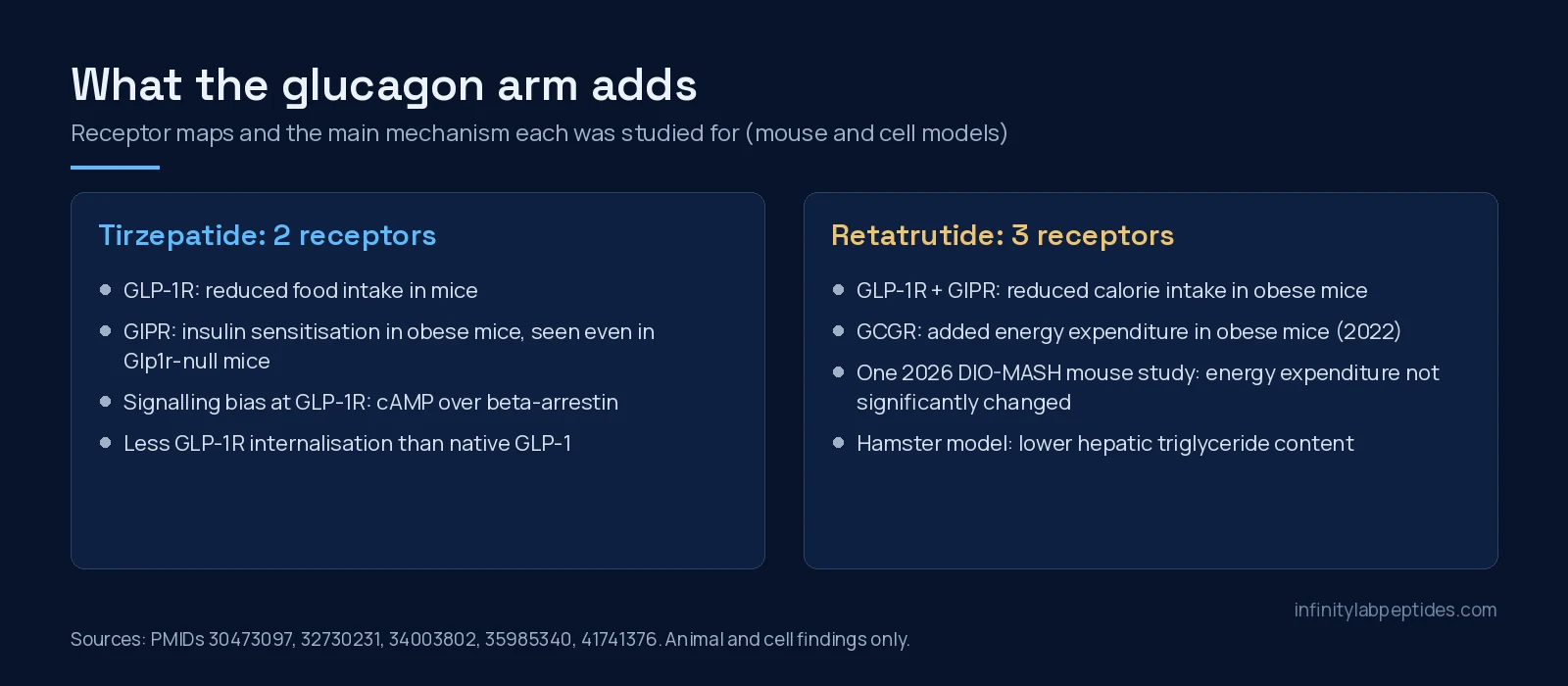
- Tirzepatide is deliberately imbalanced. In the 2018 discovery paper it activated both GIP and GLP-1 receptor signalling in cell lines and drove glucose-dependent insulin secretion in mice [1]. A 2020 pharmacology study calculated receptor occupancy at clinically used exposures and found greater engagement of the GIP receptor than the GLP-1 receptor. At the GIP receptor it behaved like native GIP; at the GLP-1 receptor it favoured cAMP generation over beta-arrestin recruitment and drove less receptor internalisation than GLP-1 [4].
- Retatrutide adds a third, balanced arm. Its 2022 discovery paper reports that in vitro it shows balanced glucagon-receptor and GLP-1-receptor activity, with more activity at the GIP receptor [2]. So both molecules lean towards GIPR; retatrutide then layers glucagon-receptor agonism on top at roughly the strength of its GLP-1R arm.
- Structures exist for both. Cryo-electron microscopy and molecular dynamics work on tirzepatide showed that its fatty-acid modification, together with its sequence, shapes how it engages each receptor [5]. A 2024 structural report described retatrutide bound to all three receptors [6].
What adding the glucagon arm changes
Glucagon-receptor agonism is the one mechanism retatrutide has that tirzepatide lacks. Its developers proposed that it adds energy expenditure to the calorie-intake reduction driven by the incretin receptors. In obese mice, they reported that the GCGR component increased energy expenditure on top of GIPR- and GLP-1R-driven intake reduction [2].
That picture is not uniform across models. A 2026 study in diet-induced obese MASH mice and hamsters found that retatrutide reduced food intake and hepatic steatosis scores in mice, but energy expenditure was not significantly altered; in hamsters, hepatic triglyceride content fell while liver histology scores did not [7]. Tirzepatide’s own extra mechanism is different: in obese mice it improved insulin sensitivity beyond GLP-1R agonism, and it still did so in Glp1r-null mice, an effect the authors attributed to GIPR agonism and glucose disposal in white adipose tissue [8].
In people, retatrutide’s liver data come from a phase 2a substudy built into its obesity trial, which used MRI-measured liver fat at 24 weeks as its primary endpoint in participants with steatotic liver disease [9]. That is a design built to measure liver fat, not a comparison with tirzepatide.
Half-life engineering: the same fatty diacid
Both peptides solve short native-hormone half-lives the same way: a C20 fatty diacid on a lysine side chain, attached through a gamma-glutamyl and two short ethoxy spacers (GSRS names for both). In human pharmacokinetic work, tirzepatide’s half-life was about 5 days in a population model pooled from 19 studies [10], and retatrutide’s was about 6 days in its phase 1b study [11]. These are the authors’ reported figures from clinical pharmacology studies and say nothing about how either compound behaves in a laboratory setting.
Animal studies that tested both
We found no human head-to-head trial, but three rodent studies ran both peptides side by side. The ranking depended on the model:
- Diabetic kidney disease, db/db mice (2025): liraglutide, tirzepatide and retatrutide were compared over 10 weeks; the authors reported larger effects on renal inflammation and fibrosis markers with retatrutide [12].
- Non-diabetic renal fibrosis, UUO and aged mice (2026): semaglutide, tirzepatide and retatrutide showed model- and drug-specific pathway patterns (PI3K-AKT, PPAR, NF-kappaB), with retatrutide the most effective at the doses tested [13].
- MC4R-knockout mice (2026): in this genetic obesity model, the three analogues all reduced fat and lean mass, and tirzepatide, not retatrutide, produced the largest body-weight change [14].
Each study picked its own doses, which were not matched for receptor exposure, so none of them is a clean test of the glucagon arm.
Trial designs side by side (design and endpoints only)
The table lists designs, not results. Outcome figures from these trials describe particular regimens in particular populations and are not repeated here.
| Trial | Compound | Design | Comparator | Primary endpoint |
|---|---|---|---|---|
| Phase 1b, type 2 diabetes [11] | Retatrutide | 12-week multiple-ascending-dose, double-blind, randomised | Placebo, dulaglutide | Safety and tolerability |
| Phase 2, obesity [15] | Retatrutide | 48-week, double-blind, randomised, dose-ranging | Placebo | Percentage change in body weight at 24 weeks |
| Phase 2a liver substudy [9] | Retatrutide | Participants with steatotic liver disease and at least 10% liver fat, within the phase 2 trial | Placebo | Relative change in liver fat at 24 weeks |
| SURPASS-2 [16] | Tirzepatide | 40-week, open-label, phase 3, type 2 diabetes | Semaglutide | Change in HbA1c at 40 weeks |
| SURMOUNT-1 [17] | Tirzepatide | 72-week, double-blind, phase 3, adults with obesity or overweight without diabetes | Placebo | Percentage change in body weight; share reaching 5% reduction |
Note the comparators. Tirzepatide has an active-comparator phase 3 trial against a GLP-1 agonist; retatrutide’s phase 1b used dulaglutide as an active control. Neither programme, in the papers cited here, used the other molecule as a comparator.
Regulatory status, from the regulators
On November 8, 2023, the U.S. Food and Drug Administration announced approval of Zepbound (tirzepatide) for chronic weight management in specified adults, and noted that tirzepatide was already approved as Mounjaro for type 2 diabetes. Health Canada’s Drug Product Database lists Mounjaro and Zepbound as prescription products. Retatrutide has no approval; its 2026 phase 3 report describes it as currently under investigation [3]. Status changes, so check the regulator rather than any vendor page, including ours.
What the evidence does not show
- No head-to-head human trial. No trial on PubMed randomises people to retatrutide versus tirzepatide. A 2026 network meta-analysis covered both only indirectly, across separate trials, and graded the evidence for emerging agents including retatrutide as very low to low certainty [18].
- The glucagon arm’s effect in people is inferred, not isolated. The energy-expenditure link comes from mice [2], and a later mouse study did not find a significant change [7]. No trial isolates the GCGR component in humans.
- Animal rankings do not agree. Retatrutide led in two kidney models and trailed tirzepatide on body weight in MC4R-knockout mice [12][13][14].
- Cell-assay potency is not clinical potency. Balanced or imbalanced receptor activity in recombinant cell lines does not predict tissue exposure in a whole animal.
- Trial outcomes do not transfer to research material. The trials used manufacturer-made drug product. A certificate for a research batch documents identity and purity of that batch, not biological activity.
What our documentation covers
For a lipidated peptide of about 4.7 kDa, a useful certificate reports chromatographic purity and a mass consistent with the expected molecular weight, because a missing side chain or a truncated sequence would shift that mass. Our COA page lists Janoshik batch APR260001010 for the GLP-3 and Retatrutide pen entries (99.479%, analysed 14 APR 2026, verification key 38J43C11UNXY). Infinity Lab Peptides does not sell tirzepatide. Our metabolic research peptides page groups the related listings, and researchers comparing suppliers can buy research peptides in Canada with the documentation status of each product stated on its page.
Frequently asked questions
What is the main difference between retatrutide and tirzepatide?
Receptor count. Tirzepatide is a dual agonist at the GIP and GLP-1 receptors. Retatrutide is a triple agonist that adds the glucagon receptor. Both are 39-residue peptides carrying the same type of C20 fatty diacid side chain.
Is tirzepatide approved and retatrutide not?
Yes. The FDA approved tirzepatide as Mounjaro for type 2 diabetes and as Zepbound for chronic weight management in specified adults, and Health Canada’s Drug Product Database lists both as prescription products. Retatrutide remains investigational; its 2026 phase 3 reports describe it as under investigation.
Has retatrutide been compared directly with tirzepatide?
Not in a human trial. Indirect comparisons exist in network meta-analyses, and three rodent studies ran both peptides side by side, with rankings that differed by model.
What does the glucagon receptor add in research models?
In the 2022 discovery work in obese mice, glucagon-receptor agonism added energy expenditure on top of incretin-driven intake reduction. A 2026 mouse study did not find a significant energy-expenditure change, so the effect is model-dependent.
Does Infinity Lab Peptides sell tirzepatide?
No. We list retatrutide as GLP-3 and as a retatrutide pen, both covered by one Janoshik report (batch APR260001010, 99.479%, analysed 14 APR 2026). Tirzepatide is not in our catalogue, so we post no certificate for it.
Research-use notice
Retatrutide (GLP-3) from Infinity Lab Peptides is sold for laboratory research and analytical use only. It is not for human or animal consumption. This article summarises published research as reported by its authors; it is not medical advice and makes no claim about any product’s effects.
References
- Coskun T, Sloop KW, Loghin C et al. (2018). LY3298176, a novel dual GIP and GLP-1 receptor agonist for the treatment of type 2 diabetes mellitus: From discovery to clinical proof of concept. Mol Metab. PMID: 30473097. doi: 10.1016/j.molmet.2018.09.009.
- Coskun T, Urva S, Roell WC et al. (2022). LY3437943, a novel triple glucagon, GIP, and GLP-1 receptor agonist for glycemic control and weight loss: From discovery to clinical proof of concept. Cell Metab. PMID: 35985340. doi: 10.1016/j.cmet.2022.07.013.
- Bellido V, le Roux CW, Ekinci EI et al. (2026). Retatrutide in adults with obesity and type 2 diabetes (TRIUMPH-2): a double-blind, parallel-group, randomised, placebo-controlled, phase 3 trial. Lancet. PMID: 42810372. doi: 10.1016/S0140-6736(26)01861-1.
- Willard FS, Douros JD, Gabe MB et al. (2020). Tirzepatide is an imbalanced and biased dual GIP and GLP-1 receptor agonist. JCI Insight. PMID: 32730231. doi: 10.1172/jci.insight.140532.
- Sun B, Willard FS, Feng D et al. (2022). Structural determinants of dual incretin receptor agonism by tirzepatide. Proc Natl Acad Sci U S A. PMID: 35333651. doi: 10.1073/pnas.2116506119.
- Li W, Zhou Q, Cong Z et al. (2024). Structural insights into the triple agonism at GLP-1R, GIPR and GCGR manifested by retatrutide. Cell Discov. PMID: 39019866. doi: 10.1038/s41421-024-00700-0.
- Briand F, Le Cudennec C, Grasset E et al. (2026). Retatrutide Shows Multiple Metabolic Benefits in Diet-Induced Obese MASH Mouse and Hamster Models. Obesity (Silver Spring). PMID: 41741376. doi: 10.1002/oby.70155.
- Samms RJ, Christe ME, Collins KA et al. (2021). GIPR agonism mediates weight-independent insulin sensitization by tirzepatide in obese mice. J Clin Invest. PMID: 34003802. doi: 10.1172/JCI146353.
- Sanyal AJ, Kaplan LM, Frias JP et al. (2024). Triple hormone receptor agonist retatrutide for metabolic dysfunction-associated steatotic liver disease: a randomized phase 2a trial. Nat Med. PMID: 38858523. doi: 10.1038/s41591-024-03018-2.
- Schneck K, Urva S (2024). Population pharmacokinetics of the GIP/GLP receptor agonist tirzepatide. CPT Pharmacometrics Syst Pharmacol. PMID: 38356317. doi: 10.1002/psp4.13099.
- Urva S, Coskun T, Loh MT et al. (2022). LY3437943, a novel triple GIP, GLP-1, and glucagon receptor agonist in people with type 2 diabetes: a phase 1b, multicentre, double-blind, placebo-controlled, randomised, multiple-ascending dose trial. Lancet. PMID: 36354040. doi: 10.1016/S0140-6736(22)02033-5.
- Ma J, Hu X, Zhang W et al. (2025). Comparison of the effects of Liraglutide, Tirzepatide, and Retatrutide on diabetic kidney disease in db/db mice. Endocrine. PMID: 39212900. doi: 10.1007/s12020-024-03998-8.
- Ding M, Li X, Wei Y et al. (2026). Comparative effects of semaglutide tirzepatide and retatrutide on renal fibrosis in UUO and aged mice. iScience. PMID: 42630988. doi: 10.1016/j.isci.2026.117174.
- Hitaka K, Sugawara T, Matsumoto M et al. (2026). Efficacy of GLP-1 analog peptides, semaglutide, tirzepatide, and retatrutide on MC4R deficient obesity and their comparison. Int J Obes (Lond). PMID: 41723268. doi: 10.1038/s41366-026-02025-2.
- Jastreboff AM, Kaplan LM, Frías JP et al. (2023). Triple-Hormone-Receptor Agonist Retatrutide for Obesity – A Phase 2 Trial. N Engl J Med. PMID: 37366315. doi: 10.1056/NEJMoa2301972.
- Frías JP, Davies MJ, Rosenstock J et al. (2021). Tirzepatide versus Semaglutide Once Weekly in Patients with Type 2 Diabetes. N Engl J Med. PMID: 34170647. doi: 10.1056/NEJMoa2107519.
- Jastreboff AM, Aronne LJ, Ahmad NN et al. (2022). Tirzepatide Once Weekly for the Treatment of Obesity. N Engl J Med. PMID: 35658024. doi: 10.1056/NEJMoa2206038.
- Nong K, Shi Q, Xie X et al. (2026). Comparative effects of drugs for adults with overweight or obesity: systematic review and network meta-analysis. BMJ. PMID: 42419792. doi: 10.1136/bmj-2026-372161.