For laboratory research only. Not for human or animal use. This article gives no dosing, administration or therapeutic advice.
Short answer: NAD+ (nicotinamide adenine dinucleotide) is the coenzyme itself: a redox carrier in every living cell and a co-substrate for enzymes such as the sirtuins and PARPs [1]. NMN (nicotinamide mononucleotide) is one step upstream, a biosynthetic precursor that cells convert into NAD+ [2]. The comparison matters in the lab because the two do not reach the inside of a cell the same way. Outside the cell, NMN can be converted to nicotinamide riboside by the ecto-enzyme CD73 before uptake, while CD38 breaks NAD+ and NMN down [3][4]. Which one you add to an experiment changes what you are actually measuring.
Identity at a glance
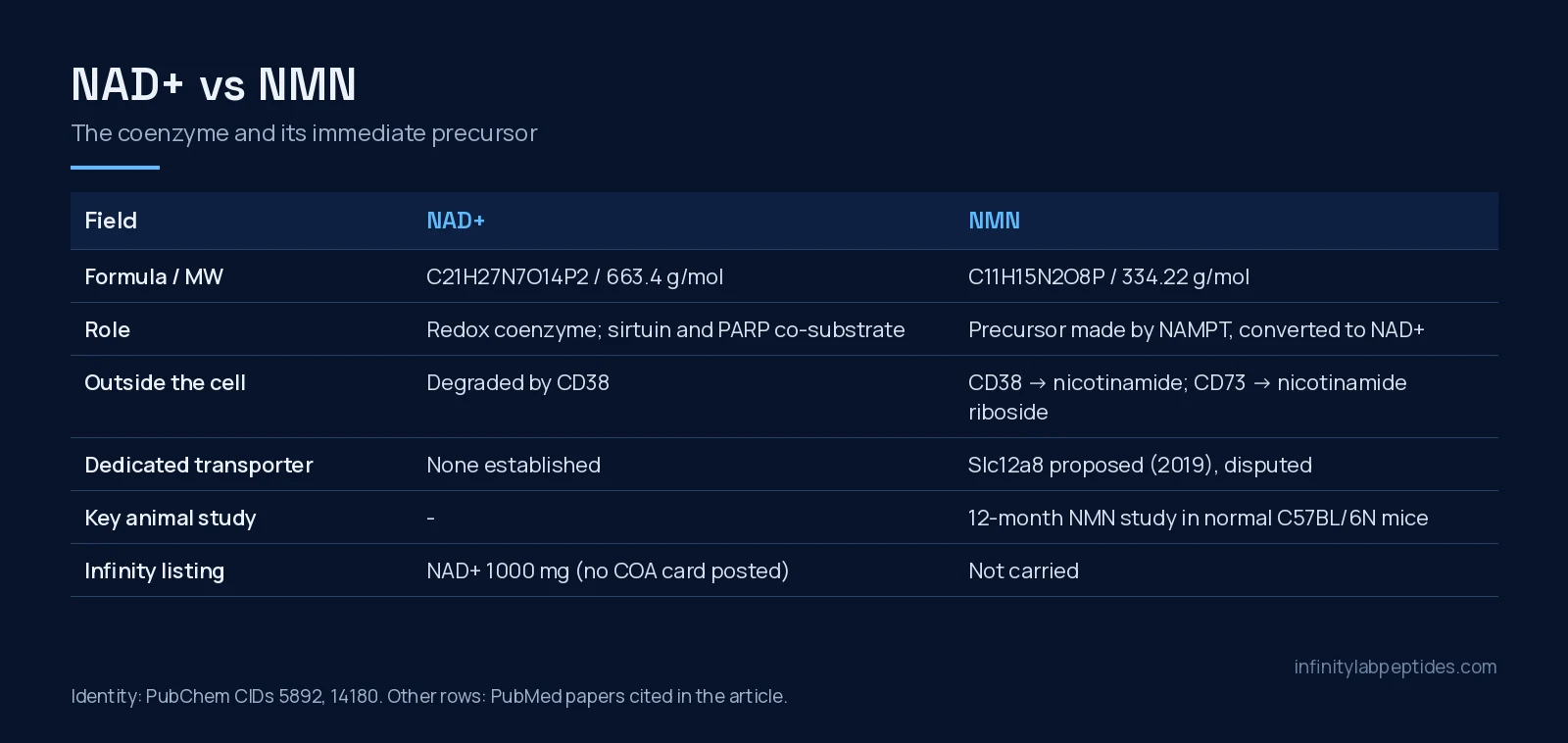
Formula and mass values come from PubChem. NMN is literally half of NAD+: NAD+ is NMN joined to AMP through a pyrophosphate bridge, which is why the mass roughly doubles.
| Field | NAD+ | NMN |
|---|---|---|
| Full name | Nicotinamide adenine dinucleotide (oxidised form) | Nicotinamide mononucleotide (beta form) |
| Molecular formula | C21H27N7O14P2 | C11H15N2O8P |
| Molecular weight | 663.4 g/mol | 334.22 g/mol |
| CAS (PubChem synonym) | 53-84-9 | 1094-61-7 |
| PubChem CID | 5892 | 14180 |
| Role | Coenzyme and enzyme co-substrate [1] | Precursor in NAD+ synthesis [2] |
| Broken down outside cells by | CD38 [4] | CD38 (to nicotinamide) and CD73 (to nicotinamide riboside) [3] |
| Proposed dedicated transporter | None established | Slc12a8 (disputed) [2][5] |
What NAD+ does, and why its level moves
A 2015 review in Science lays out the two jobs. NAD+ carries electrons between oxidation-reduction reactions, and it is consumed as a co-substrate by sirtuins and poly(ADP-ribose) polymerases. Cellular NAD+ concentrations change with age, and the review discusses how changing NAD+ use or production has extended health span and life span in model organisms [1].
The pool turns over fast. A 2021 perspective in Cell Metabolism notes that non-oxidative reactions consume NAD in net terms, that NAD metabolites also act in signalling, post-translational modification and RNA capping, and that NAD has a half-life on the order of minutes in some tissues [6]. A pool that turns over in minutes is a pool that depends heavily on supply, which is where precursors such as NMN come in.
Where NMN fits
Human cells make most of their NAD+ through salvage pathways that start from nicotinamide, nicotinic acid or nicotinamide riboside. The enzyme NAMPT catalyses the first step from nicotinamide, producing NMN, which is then converted to NAD+ [3]. That makes NMN the intermediate directly downstream of NAMPT.
The 2013 study that showed this most clearly used tumour cells treated with FK866, a NAMPT inhibitor. Low micromolar extracellular NAD+, NMN or nicotinamide riboside each reversed FK866-induced cell death. The authors proposed this as a plausible reason NAMPT inhibition failed to produce tumour remission in clinical studies of FK866 [3]. For a lab, the lesson is practical: NAD+ precursors in the medium can rescue cells from a NAMPT block, so culture conditions matter when either compound is in the design.
Getting into the cell: the key experimental difference
The ecto-enzymes decide what arrives
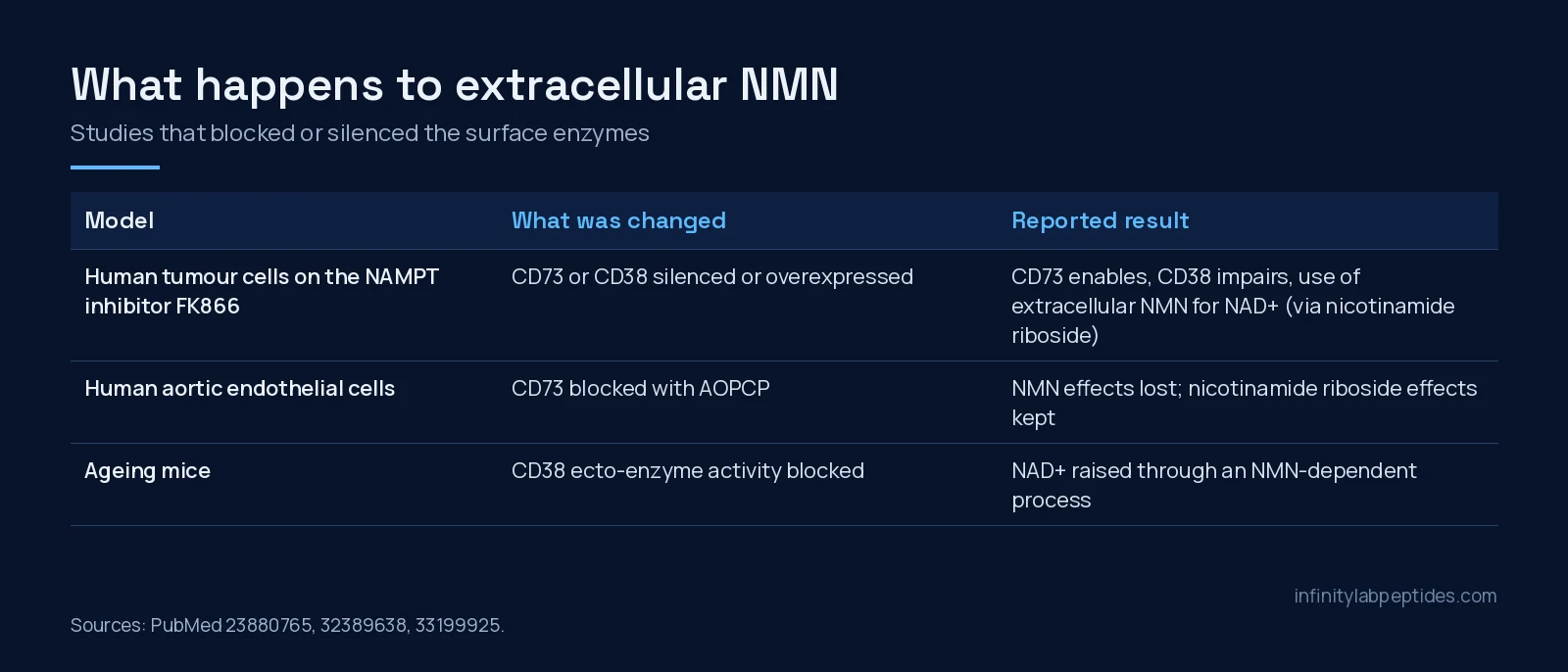
NMN is a substrate of two enzymes on the cell surface. CD38 converts it to nicotinamide; CD73 converts it to nicotinamide riboside. By silencing or overexpressing each enzyme, the 2013 group showed that CD73 enables, and CD38 impairs, the use of extracellular NMN as a source of intracellular NAD+ in human cells, by way of nicotinamide riboside [3].
A 2020 endothelial study reached the same conclusion from a different angle. In human aortic endothelial cells, both NMN and nicotinamide riboside reduced markers of inflammation. Blocking CD73 with the inhibitor AOPCP stopped the extracellular conversion of NMN to nicotinamide riboside and abolished the effects of NMN, but not those of nicotinamide riboside [7]. In that model, NMN acted through its conversion product.
CD38, ageing and the NMN connection
CD38 links the two molecules in vivo. In ageing mice, CD38 rose in white adipose tissue and liver because CD38-positive immune cells accumulated there; inflammation raised CD38 and lowered NAD+. Blocking CD38’s ecto-enzymatic activity raised NAD+ through an NMN-dependent process [4]. So CD38 degrades both NAD+ and NMN, and its activity is part of what an NAD+ measurement reflects.
The Slc12a8 debate
In 2019, Grozio and colleagues reported that the Slc12a8 gene encodes a specific, sodium-dependent NMN transporter. It was highly expressed in mouse small intestine, its knockdown abolished NMN uptake in vitro and in vivo, it did not transport nicotinamide riboside, and its loss lowered NAD+ in the jejunum and ileum [2]. The same journal then published a correspondence titled “Absence of evidence that Slc12a8 encodes a nicotinamide mononucleotide transporter” [5], followed by the original authors’ reply [8]. The question of whether intact NMN enters cells through a dedicated transporter, or mostly after conversion, is still listed among the field’s open controversies [9].
The animal evidence most often quoted
The study behind much of NMN’s profile is a 12-month experiment in normal, chow-fed C57BL/6N mice. Orally given NMN was rapidly used to make NAD+ in tissues, and the authors reported that it mitigated age-associated physiological decline: less age-related weight gain, better energy metabolism, physical activity, insulin sensitivity, plasma lipids and eye function, with no obvious toxicity. NMN also prevented age-associated gene expression changes in key metabolic organs [10].
That is a mouse study. Reviews from 2022 and 2023 stress that most NMN studies have been done in cells or animals, that only a small number of safety studies existed at the time, and that more controlled human research is still under way [11][12]. We do not summarise human results here.
Open questions to plan around
- Compartments. Cells keep separate NAD+ and NADH pools in different compartments, and a 2024 review lists this, precursor availability, the microbiome and non-canonical degradation pathways among factors that complicate supplementation studies [9].
- Conversion in the medium. If a culture expresses CD73 or CD38, extracellular NMN may be acting as nicotinamide riboside or nicotinamide [3][7]. Measuring the medium, not just the cells, helps.
- Transport. Results that depend on Slc12a8 should be read alongside the published challenge [2][5].
- Turnover. With a half-life of minutes in some tissues, sampling time can dominate an NAD+ readout [6].
Which one fits a given research question?
Questions that point to NAD+
Work on the coenzyme pool itself: redox balance, sirtuin or PARP activity, CD38 degradation, or rescue of cells from a NAMPT block with the end product rather than a precursor [1][4][3].
Questions that point to NMN
Work on the salvage step after NAMPT, on CD73-dependent conversion to nicotinamide riboside, or on the disputed Slc12a8 uptake route [3][7][2].
Questions that need both
Designs that ask whether an effect comes from the precursor or the product. The endothelial study, which ran NMN and nicotinamide riboside side by side with and without a CD73 inhibitor, is a useful template [7].
One design point applies to every option. Because NMN can be converted outside the cell and NAD+ can be broken down there, a control arm that blocks the relevant surface enzyme is often what lets a result be attributed to one molecule rather than its metabolites [3][7]. The 2024 review in Nature Reviews Molecular Cell Biology makes the broader point that better detection of NAD+ and its metabolites in specific cells and compartments is needed before translational claims can be judged [9].
Sourcing NAD+ for laboratory work
Our NAD+ 1000 mg listing is supplied for in vitro and laboratory research only; we do not carry NMN. At the time of writing our COA page lists no certificate for NAD+, so we do not quote a purity figure, batch or date for it. For related reading, see our comparisons of 5-amino-1MQ and NAD+, which looks at the NNMT side of nicotinamide metabolism, and SS-31 and NAD+, which covers mitochondrial targets. You can also buy research peptides in Canada from Infinity Lab Peptides.
Frequently asked questions
What is the difference between NAD+ and NMN?
NAD+ is the coenzyme itself, used in redox reactions and consumed by sirtuins and PARPs. NMN is its immediate precursor: NAMPT makes NMN from nicotinamide, and NMN is then converted into NAD+.
Does NMN enter cells intact?
It is debated. A 2019 study proposed Slc12a8 as a dedicated, sodium-dependent NMN transporter in mouse gut, but a published correspondence challenged that conclusion. Other work shows extracellular NMN is often converted to nicotinamide riboside by CD73 before it is used.
What does CD38 do to NAD+ and NMN?
CD38 is a cell-surface enzyme that degrades NAD+ and NMN. In ageing mice, CD38-positive immune cells accumulated in fat and liver, and blocking CD38’s enzyme activity raised NAD+ through an NMN-dependent process.
Is there human evidence for NMN?
Reviews from 2022 and 2023 note that most NMN studies have been done in cells or animals, with few completed safety studies and more trials still in progress. This article does not discuss human use.
Does Infinity Lab Peptides post a COA for NAD+?
Not at the time of writing. Our COA page lists no certificate for NAD+ 1000 mg, so we do not quote a purity figure for it. We do not carry NMN.
References
- Verdin E (2015). NAD⁺ in aging, metabolism, and neurodegeneration. Science. PMID: 26785480. doi: 10.1126/science.aac4854.
- Grozio A, Mills KF, Yoshino J et al. (2019). Slc12a8 is a nicotinamide mononucleotide transporter. Nat Metab. PMID: 31131364. doi: 10.1038/s42255-018-0009-4.
- Grozio A, Sociali G, Sturla L et al. (2013). CD73 protein as a source of extracellular precursors for sustained NAD+ biosynthesis in FK866-treated tumor cells. J Biol Chem. PMID: 23880765. doi: 10.1074/jbc.M113.470435.
- Chini CCS, Peclat TR, Warner GM et al. (2020). CD38 ecto-enzyme in immune cells is induced during aging and regulates NAD(+) and NMN levels. Nat Metab. PMID: 33199925. doi: 10.1038/s42255-020-00298-z.
- Schmidt MS, Brenner C (2019). Absence of evidence that Slc12a8 encodes a nicotinamide mononucleotide transporter. Nat Metab. PMID: 32694648. doi: 10.1038/s42255-019-0085-0.
- Chini CCS, Zeidler JD, Kashyap S et al. (2021). Evolving concepts in NAD(+) metabolism. Cell Metab. PMID: 33930322. doi: 10.1016/j.cmet.2021.04.003.
- Mateuszuk Ł, Campagna R, Kutryb-Zając B et al. (2020). Reversal of endothelial dysfunction by nicotinamide mononucleotide via extracellular conversion to nicotinamide riboside. Biochem Pharmacol. PMID: 32389638. doi: 10.1016/j.bcp.2020.114019.
- Grozio A, Mills K, Yoshino J et al. (2019). Reply to: Absence of evidence that Slc12a8 encodes a nicotinamide mononucleotide transporter. Nat Metab. PMID: 32694650. doi: 10.1038/s42255-019-0086-z.
- Migaud ME, Ziegler M, Baur JA (2024). Regulation of and challenges in targeting NAD(+) metabolism. Nat Rev Mol Cell Biol. PMID: 39026037. doi: 10.1038/s41580-024-00752-w.
- Mills KF, Yoshida S, Stein LR et al. (2016). Long-Term Administration of Nicotinamide Mononucleotide Mitigates Age-Associated Physiological Decline in Mice. Cell Metab. PMID: 28068222. doi: 10.1016/j.cmet.2016.09.013.
- Nadeeshani H, Li J, Ying T et al. (2022). Nicotinamide mononucleotide (NMN) as an anti-aging health product – Promises and safety concerns. J Adv Res. PMID: 35499054. doi: 10.1016/j.jare.2021.08.003.
- Song Q, Zhou X, Xu K et al. (2023). The Safety and Antiaging Effects of Nicotinamide Mononucleotide in Human Clinical Trials: an Update. Adv Nutr. PMID: 37619764. doi: 10.1016/j.advnut.2023.08.008.