For laboratory research only. Not for human or animal use. This article gives no dosing, administration or therapeutic advice.
Short answer: kisspeptin-10 and kisspeptin-54 come from the same gene, KISS1, and act on the same receptor, KISS1R (also called GPR54). Kisspeptin-54, first isolated from human placenta as “metastin”, is the 54-residue processed peptide with an amidated C-terminus [1]. Kisspeptin-10 is its last ten residues, YNWNSFGLRF-NH2 [2], the shortest sequence that keeps full receptor activity [3]. In cell assays the short form binds at least as tightly as the long one [3][4]. In living animals the gap is time: in male mice, kisspeptin-54 lasted about 32 minutes in the bloodstream against about 4 minutes for kisspeptin-10, and only kisspeptin-54 reached GnRH neurons behind the blood-brain barrier after peripheral injection [5].
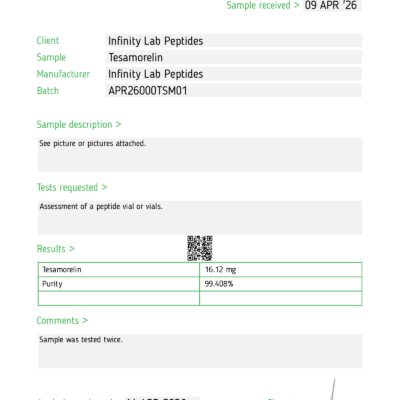
Spec card
Kisspeptin
Purity: not shown
Batch: not shown
Analysis date: not shown
Lab: not shown
Listing: Kisspeptin 10 mg
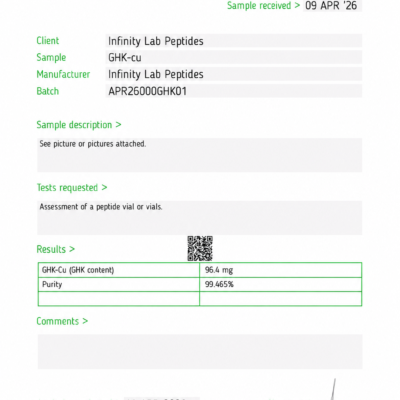
No certificate is posted for this product on our COA page at the time of writing.
Read the label twice
“Kisspeptin 10 mg” names the amount in the vial. “Kisspeptin-10” names the decapeptide. The two are easy to mix up in catalogues. Our listing states strength and format; it does not name the isoform, and with no certificate posted there is no report confirming identity. Contact us before ordering if the isoform matters to your protocol.
Identity: one gene, several peptides
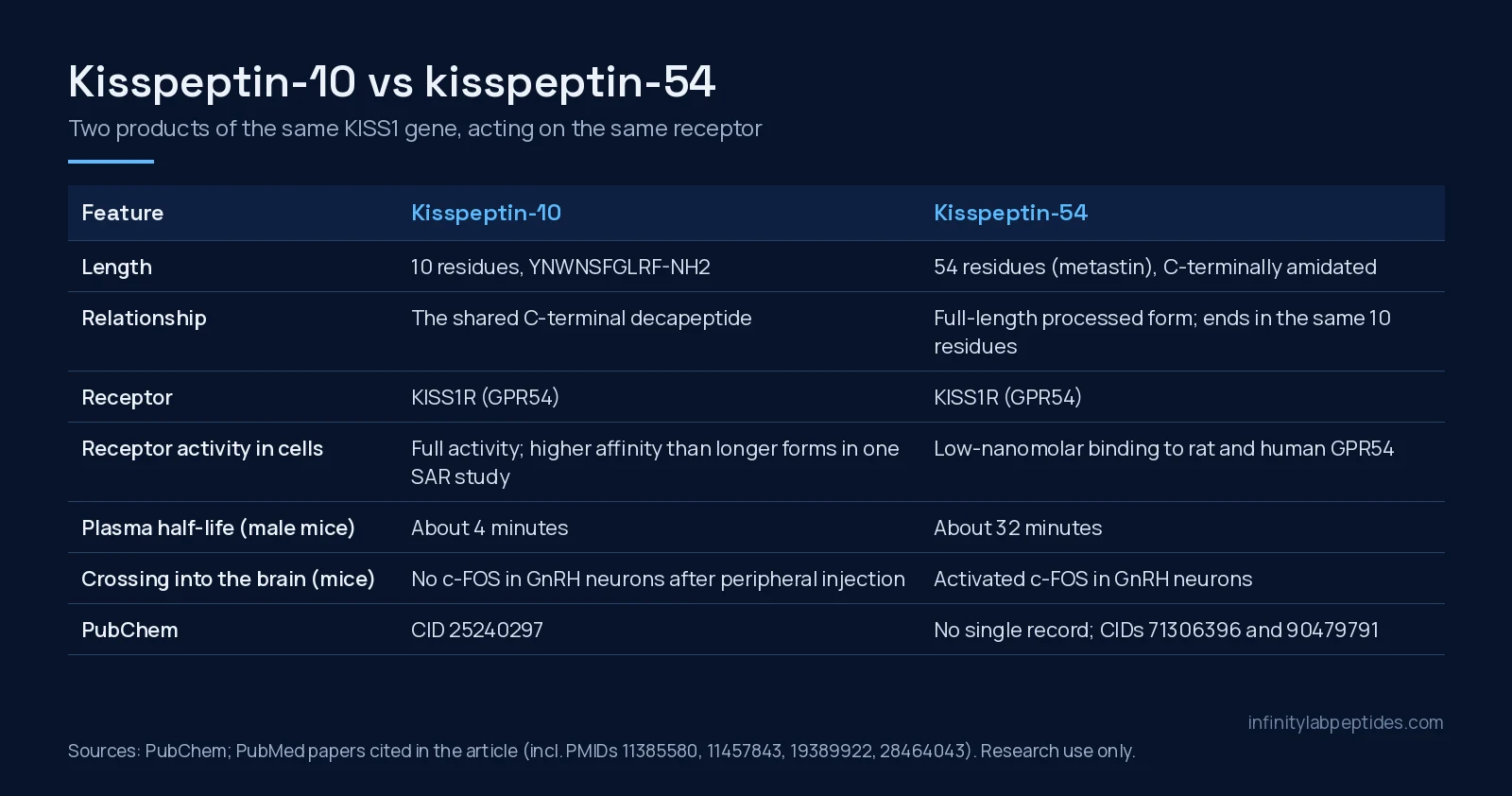
Kisspeptins were identified in 2001 by two groups searching for the ligand of an orphan receptor. One isolated a 54-residue amidated peptide from human placenta and named it metastin [1]. The other isolated 54-, 14- and 13-residue peptides that share an Arg-Phe-amide C-terminus and called the family kisspeptins [4]. All these forms share the same C-terminal ten residues, which is kisspeptin-10 [5]. Rodents differ: the rat study discussed below used rat kisspeptin-52 as its long form [6].
| Field | Kisspeptin-10 (human) | Kisspeptin-54 (human) |
|---|---|---|
| Other names | KP-10, metastin 45-54, kisspeptin 112-121 | Metastin, KP-54 |
| Sequence | YNWNSFGLRF-NH2 | 54 residues ending in the kisspeptin-10 sequence, C-terminal amide |
| Molecular formula (PubChem) | C63H83N17O14 | C258H401N79O78 |
| Molecular weight (PubChem) | 1302.4 g/mol | 5857 g/mol |
| CAS (PubChem synonym) | 374675-21-5 | 388138-21-4 (listed on the general “Kisspeptin” record) |
| PubChem CID | 25240297 | No single record: 71306396 (“Kisspeptin”) and 90479791 (“Metastin (human)”) both carry this formula |
| Receptor | KISS1R / GPR54 | KISS1R / GPR54 |
We list both PubChem records for the 54-residue peptide rather than pick one, because neither is a clean one-to-one match for “kisspeptin-54” as sold for research.
Why the receptor matters
The interest in both peptides traces to human genetics. In 2003, a family with hypogonadotropic hypogonadism, a failure of pituitary LH and FSH output that blocks puberty, carried a deletion in GPR54 [7]. The same year, a second group linked GPR54 mutations to absent puberty in people and showed that mice lacking the receptor reproduced the defect [8]. In 2012 an inactivating mutation in KISS1 itself was found in a family with failed pubertal progression [9].
Animal work then placed the receptor on GnRH neurons. In mice, GPR54 transcripts sat in GnRH neurons, and injected kisspeptin raised LH and FSH in normal mice but had no effect in mice lacking GPR54 [10]. Both kisspeptin-54 and kisspeptin-10 raised LH when given into the brain’s ventricles in mice, and a GnRH antagonist blocked the kisspeptin-54 response [11]. In juvenile male rhesus monkeys, hourly kisspeptin-10 pulses drove a train of GnRH-dependent LH discharges [12].
Same receptor, different behaviour in the body
In receptor assays the short form is not the weaker one. The 2001 work found the long and mid-length kisspeptins bound rat and human GPR54 at low-nanomolar affinities [4]. A 2009 structure-activity study described kisspeptin-10 as having higher receptor affinity and biopotency than longer forms; swapping residue 6 or 10 for alanine sharply weakened it in rat receptor-expressing cells, and the residue-10 swap abolished its LH response in rats [3].
The differences show up after injection into the bloodstream.
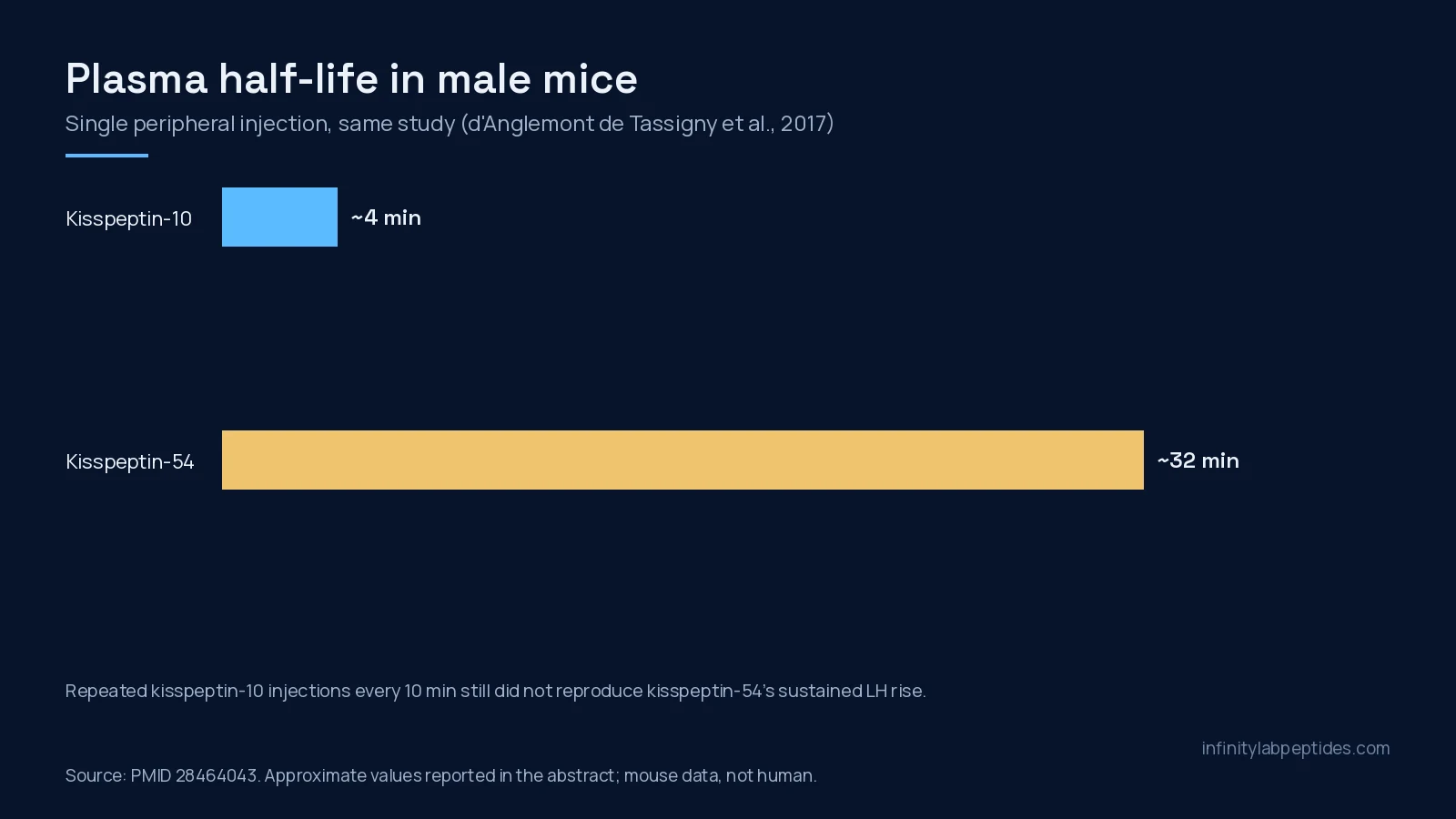
- Clearance. In male mice, the half-life was about 32 minutes for kisspeptin-54 and about 4 minutes for kisspeptin-10 [5]. In rat plasma, kisspeptin-10 broke down within minutes, faster as temperature rose, and its main breakdown product had lost its N-terminal tyrosine. After a single intravenous bolus in rats it was undetectable within half an hour [2].
- Not only clearance. The same mouse study gave kisspeptin-10 every 10 minutes for an hour to make up for its short life and still could not reproduce the sustained LH rise seen after one kisspeptin-54 injection [5].
- Access to the brain. Only peripherally injected kisspeptin-54 switched on c-FOS in mouse GnRH neurons behind the blood-brain barrier, consistent with the long form crossing it more readily [5].
- Species matter. In conscious male rats, intravenous kisspeptin-10 and rat kisspeptin-52 gave similar dynamic LH responses, with only slightly greater magnitude and duration for the long form [6].
Kisspeptin-10 vs kisspeptin-54 side by side
| Question | Kisspeptin-10 | Kisspeptin-54 |
|---|---|---|
| What it is | C-terminal decapeptide shared by all kisspeptins [5] | 54-residue amidated peptide from human placenta [1] |
| Receptor potency in cells | Full activity; higher affinity than longer forms in a SAR study [3] | Low-nanomolar binding to rat and human GPR54 [4] |
| Half-life, male mice | About 4 minutes [5] | About 32 minutes [5] |
| Plasma stability | Rapid breakdown in rat plasma; des-Tyr fragment main product [2] | Longer circulation in mice [5] |
| Brain access after peripheral injection (mice) | No c-FOS in GnRH neurons [5] | c-FOS in GnRH neurons [5] |
| Rodent LH response | Robust, dose-dependent LH bursts in rats [6] | Sustained LH in mice [5]; slightly longer response for rat Kp-52 [6] |
| Human research protocols (design only) | Bolus and infusion physiology study in healthy men, LH pulse endpoints [13] | Placebo-controlled infusion study in men [14]; IVF egg-maturation study [15] |
Human studies: what was measured
Both peptides have been given to volunteers in research settings. We describe design and endpoints only; kisspeptin peptides remain research compounds, and these studies were physiology and early-phase protocols.
- Kisspeptin-54 in men (2005): a double-blind, placebo-controlled crossover infusion study in six male volunteers, measuring LH, FSH and testosterone, with plasma half-life calculated [14].
- Kisspeptin-10 in men (2011): bolus dose-response testing and longer infusions in healthy men, with LH pulse frequency and size as endpoints [13].
- Direct comparison (2015): a single-blinded, placebo-controlled study in healthy men gave kisspeptin-10, kisspeptin-54 and GnRH intravenously on separate days, with five men per dose group and LH and FSH as endpoints. The authors reported broadly similar gonadotrophin responses to the two kisspeptins across the doses tested, and stronger responses to GnRH than to either [16].
- IVF (2014): a study in women undergoing in vitro fertilisation used kisspeptin-54 to trigger an LH surge, with egg maturation as the primary outcome [15].
Note the tension: the mouse data favour kisspeptin-54 after peripheral injection [5], while the 2015 human comparison found the two isoforms closer than rodent studies had suggested [16].
What the evidence does not show
- No settled potency ranking. Cell assays, rats, mice and humans each give a different picture. Potency depends on the test system, route and timing [3][6][16].
- Brain entry is inferred. The blood-brain barrier finding rests on c-FOS staining in mice, which the authors describe as consistent with crossing, not a direct measurement in people [5].
- Short-form stability numbers are from rat plasma in vitro and in rats. They may not match other species or conditions [2].
- Small human samples. The physiology studies enrolled a handful of participants per group, so they describe responses rather than settle comparisons [14][16].
- Species forms differ. Rat work used kisspeptin-52, not human kisspeptin-54, so rodent comparisons are not exact copies of the human pairing [6][17].
Notes for lab buyers
For short, sharp receptor activation, cell signalling or structure-activity work, kisspeptin-10 is the usual tool, since it carries full receptor activity in a small, well-defined sequence [3]. For models where circulation time or central access after peripheral delivery matters, the long form behaves differently, as the mouse data show [5]. Either way, confirm which isoform a vial contains and ask for identity and purity documents first. Researchers who want to buy research peptides in Canada can start by checking which certificates are posted on our COA page.
Frequently asked questions
What is the difference between kisspeptin-10 and kisspeptin-54?
Both come from the KISS1 gene and act on the KISS1R (GPR54) receptor. Kisspeptin-54 is the 54-residue amidated peptide; kisspeptin-10 is its last ten residues. In cell assays the short form is fully active, but in male mice kisspeptin-54 stayed in the blood far longer and reached GnRH neurons behind the blood-brain barrier after peripheral injection.
What is the half-life of kisspeptin-10 vs kisspeptin-54?
In a 2017 study in male mice, kisspeptin-54 had a plasma half-life of about 32 minutes and kisspeptin-10 about 4 minutes. Kisspeptin-10 also broke down within minutes in rat plasma in a separate study. These are animal values.
Is kisspeptin-10 weaker than kisspeptin-54?
Not at the receptor. A structure-activity study found kisspeptin-10 had higher receptor affinity than longer forms in cells. Differences appear in living animals, where clearance and brain access favour the long form in mice, while rats and a small human physiology study showed closer responses.
Does Infinity’s Kisspeptin 10 mg contain kisspeptin-10?
The listing names a 10 mg vial and does not state the isoform, and no certificate is posted for it on our COA page at the time of writing. Contact us before ordering if the isoform matters for your work.
Which receptor do kisspeptins act on?
KISS1R, first described as the orphan receptor GPR54. Loss-of-function mutations in this receptor, and later in KISS1 itself, were found in families with failed puberty, and mice lacking GPR54 do not respond to injected kisspeptin.
References
- Ohtaki T, Shintani Y, Honda S et al. (2001). Metastasis suppressor gene KiSS-1 encodes peptide ligand of a G-protein-coupled receptor. Nature. PMID: 11385580. doi: 10.1038/35079135.
- Liu Z, Ren C, Jones W et al. (2013). LC-MS/MS quantification of a neuropeptide fragment kisspeptin-10 (NSC 741805) and characterization of its decomposition product and pharmacokinetics in rats. J Chromatogr B Analyt Technol Biomed Life Sci. PMID: 23524040. doi: 10.1016/j.jchromb.2013.02.027.
- Gutiérrez-Pascual E, Leprince J, Martínez-Fuentes AJ et al. (2009). In vivo and in vitro structure-activity relationships and structural conformation of Kisspeptin-10-related peptides. Mol Pharmacol. PMID: 19389922. doi: 10.1124/mol.108.053751.
- Kotani M, Detheux M, Vandenbogaerde A et al. (2001). The metastasis suppressor gene KiSS-1 encodes kisspeptins, the natural ligands of the orphan G protein-coupled receptor GPR54. J Biol Chem. PMID: 11457843. doi: 10.1074/jbc.M104847200.
- d’Anglemont de Tassigny X, Jayasena CN, Murphy KG et al. (2017). Mechanistic insights into the more potent effect of KP-54 compared to KP-10 in vivo. PLoS One. PMID: 28464043. doi: 10.1371/journal.pone.0176821.
- Tovar S, Vázquez MJ, Navarro VM et al. (2006). Effects of single or repeated intravenous administration of kisspeptin upon dynamic LH secretion in conscious male rats. Endocrinology. PMID: 16513831. doi: 10.1210/en.2005-1397.
- de Roux N, Genin E, Carel JC et al. (2003). Hypogonadotropic hypogonadism due to loss of function of the KiSS1-derived peptide receptor GPR54. Proc Natl Acad Sci U S A. PMID: 12944565. doi: 10.1073/pnas.1834399100.
- Seminara SB, Messager S, Chatzidaki EE et al. (2003). The GPR54 gene as a regulator of puberty. N Engl J Med. PMID: 14573733. doi: 10.1056/NEJMoa035322.
- Topaloglu AK, Tello JA, Kotan LD et al. (2012). Inactivating KISS1 mutation and hypogonadotropic hypogonadism. N Engl J Med. PMID: 22335740. doi: 10.1056/NEJMoa1111184.
- Messager S, Chatzidaki EE, Ma D et al. (2005). Kisspeptin directly stimulates gonadotropin-releasing hormone release via G protein-coupled receptor 54. Proc Natl Acad Sci U S A. PMID: 15665093. doi: 10.1073/pnas.0409330102.
- Gottsch ML, Cunningham MJ, Smith JT et al. (2004). A role for kisspeptins in the regulation of gonadotropin secretion in the mouse. Endocrinology. PMID: 15217982. doi: 10.1210/en.2004-0431.
- Plant TM, Ramaswamy S, Dipietro MJ (2006). Repetitive activation of hypothalamic G protein-coupled receptor 54 with intravenous pulses of kisspeptin in the juvenile monkey (Macaca mulatta) elicits a sustained train of gonadotropin-releasing hormone discharges. Endocrinology. PMID: 16282350. doi: 10.1210/en.2005-1261.
- George JT, Veldhuis JD, Roseweir AK et al. (2011). Kisspeptin-10 is a potent stimulator of LH and increases pulse frequency in men. J Clin Endocrinol Metab. PMID: 21632807. doi: 10.1210/jc.2011-0089.
- Dhillo WS, Chaudhri OB, Patterson M et al. (2005). Kisspeptin-54 stimulates the hypothalamic-pituitary gonadal axis in human males. J Clin Endocrinol Metab. PMID: 16174713. doi: 10.1210/jc.2005-1468.
- Jayasena CN, Abbara A, Comninos AN et al. (2014). Kisspeptin-54 triggers egg maturation in women undergoing in vitro fertilization. J Clin Invest. PMID: 25036713. doi: 10.1172/JCI75730.
- Jayasena CN, Abbara A, Narayanaswamy S et al. (2015). Direct comparison of the effects of intravenous kisspeptin-10, kisspeptin-54 and GnRH on gonadotrophin secretion in healthy men. Hum Reprod. PMID: 26089302. doi: 10.1093/humrep/dev143.
- Sivalingam M, Parhar IS (2022). Hypothalamic kisspeptin and kisspeptin receptors: Species variation in reproduction and reproductive behaviours. Front Neuroendocrinol. PMID: 34757093. doi: 10.1016/j.yfrne.2021.100951.