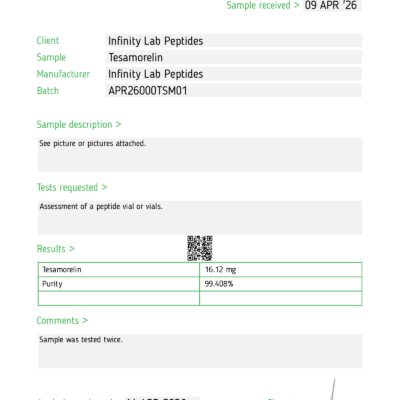
For laboratory research only. Not for human or animal use. This article gives no dosing, administration or therapeutic advice.
Short answer: GHK-Cu and Matrixyl are both called “collagen peptides”, but they come from different places and were built on different ideas. GHK (glycyl-L-histidyl-L-lysine) is a tripeptide first described in human serum in 1973 [1]. It binds copper(II), and early work proposed it as a copper transport factor [2]. Matrixyl is a trade name for palmitoyl pentapeptide-4 (Pal-KTTKS) [3]. Its peptide part, Lys-Thr-Thr-Lys-Ser, is residues 212–216 of the type I procollagen C-terminal propeptide. In 1993 it was identified as the minimum sequence that stimulated collagen and fibronectin production in cultured mesenchymal cells [4]. The palmitoyl tail was added to make it more lipophilic and more stable in skin [5][6]. One detail links the two: the newer blend sold as Matrixyl 3000 contains palmitoyl-GHK, which has the same three amino acids as GHK-Cu but no copper. The evidence for both comes from cells, skin explants, animals and formulation chemistry. This article describes those models and their limits and makes no claims about skin or health.
Spec cards from our COA library
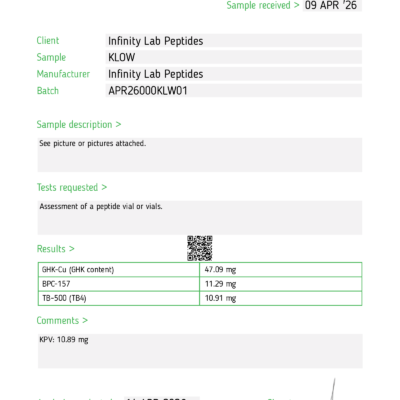
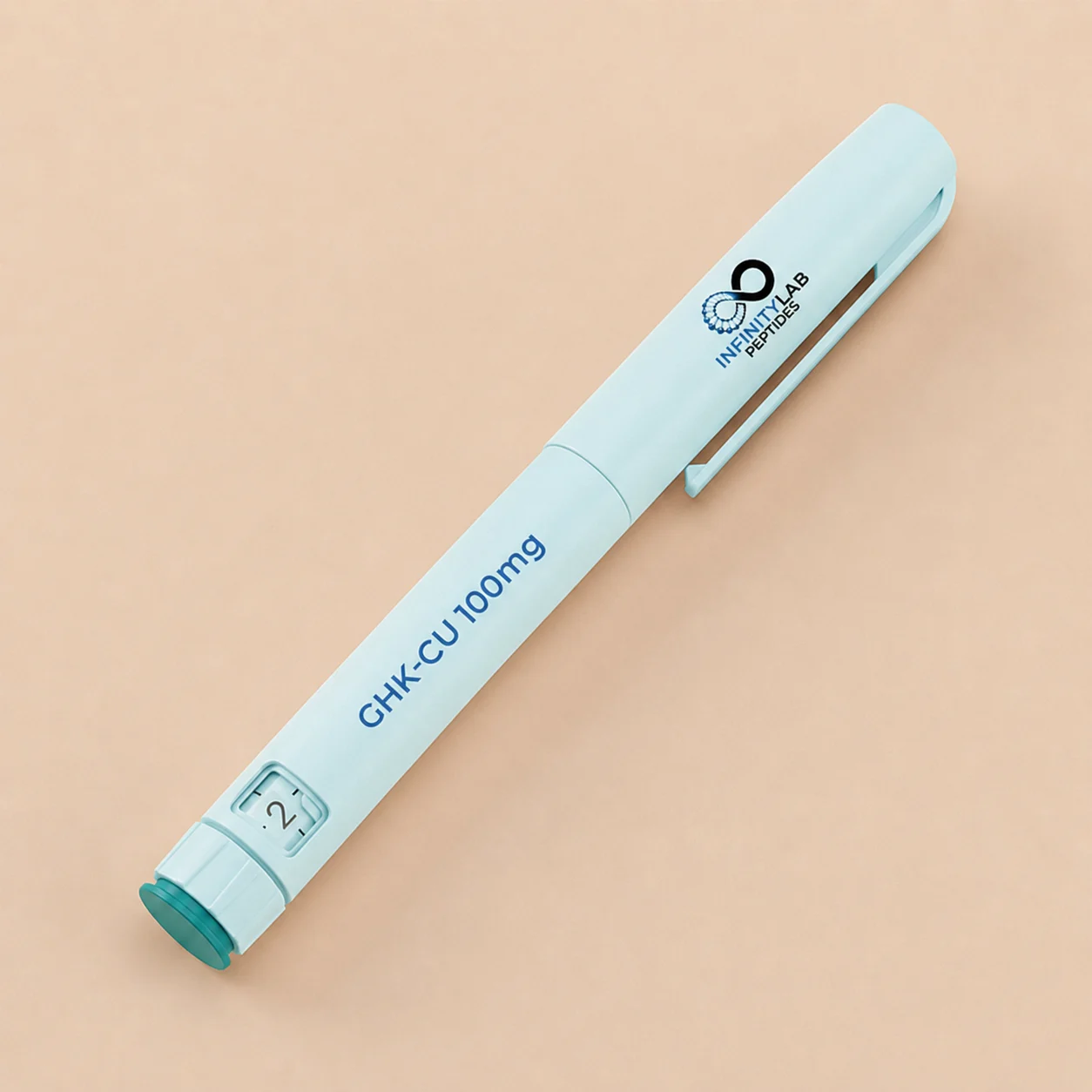
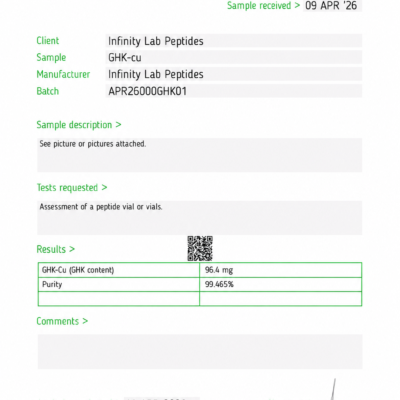
GHK-Cu 100 mg
Purity: 99.465%
Batch: APR26000GHK01
Analysis date: 14 APR 2026
Lab: Janoshik
Verification key: 6154WM73YX5R
Listing: GHK-CU 100 mg
Janoshik report shown on our COA page as “GHK-cu”. The same batch and key are listed for the GHK-CU 100 mg (Pen) as “GHK-cu pen”, so one report covers both listings.
Matrixyl (Pal-KTTKS)
Purity: not applicable
Batch: not applicable
Analysis date: not applicable
Lab: not applicable
Listing: not sold here
We do not sell Matrixyl or Matrixyl 3000. It is here as the cosmetic peptide GHK-Cu is most often compared with.
Card values are copied from our COA library as posted on 14 APR 2026. They describe that batch only.
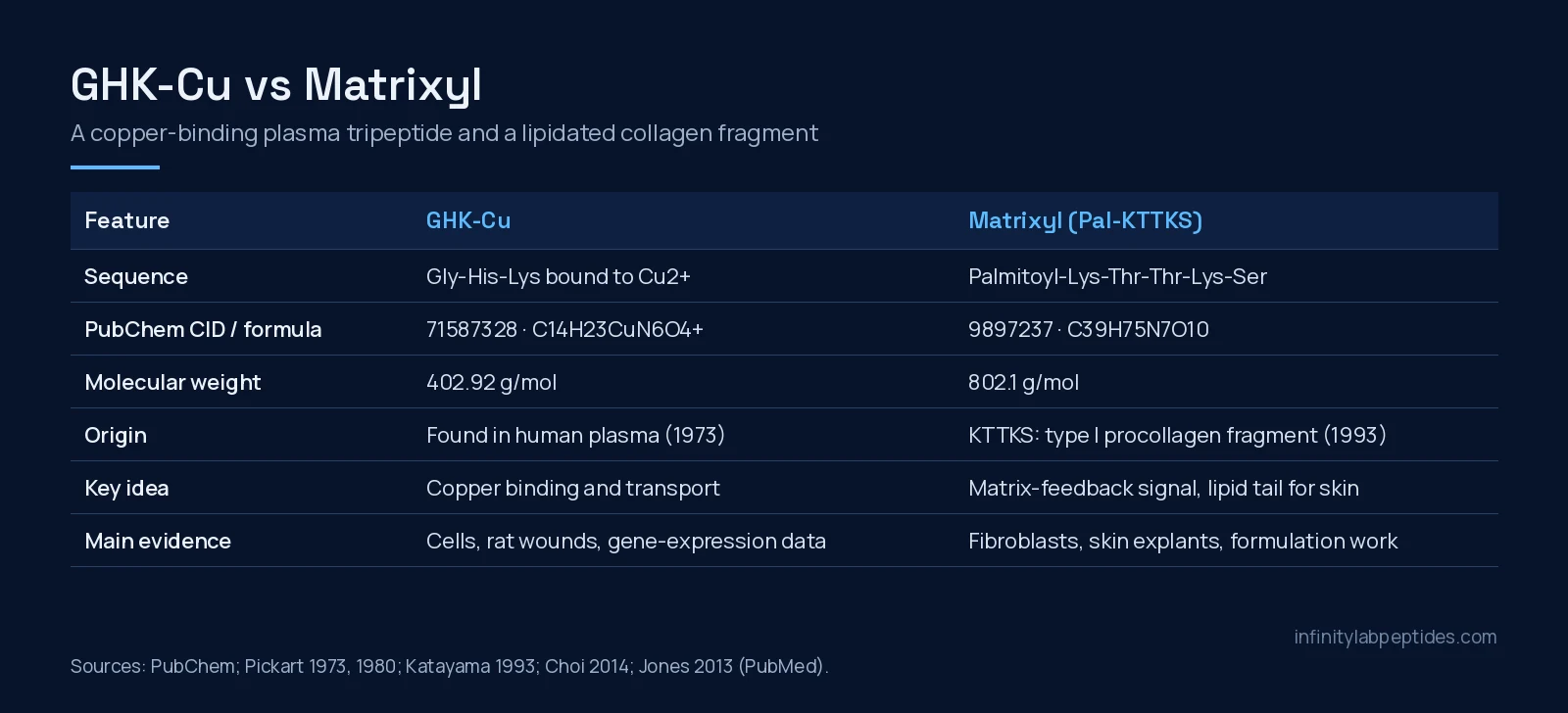
Identity: four molecules behind two names
“Matrixyl” covers more than one material, so the identity table has four columns. All values come from PubChem.
| Field | GHK-Cu | Pal-KTTKS (Matrixyl) | Pal-GHK | Pal-GQPR |
|---|---|---|---|---|
| PubChem title | Prezatide copper | Palmitoyl Pentapeptide-4 | Palmitoyl Tripeptide-1 | Palmitoyl Tetrapeptide-7 |
| Sequence | Gly-His-Lys + Cu2+ | Pal-Lys-Thr-Thr-Lys-Ser | Pal-Gly-His-Lys | Pal-Gly-Gln-Pro-Arg |
| Molecular formula | C14H23CuN6O4+ | C39H75N7O10 | C30H54N6O5 | C34H62N8O7 |
| Molecular weight | 402.92 g/mol | 802.1 g/mol | 578.8 g/mol | 694.9 g/mol |
| CAS (PubChem synonym) | 89030-95-5 | 214047-00-4 | 147732-56-7 | 221227-05-0 |
| PubChem CID | 71587328 | 9897237 | 10231864 | 10078408 |
| Contains copper? | Yes | No | No | No |
The free GHK peptide is a separate PubChem record (CID 73587, C14H24N6O4, 340.38 g/mol). Its synonyms include “prezatide”, and the copper complex’s synonyms include “copper tripeptide-1”. PubChem lists “palmitoyl oligopeptide” as a synonym of Pal-GHK, and a 2015 study using skin explants and in vivo skin imaging tested a blend of palmitoyl oligopeptide and palmitoyl tetrapeptide-7, the same pair marketed as Matrixyl 3000 [7]. The non-lipidated pentapeptide KTTKS is CID 9959565.
GHK-Cu: a copper complex first
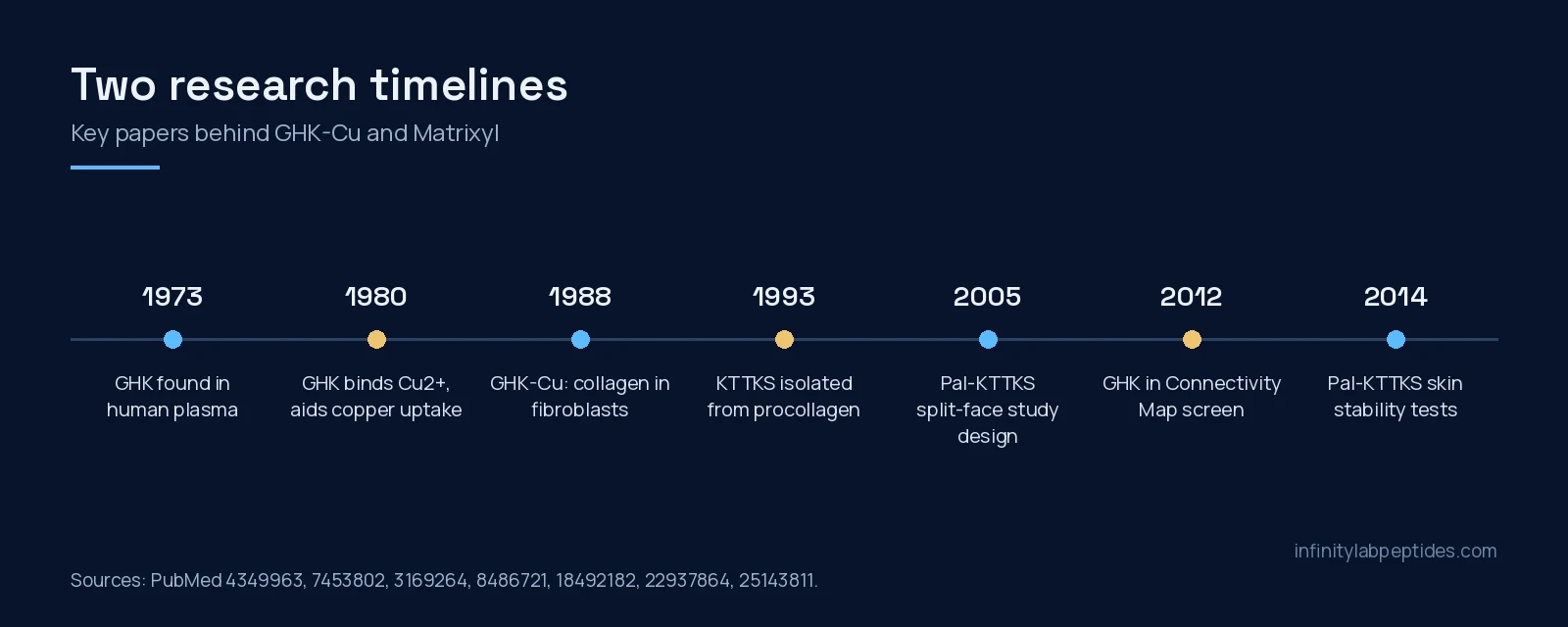
Pickart’s 1973 paper reported a serum tripeptide that prolonged survival of normal liver cells and stimulated growth of hepatoma cells in culture [1]. By 1980 the group found that GHK co-purified with roughly equimolar copper. It readily formed copper(II) complexes and increased copper uptake into cultured hepatoma cells. They noted its similarity to the copper-binding sites of albumin [2]. Solution spectroscopy later showed that at neutral pH GHK forms a 1:1 copper(II) complex, with one coordinating nitrogen from the histidine imidazole ring [8].
The connective-tissue work followed. Maquart and colleagues reported that GHK-Cu stimulated collagen synthesis in fibroblast cultures starting in the picomolar range and peaking near 1 nM, with no change in cell number [9]. In a rat wound-chamber model, GHK-Cu increased dry weight, DNA, protein, collagen and glycosaminoglycan content in a concentration-dependent way. Type I and III collagen mRNAs rose, but TGF-beta mRNA did not. A control tripeptide had no significant effect [10].
More recent work comes from gene-expression data. Campbell and colleagues profiled lung tissue from smokers with COPD and used the Connectivity Map to look for compounds that reversed the gene signature linked to emphysema. GHK was one hit. In human fibroblasts it reproduced TGF-beta-like expression patterns and restored collagen gel contraction by fibroblasts from emphysematous lung [11]. Reviews by Pickart and co-authors gather these data, including the observation that GHK in plasma declines with age [12][13]. Those reviews are written by the peptide’s original discoverer, so read them alongside the primary papers.
Matrixyl: a matrix fragment with a lipid tail
The Matrixyl idea starts from feedback biology. Procollagen propeptides are cut off outside the cell, and fragments of them may regulate further matrix synthesis. Katayama and colleagues narrowed a C-terminal propeptide subfragment down to KTTKS. That five-residue sequence was enough to stimulate collagen and fibronectin production in several mesenchymal cell types [4]. Later work in rat Achilles tendon cells reported higher type I collagen expression with KTTKS and no loss of viability [14].
The bare pentapeptide is very water-soluble. A preformulation study measured a logP of about −1.6 for KTTKS and about 3.7 for Pal-KTTKS. Only the palmitoylated form showed surfactant-like behaviour, with a measurable critical micelle concentration [5]. In human dermal and corneal fibroblasts, C16-KTTKS stimulated collagen production in a concentration-dependent way. The effect appeared close to its critical aggregation concentration, which suggests that self-assembly into nanotapes and bioactivity are linked [3].
Stability and penetration are the weak points. In hairless-mouse skin extracts, both KTTKS and Pal-KTTKS degraded rapidly, though the palmitoylated form lasted longer. Neither crossed full-thickness skin in diffusion cells. Pal-KTTKS was found in the stratum corneum, epidermis and dermis, but unmodified KTTKS was not detected in any layer [6]. A 2011 review pointed to a “surprising absence” of in vitro skin-penetration data and few clinical studies [15].
The best-known human study is a 12-week, double-blind, placebo-controlled, split-face trial in 93 women aged 35–55, comparing a moisturiser with and without Pal-KTTKS [16]. We describe it by design only. It tested a finished cosmetic formulation, not the raw peptide, and was not a drug study.
Where they overlap: Pal-GHK
Pal-GHK (palmitoyl tripeptide-1) carries the GHK sequence with a C16 fatty acid on the N-terminus and no copper. Analytical chemists have used Pal-GHK as an internal standard when measuring Pal-KTTKS in anti-wrinkle creams by LC-MS/MS, which shows how closely related these lipopeptides are as analytes [17]. A 2025 review of topical GHK points out that GHK-Cu and Pal-GHK are the two forms most used in formulations, yet clinical studies of either are largely missing. It also notes that metal complexation and a hydrophobic tail both raise skin permeability compared with free GHK [18]. So sharing a sequence is not the same as sharing evidence. Copper-binding data for GHK do not carry over to Pal-GHK, because Pal-GHK is not a copper complex.
Comparison at a glance
| Question | GHK-Cu | Matrixyl (Pal-KTTKS) |
|---|---|---|
| Origin | Tripeptide isolated from human serum [1] | Synthetic; KTTKS is procollagen I residues 212–216 [4] |
| Central property | 1:1 copper(II) complex; copper uptake into cells [2][8] | Lipidated, self-assembling amphiphile [3][5] |
| Cell data | Fibroblast collagen synthesis [9]; TGF-beta-like gene patterns [11] | Collagen/fibronectin in mesenchymal cells and fibroblasts [4][3] |
| Animal data | Rat wound chambers [10] | Rat tendon cells; hairless-mouse skin stability [14][6] |
| Skin delivery evidence | Reviews call permeability a limiting question [18][19] | Retained in skin layers; no full-thickness permeation [6] |
| Human cosmetic studies | Clinical studies largely absent [18] | Few; one widely cited split-face design [16][15] |
For GHK-Cu next to a repair peptide rather than a cosmetic one, see BPC-157 vs GHK-Cu.
What the evidence does not show
- A head-to-head study. We found no paper testing GHK-Cu against Pal-KTTKS in the same model. Any “which is better” claim online goes beyond the published data.
- That cell effects reach deep skin. A review of anti-wrinkle peptides argues that without enough skin permeation, effects seen in cell culture tell you little about what happens in skin [19]. Neither KTTKS form crossed full-thickness mouse skin in one study [6].
- That Pal-GHK behaves like GHK-Cu. Without copper, the copper-transport data do not apply [2][18].
- Independent breadth for GHK. Much of the GHK review literature comes from one author group [12][13]. The Connectivity Map result is a gene-expression screen, not a tissue outcome [11].
- Clinical depth. Reviews describe few or no controlled human studies for these peptides [15][18], and the studies that exist tested finished cosmetic formulas.
For lab buyers
For GHK-Cu, confirm the copper:peptide ratio and the identity of the complex as well as HPLC purity, because the free peptide (340.38 g/mol) and the complex (402.92 g/mol) are different analytes. For any palmitoyl peptide, LC-MS/MS methods exist that separate these lipopeptides in formulations [17]. Our GHK-CU 100 mg and GHK-CU 100 mg (Pen) listings share the Janoshik report shown above; we do not sell Matrixyl. You can browse the catalogue and buy research peptides in Canada; every product is sold for laboratory research only.
Frequently asked questions
What is the difference between GHK-Cu and Matrixyl?
GHK-Cu is the tripeptide Gly-His-Lys bound to copper(II), first described in human serum in 1973. Matrixyl is a trade name for palmitoyl pentapeptide-4 (Pal-KTTKS), a synthetic lipidated version of the procollagen I fragment Lys-Thr-Thr-Lys-Ser.
Does Matrixyl 3000 contain GHK-Cu?
No. The blend sold as Matrixyl 3000 pairs palmitoyl oligopeptide (Pal-GHK, palmitoyl tripeptide-1) with palmitoyl tetrapeptide-7 (Pal-GQPR). Pal-GHK shares the GHK sequence but carries a palmitoyl tail and no copper.
Why is Matrixyl palmitoylated?
Unmodified KTTKS is highly water-soluble. The palmitoyl tail makes it lipophilic and surface-active. In hairless-mouse skin it was more stable than KTTKS and was retained in skin layers, though neither form crossed full-thickness skin in that study.
What models were GHK-Cu studied in?
Mainly cultured cells (hepatoma cells, fibroblasts), rat wound chambers, and gene-expression analyses such as a Connectivity Map screen on emphysema-related lung tissue signatures.
Is there a COA for GHK-Cu at Infinity Lab Peptides?
Yes. Our COA page lists GHK-cu batch APR26000GHK01, purity 99.465%, dated 14 APR 2026, Janoshik, key 6154WM73YX5R. The same report is listed for the vial and the pen. We do not sell Matrixyl.
References
- Pickart L, Thaler MM (1973). Tripeptide in human serum which prolongs survival of normal liver cells and stimulates growth in neoplastic liver. Nat New Biol. PMID: 4349963.
- Pickart L, Freedman JH, Loker WJ et al. (1980). Growth-modulating plasma tripeptide may function by facilitating copper uptake into cells. Nature. PMID: 7453802. doi: 10.1038/288715a0.
- Jones RR, Castelletto V, Connon CJ et al. (2013). Collagen stimulating effect of peptide amphiphile C16-KTTKS on human fibroblasts. Mol Pharm. PMID: 23320752. doi: 10.1021/mp300549d.
- Katayama K, Armendariz-Borunda J, Raghow R et al. (1993). A pentapeptide from type I procollagen promotes extracellular matrix production. J Biol Chem. PMID: 8486721.
- Mortazavi SM, Kobarfard F, Maibach HI et al. (2019). Effect of Palmitic Acid Conjugation on Physicochemical Properties of Peptide KTTKS: A Preformulation Study. J Cosmet Sci. PMID: 31829923.
- Choi YL, Park EJ, Kim E et al. (2014). Dermal Stability and In Vitro Skin Permeation of Collagen Pentapeptides (KTTKS and palmitoyl-KTTKS). Biomol Ther (Seoul). PMID: 25143811. doi: 10.4062/biomolther.2014.053.
- Mondon P, Hillion M, Peschard O et al. (2015). Evaluation of dermal extracellular matrix and epidermal-dermal junction modifications using matrix-assisted laser desorption/ionization mass spectrometric imaging, in vivo reflectance confocal microscopy, echography, and histology: effect of age and peptide applications. J Cosmet Dermatol. PMID: 25817264. doi: 10.1111/jocd.12135.
- Freedman JH, Pickart L, Weinstein B et al. (1982). Structure of the Glycyl-L-histidyl-L-lysine–copper(II) complex in solution. Biochemistry. PMID: 6291585. doi: 10.1021/bi00262a004.
- Maquart FX, Pickart L, Laurent M et al. (1988). Stimulation of collagen synthesis in fibroblast cultures by the tripeptide-copper complex glycyl-L-histidyl-L-lysine-Cu2+. FEBS Lett. PMID: 3169264. doi: 10.1016/0014-5793(88)80509-x.
- Maquart FX, Bellon G, Chaqour B et al. (1993). In vivo stimulation of connective tissue accumulation by the tripeptide-copper complex glycyl-L-histidyl-L-lysine-Cu2+ in rat experimental wounds. J Clin Invest. PMID: 8227353. doi: 10.1172/JCI116842.
- Campbell JD, McDonough JE, Zeskind JE et al. (2012). A gene expression signature of emphysema-related lung destruction and its reversal by the tripeptide GHK. Genome Med. PMID: 22937864. doi: 10.1186/gm367.
- Pickart L, Vasquez-Soltero JM, Margolina A (2015). GHK Peptide as a Natural Modulator of Multiple Cellular Pathways in Skin Regeneration. Biomed Res Int. PMID: 26236730. doi: 10.1155/2015/648108.
- Pickart L, Margolina A (2018). Regenerative and Protective Actions of the GHK-Cu Peptide in the Light of the New Gene Data. Int J Mol Sci. PMID: 29986520. doi: 10.3390/ijms19071987.
- Tsai WC, Hsu CC, Chung CY et al. (2007). The pentapeptide KTTKS promoting the expressions of type I collagen and transforming growth factor-beta of tendon cells. J Orthop Res. PMID: 17593541. doi: 10.1002/jor.20455.
- Abu Samah NH, Heard CM (2011). Topically applied KTTKS: a review. Int J Cosmet Sci. PMID: 21535443. doi: 10.1111/j.1468-2494.2011.00657.x.
- Robinson LR, Fitzgerald NC, Doughty DG et al. (2005). Topical palmitoyl pentapeptide provides improvement in photoaged human facial skin. Int J Cosmet Sci. PMID: 18492182. doi: 10.1111/j.1467-2494.2005.00261.x.
- Chirita RI, Chaimbault P, Archambault JC et al. (2009). Development of a LC-MS/MS method to monitor palmitoyl peptides content in anti-wrinkle cosmetics. Anal Chim Acta. PMID: 19393372. doi: 10.1016/j.aca.2009.03.015.
- Mortazavi SM, Mohammadi Vadoud SA, Moghimi HR (2025). Topically applied GHK as an anti-wrinkle peptide: Advantages, problems and prospective. Bioimpacts. PMID: 39963574. doi: 10.34172/bi.30071.
- Mortazavi SM, Moghimi HR (2022). Skin permeability, a dismissed necessity for anti-wrinkle peptide performance. Int J Cosmet Sci. PMID: 35302659. doi: 10.1111/ics.12770.