For laboratory research only. Not for human or animal use. This article gives no dosing, administration or therapeutic advice.
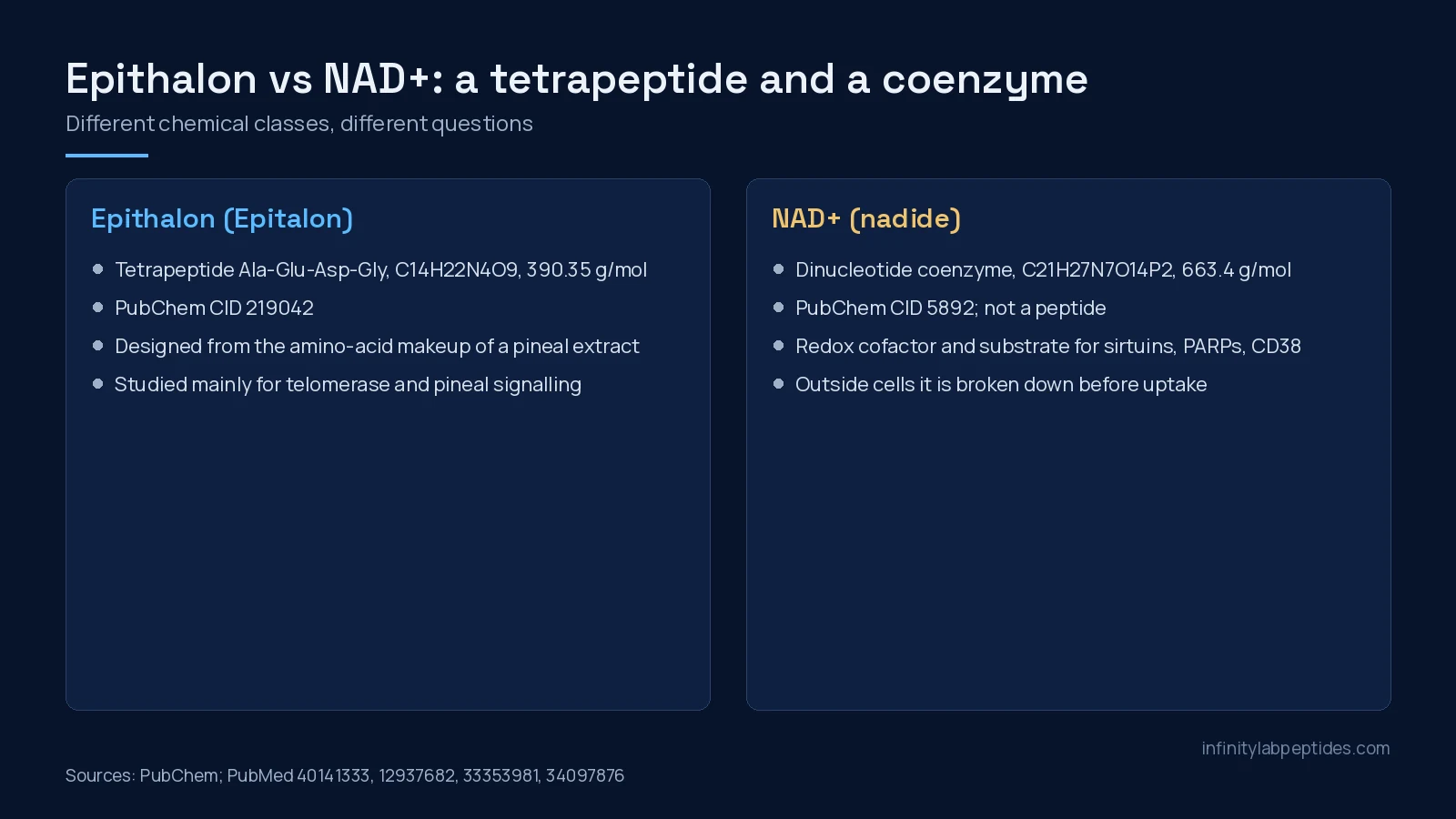
Short answer: epithalon and NAD+ are often grouped as “longevity” compounds, but they have almost nothing in common chemically. Epithalon (also spelled epitalon) is a synthetic four-residue peptide, Ala-Glu-Asp-Gly, modelled on the amino-acid makeup of a bovine pineal extract[1],[2]. NAD+ is a dinucleotide coenzyme present in every living cell, used in redox reactions and consumed by sirtuins, PARPs and CD38[3]. Epithalon’s literature is mostly cell and rodent work from one research network, centred on telomerase[4],[5]. NAD+ has a much larger literature, but the claim that it simply “declines with age” is contested, and no outcome trial has tested intravenous NAD+ itself[6],[7].
Batch documentation at a glance
Our COA library is the only source for the statements below.
Epithalon 50 mg
Listing: Epithalon 50 mg vial
Purity: not available
Batch: not available
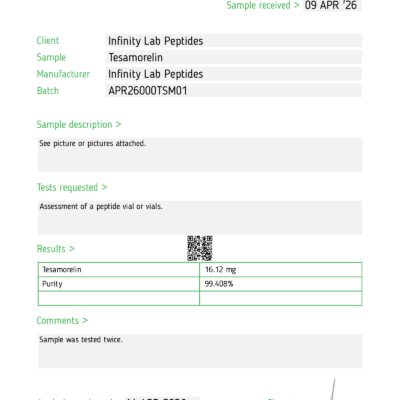
No certificate is posted for this product on our COA page at the time of writing.
NAD+ 1000 mg
Listing: NAD+ 1000 mg vial
Purity: not available
Batch: not available
No certificate is posted for this product on our COA page at the time of writing.
With no posted report for either listing, identity and content cannot be checked from our library today. If your work depends on either compound, request batch documentation before you plan around it, and treat identity confirmation as part of your own method.
Identity
Values below are PubChem’s.
| Property | Epithalon | NAD+ |
|---|---|---|
| Chemical class | Linear tetrapeptide | Dinucleotide (nicotinamide + adenine nucleotides); not a peptide |
| Sequence / structure | Ala-Glu-Asp-Gly (AEDG)[8] | Nicotinamide riboside and adenosine joined through a pyrophosphate |
| Synonyms | Epitalon, Epithalone, AEDG peptide | Nadide, beta-NAD, coenzyme I, diphosphopyridine nucleotide |
| Molecular formula | C14H22N4O9 | C21H27N7O14P2 |
| Molecular weight | 390.35 g/mol | 663.4 g/mol |
| CAS | 307297-39-8 | 53-84-9 |
| PubChem CID | 219042 | 5892 |
One naming point: epithalamin is the pineal gland extract; epithalon is the synthetic tetrapeptide derived from it[1],[9]. Older papers on epithalamin describe a different, undefined material and should not be read as epithalon data.
Epithalon: what has been studied
Telomerase and telomeres in cultured cells
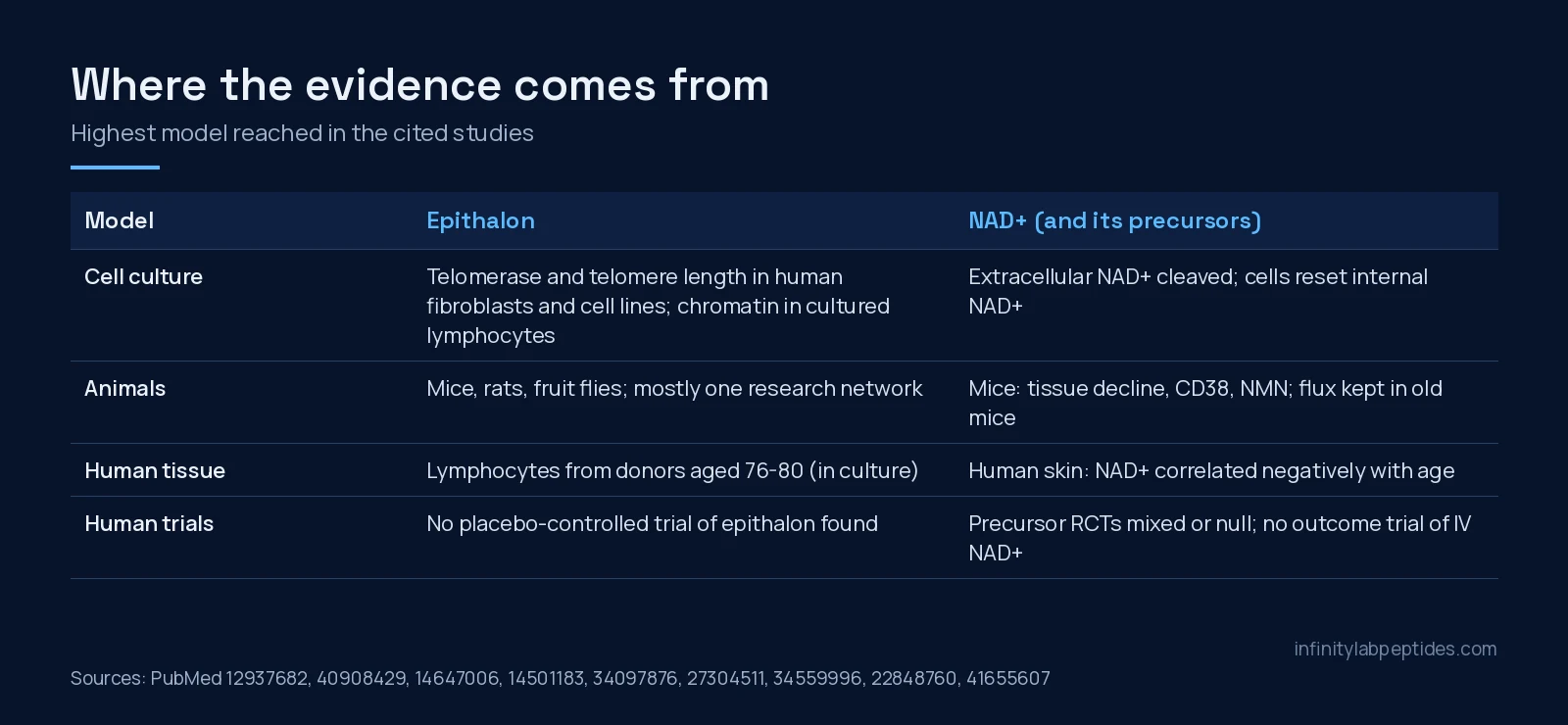
The work that made epithalon known came from human fetal fibroblasts. In telomerase-negative fibroblast cultures, adding the peptide induced expression of telomerase’s catalytic subunit, telomerase activity and telomere elongation[4]. In a follow-up, fetal lung fibroblasts that had stopped dividing at passage 34 showed telomere lengthening after treatment and continued for 10 additional passages beyond controls[8]. Both studies came from the peptide’s developers.
A 2025 study from a different group tested the claim more quantitatively in breast cancer lines and in normal epithelial and fibroblast cells. In normal cells it reported dose-dependent telomere extension through hTERT and telomerase upregulation; in cancer cells, telomere lengthening also occurred through the alternative lengthening of telomeres (ALT) pathway[10]. That second finding deserves attention: telomere extension in cancer cell lines is not a neutral observation.
Chromatin, oocytes and the pineal gland
In cultured lymphocytes from people aged 76 to 80, epithalon was reported to activate ribosomal genes and decondense heterochromatin[11]. In mouse oocytes aged in vitro, it reduced reactive oxygen species and spindle defects and raised mitochondrial membrane potential[9]. In rats under osmotic stress, intranasal epithalon produced a small rise in the activation marker C-Fos in pinealocytes[2].
Whole-animal studies
The best-known animal study treated 54 female SHR mice per group from 3 months of age until natural death. Epithalon did not change food intake, body weight or mean lifespan; it was associated with longer survival of the longest-lived 10%, a 12.3% higher maximum lifespan, fewer bone-marrow chromosome aberrations and less leukaemia, but no change in total spontaneous tumour incidence[5]. In rats given a colon carcinogen, epithalon given throughout the experiment reduced tumour-cell mitotic activity and increased apoptosis[12]. A 2002 report from the developers’ group described retinal findings in Campbell rats and an uncontrolled series in patients with retinal degeneration[13]; the abstract describes no control group or blinding.
NAD+: what has been studied
Biochemistry
NAD+ is the coenzyme for redox reactions at the centre of energy metabolism and an essential substrate for non-redox enzymes, including sirtuins, CD38 and poly(ADP-ribose) polymerases[3]. Its role is not in question; the questions are whether tissue levels fall with age in a way that matters, and whether supplying NAD+ from outside the cell changes anything inside it.
Does NAD+ decline with age?
In human pelvic skin from 49 people aged 0 to 77, NAD+ correlated negatively with age in both sexes, while PARP activity rose with age in males[14]. In mice, the NADase CD38 rose with age and was required for age-related NAD decline and mitochondrial dysfunction; CD38 also degraded the precursor NMN in vivo[15]. Yet isotope-tracing in aged mice found only a modest (around 30%) tissue decline, with absolute NAD+ synthesis flux maintained because the smaller pool turned over faster[16]. A 2021 review concluded that evidence for age-related NAD+ decline is limited, often from a single tissue or cell type, and poorly characterised in humans[6].
What happens to NAD+ supplied from outside
NAD+ is a large, charged molecule. In cultured cells exposed to extracellular NAD+, the cells reset their internal NAD+ by reducing expression of CD73, the NMN transporter SLC12A8 and nicotinamide riboside kinase, a SIRT1-dependent homeostatic response[17]. A mouse study reported a different route in hypothalamic neurons, where extracellular NAD was imported through connexin 43 independently of CD73[18]. Much of the in-vivo “NAD+ boosting” literature uses precursors instead, such as NMN, which restored NAD+ and improved glucose tolerance in diet-induced diabetic mice[19].
Human data
A 2026 systematic review found that NAD+ precursor trials showed target engagement and were generally well tolerated, but effects on functional and metabolic outcomes were heterogeneous and often null; no eligible outcome trial evaluated intravenous or intramuscular NAD+ itself[7]. A 2026 retrospective comparison of intravenous NAD+ and nicotinamide riboside infusions reported gastrointestinal symptoms, raised heart rate and chest pressure during NAD+ infusions, leading to longer infusion times[20].
Side-by-side research comparison
| Question | Epithalon | NAD+ |
|---|---|---|
| What it is | Synthetic tetrapeptide[1] | Endogenous coenzyme[3] |
| Main research theme | Telomerase, chromatin, pineal signalling[4],[11],[2] | Redox metabolism, sirtuins, PARP, CD38[3],[15] |
| Who has studied it | Mostly the developers’ network; one independent 2025 cell study[10] | Many independent groups worldwide |
| Lifespan data | Mice: no change in mean lifespan[5] | Not addressed by the cited studies of NAD+ itself |
| Cell entry question | Not characterised in the cited studies | Largely cleaved or regulated at the cell surface[17] |
| Human outcome trials | None placebo-controlled found | None for IV NAD+; precursors mixed[7] |
| Our posted COA | None posted | None posted |
Null and negative results
- Epithalon, mean lifespan in mice: no effect on mean lifespan, food intake or body weight across the whole life of SHR mice; total tumour incidence was also unchanged[5].
- NAD+ synthesis in old mice: absolute NAD+ synthesis flux was maintained in aged mice, which argues against a simple production failure[16].
- NAD+ precursor trials: effects on functional and metabolic outcomes were often null or endpoint-specific[7].
- Intravenous NAD+: no biomarker changes in liver enzymes, hsCRP, kidney markers or TSH, alongside poorer infusion tolerability than nicotinamide riboside[20].
What the evidence does not show
- It does not show that epithalon extends lifespan in mammals. The whole-life mouse study found no change in mean lifespan[5].
- It does not show independent replication of most epithalon findings. Most come from one network; the 2025 independent study was in cultured cells only[10].
- It does not show that telomere lengthening is harmless. The same 2025 study saw ALT-driven lengthening in cancer cell lines[10].
- It does not show that NAD+ added outside cells raises NAD+ inside them in a lasting way; cells actively reset their internal level[17].
- It does not show a universal age-related NAD+ decline in humans[6],[14].
- It does not show that epithalon and NAD+ act on the same pathway, or that combining them does anything. We found no study of the pair.
Practical notes for a research plan
Epithalon questions are mostly about telomerase, chromatin and pineal function, and the available data are best treated as hypotheses to replicate. NAD+ questions are about metabolism and enzyme substrates, and the main design issue is delivery: decide whether you are studying NAD+ itself, a precursor, or intracellular levels, and measure the latter directly. For both, the absence of a posted COA means your own identity check matters more. Our research peptides overview lists related compounds, and you can buy research peptides in Canada once documentation meets your requirements.
Frequently asked questions
Is epithalon a form of NAD+?
No. Epithalon is a synthetic tetrapeptide (Ala-Glu-Asp-Gly, PubChem CID 219042, 390.35 g/mol). NAD+ is a dinucleotide coenzyme (PubChem CID 5892, 663.4 g/mol) and not a peptide at all. They are studied for different questions.
What is the difference between epithalon and epithalamin?
Epithalamin is an extract of the pineal gland. Epithalon is a synthetic four-amino-acid peptide designed from that extract’s amino-acid composition. Data on the extract should not be treated as data on the synthetic peptide.
Does epithalon extend lifespan in animals?
In the best-known study, lifelong treatment of female SHR mice did not change mean lifespan, food intake or body weight. It was associated with longer survival among the longest-lived 10 percent and a higher maximum lifespan, and no change in total tumour incidence.
Does NAD+ really decline with age?
Human skin samples showed lower NAD+ with age, and in mice the enzyme CD38 drives an age-related decline. But tracing studies in aged mice found synthesis flux maintained, and a 2021 review judged the evidence for an age-related decline in humans to be limited.
Are COAs posted for Epithalon 50 mg and NAD+ 1000 mg?
No. At the time of writing our COA page shows no certificate for either listing, so purity and identity cannot be checked from our library for these products.
Research use only. All products referenced on this page are intended for laboratory research and analytical applications. They are not for human or animal consumption, and nothing here is medical advice, dosing guidance or a treatment recommendation.
References
- Araj SK, Brzezik J, Mądra-Gackowska K et al. (2025). Overview of Epitalon-Highly Bioactive Pineal Tetrapeptide with Promising Properties. Int J Mol Sci. PMID: 40141333. doi: 10.3390/ijms26062691.
- Sibarov DA, Kovalenko RI, Malinin VV et al. (2002). Epitalon influences pineal secretion in stress-exposed rats in the daytime. Neuro Endocrinol Lett. PMID: 12500171.
- Covarrubias AJ, Perrone R, Grozio A et al. (2021). NAD(+) metabolism and its roles in cellular processes during ageing. Nat Rev Mol Cell Biol. PMID: 33353981. doi: 10.1038/s41580-020-00313-x.
- Khavinson VKh, Bondarev IE, Butyugov AA (2003). Epithalon peptide induces telomerase activity and telomere elongation in human somatic cells. Bull Exp Biol Med. PMID: 12937682. doi: 10.1023/a:1025493705728.
- Anisimov VN, Khavinson VKh, Popovich IG et al. (2003). Effect of Epitalon on biomarkers of aging, life span and spontaneous tumor incidence in female Swiss-derived SHR mice. Biogerontology. PMID: 14501183. doi: 10.1023/a:1025114230714.
- Peluso A, Damgaard MV, Mori MAS et al. (2021). Age-Dependent Decline of NAD(+)-Universal Truth or Confounded Consensus?. Nutrients. PMID: 35010977. doi: 10.3390/nu14010101.
- Gallagher C, Emmanuel OO (2026). NAD⁺ supplementation for anti-aging and wellness: A PRISMA-guided systematic review of preclinical and clinical evidence. Ageing Res Rev. PMID: 41655607. doi: 10.1016/j.arr.2026.103057.
- Khavinson VKh, Bondarev IE, Butyugov AA et al. (2004). Peptide promotes overcoming of the division limit in human somatic cell. Bull Exp Biol Med. PMID: 15455129. doi: 10.1023/b:bebm.0000038164.49947.8c.
- Yue X, Liu SL, Guo JN et al. (2022). Epitalon protects against post-ovulatory aging-related damage of mouse oocytes in vitro. Aging (Albany NY). PMID: 35413689. doi: 10.18632/aging.204007.
- Al-Dulaimi S, Thomas R, Matta S et al. (2025). Epitalon increases telomere length in human cell lines through telomerase upregulation or ALT activity. Biogerontology. PMID: 40908429. doi: 10.1007/s10522-025-10315-x.
- Khavinson VKh, Lezhava TA, Monaselidze JR et al. (2003). Peptide Epitalon activates chromatin at the old age. Neuro Endocrinol Lett. PMID: 14647006.
- Kossoy G, Zandbank J, Tendler E et al. (2003). Epitalon and colon carcinogenesis in rats: proliferative activity and apoptosis in colon tumors and mucosa. Int J Mol Med. PMID: 12964022.
- Khavinson V, Razumovsky M, Trofimova S et al. (2002). Pineal-regulating tetrapeptide epitalon improves eye retina condition in retinitis pigmentosa. Neuro Endocrinol Lett. PMID: 12195242.
- Massudi H, Grant R, Braidy N et al. (2012). Age-associated changes in oxidative stress and NAD+ metabolism in human tissue. PLoS One. PMID: 22848760. doi: 10.1371/journal.pone.0042357.
- Camacho-Pereira J, Tarragó MG, Chini CCS et al. (2016). CD38 Dictates Age-Related NAD Decline and Mitochondrial Dysfunction through an SIRT3-Dependent Mechanism. Cell Metab. PMID: 27304511. doi: 10.1016/j.cmet.2016.05.006.
- McReynolds MR, Chellappa K, Chiles E et al. (2021). NAD(+) flux is maintained in aged mice despite lower tissue concentrations. Cell Syst. PMID: 34559996. doi: 10.1016/j.cels.2021.09.001.
- Buonvicino D, Ranieri G, Pittelli M et al. (2021). SIRT1-dependent restoration of NAD+ homeostasis after increased extracellular NAD+ exposure. J Biol Chem. PMID: 34097876. doi: 10.1016/j.jbc.2021.100855.
- Roh E, Park JW, Kang GM et al. (2018). Exogenous nicotinamide adenine dinucleotide regulates energy metabolism via hypothalamic connexin 43. Metabolism. PMID: 30179604. doi: 10.1016/j.metabol.2018.08.005.
- Yoshino J, Mills KF, Yoon MJ et al. (2011). Nicotinamide mononucleotide, a key NAD(+) intermediate, treats the pathophysiology of diet- and age-induced diabetes in mice. Cell Metab. PMID: 21982712. doi: 10.1016/j.cmet.2011.08.014.
- Reyna K, Heinzen G, Patel N et al. (2026). Intravenous infusion of nicotinamide adenine dinucleotide (NAD(+)) versus nicotinamide riboside (NR): a retrospective tolerability pilot study in a real-world setting. Front Aging. PMID: 41704678. doi: 10.3389/fragi.2026.1652582.