For laboratory research only. Not for human or animal use. This article gives no dosing, administration or therapeutic advice.
Short answer: melatonin is the pineal gland’s own hormone, a small indoleamine made from serotonin every night. Epithalon (also spelled epitalon) is a synthetic four-residue peptide, Ala-Glu-Asp-Gly, designed from the amino-acid composition of epithalamin, a bovine pineal extract [1]. People compare them because both sit in the “pineal and ageing” literature, and a handful of rodent studies tested them side by side [2][3][4]. They are not interchangeable. Melatonin acts through two characterised G protein-coupled receptors, MT1 and MT2 [5]. Epithalon has no identified receptor, and whether it changes melatonin output at all depends on the model: no effect in isolated rat pineal glands [6], higher evening melatonin in old rhesus monkeys [7].
Identity at a glance
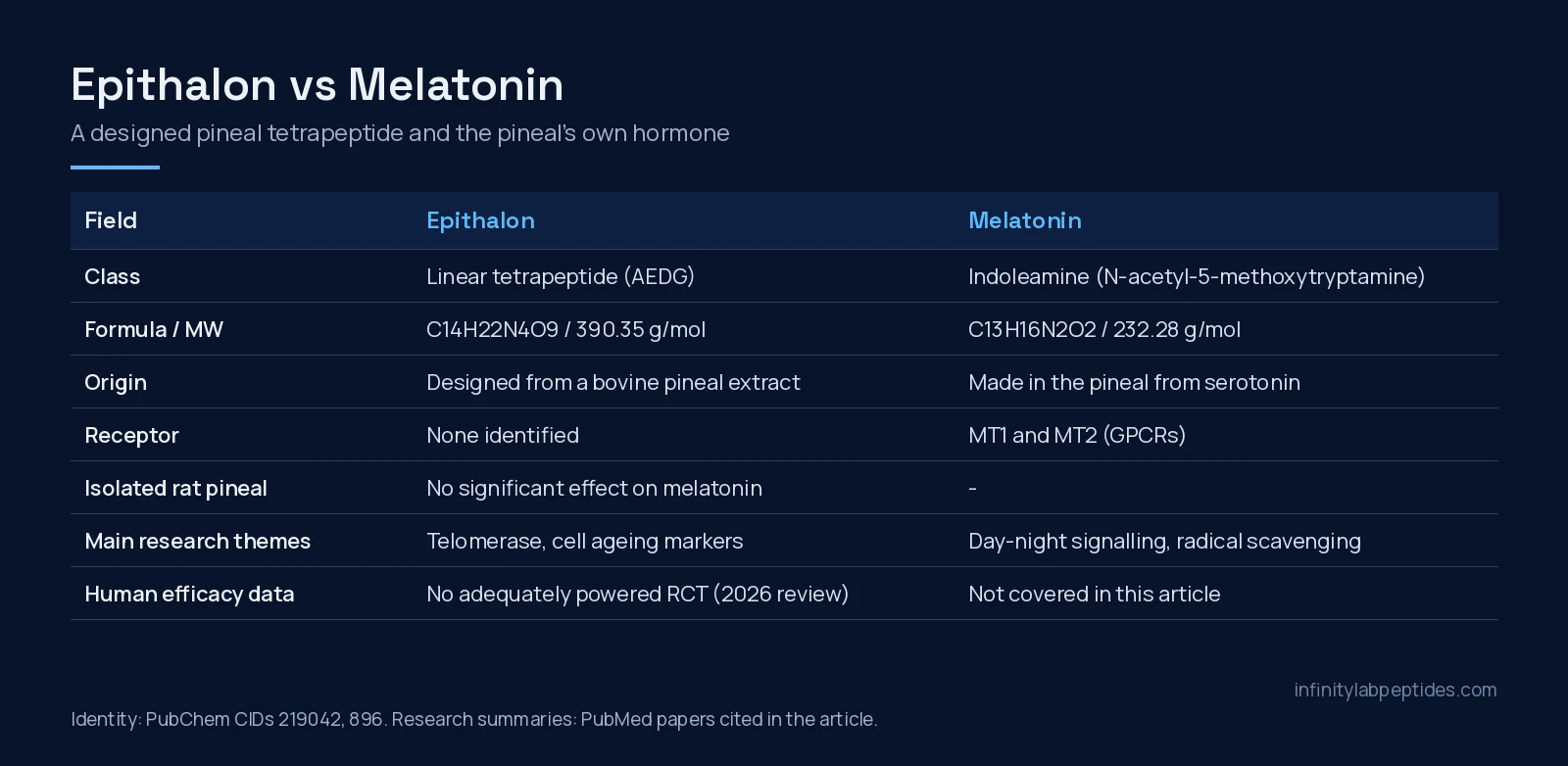
Values below come from PubChem. Both are small, but they belong to different chemical classes: one is a peptide, the other a modified tryptamine.
| Field | Epithalon | Melatonin |
|---|---|---|
| Chemical class | Linear tetrapeptide | Indoleamine (N-acetyl-5-methoxytryptamine) |
| Sequence or structure | Ala-Glu-Asp-Gly (AEDG) | Indole ring with a 5-methoxy group and an N-acetyl ethylamine side chain |
| Molecular formula | C14H22N4O9 | C13H16N2O2 |
| Molecular weight | 390.35 g/mol | 232.28 g/mol |
| CAS (PubChem synonym) | 307297-39-8 | 73-31-4 |
| PubChem CID | 219042 | 896 |
| Made in the body? | Designed first; later reported in pineal polypeptide material [1] | Yes: pineal gland, from serotonin [8] |
| Known receptor | None identified | MT1 and MT2 (genes MTNR1A, MTNR1B) [5] |
The practical consequence for a lab: identity testing differs. Epithalon is checked like any short peptide, by mass and HPLC purity. Melatonin is a non-peptide small molecule with its own reference standards.
How each one reached the lab
Melatonin: a hormone with a known pathway
The defining feature of melatonin physiology is a large day-night rhythm in circulating levels, with high values at night in every vertebrate studied [8]. The pathway is short: serotonin is acetylated to N-acetylserotonin, which is then methylated to melatonin. The step that sets the rhythm is the next-to-last enzyme, arylalkylamine N-acetyltransferase (AANAT), which Klein’s chapter calls the “melatonin rhythm enzyme” because it links environmental light and dark to the hormonal signal of time [8].
The clock itself sits elsewhere. Rhythms in the mammalian pineal depend on input from the suprachiasmatic nucleus of the hypothalamus, and the best-characterised pineal function is the night-time rise in melatonin synthesis that signals the length of the night [9]. Species differ in the details: rodents regulate the Aanat gene at the transcription level, while post-mortem work on human pineal tissue points to post-translational shaping of the melatonin pattern [9]. That species gap matters when reading any pineal study, including the epithalon ones below.
Epithalon: designed from an extract
Epithalon came at the pineal from the other direction. A 2025 review in the International Journal of Molecular Sciences describes it as a tetrapeptide synthesised on the basis of the amino-acid composition of epithalamin, a bovine pineal extract, before it was found in pineal polypeptide complex solution [1]. The same review notes that despite 25 years of in vitro, in vivo and in silico studies, physico-chemical and structural work on the peptide remains limited [1].
A 2026 narrative review draws a firmer line: epitalon and epithalamin are chemically distinct, and their studies should be judged separately [10]. Much of the older “pineal peptide” literature used the extract, not the tetrapeptide, so a claim about one does not transfer to the other.
Does epithalon change melatonin?
This is the question most search results answer with confidence. The primary papers are less tidy.
Isolated rat pineal: no effect
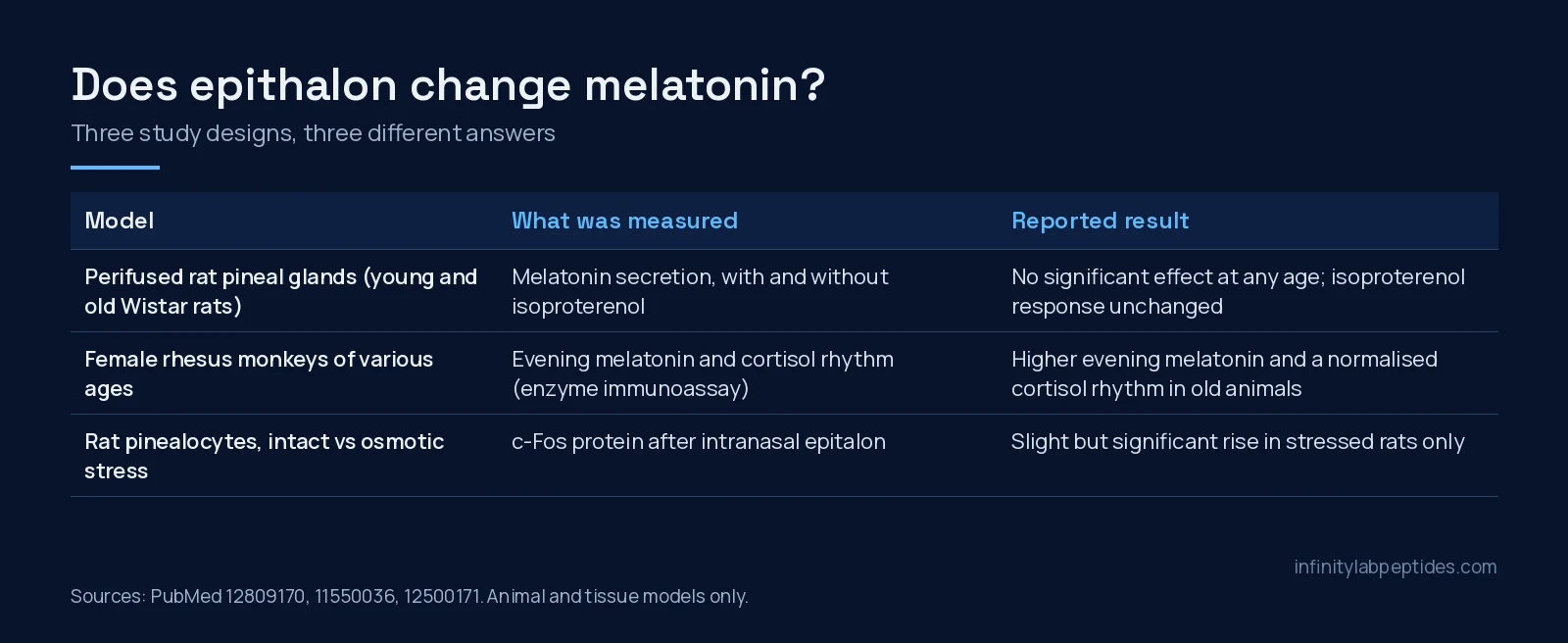
Pineal glands from young (9-week) and old (27-month) Wistar rats were perifused with the tetrapeptide. Across the concentrations tested it had no significant effect on melatonin secretion at either age, and it did not change the melatonin rise driven by the beta-adrenergic agonist isoproterenol [6].
Old rhesus monkeys: higher evening melatonin
In female rhesus monkeys of different ages, measured by enzyme immunoassay, epithalon stimulated evening melatonin production and normalised the day-night cortisol rhythm in the old animals [7].
Stressed rats: a small c-Fos signal
In rat pinealocytes, intranasal epitalon produced a slight but significant rise in c-Fos protein, but only in animals exposed to osmotic stress, not in intact rats [11].
Read together, these do not show that epithalon acts on the melatonin-making cells directly. The in vitro result argues against a direct action on the gland, at least under those conditions [6]. The monkey result was a whole-animal measurement, which leaves room for an indirect route through other tissues or the clock. The 2026 review lists circadian and neuroendocrine effects among reported findings but concludes that the peptide is biologically active yet clinically unproven [10].
Head-to-head: the rodent studies that tested both
A few Russian and Ukrainian groups ran melatonin and epithalon in the same experiment, which is the closest the literature gets to a direct comparison.
Lifespan in senescence-accelerated mice
In senescence-accelerated SAMP-1 mice, both melatonin and epitalon were followed by longer mean and maximum survival in the last 10% of survivors. Only melatonin was associated with a slower ageing rate and a longer mortality doubling time. Neither changed tumour frequency, although epitalon was followed by longer survival in tumour-free animals [2]. So the two overlapped on one survival measure and diverged on the others.
Blood leukocytes under different light schedules
A rat study looked at white cell counts under standard, constant-light and other photoperiods. Both compounds lowered total leukocytes and band neutrophils in 12-month-old rats. They then split: melatonin prevented the age-related fall in blood lymphocytes under a standard 12-hour light/dark cycle, whereas epithalon reduced lymphocytes and raised neutrophils at some ages [3].
Reproductive ageing under light pollution
In female rats exposed to light pollution and a chemical model of premature reproductive ageing, the authors reported that both melatonin and epitalon could correct changes in hypothalamic biogenic amines in the areas that control gonadotropin-releasing hormone [4].
All three are small animal studies from a narrow set of laboratories. They show the two molecules can produce overlapping readouts in rodents. They do not show that one substitutes for the other, and none has been independently replicated as far as the reviews report [10].
Where their mechanisms diverge
Melatonin has receptors and chemistry you can point to. MT1 and MT2 are seven-transmembrane receptors in the GPCR superfamily, and the IUPHAR review covers their ligands, knockout-mouse phenotypes, structures and disease-linked variants [5]. Separately, melatonin was identified as a free radical scavenger in 1993; structure-activity work places the reactive centre on the indole ring, with the methoxy and amide side chains adding to its capacity [12]. A 1994 review tied these threads to ageing: pineal melatonin output falls progressively with age, which led to the hypothesis that the loss might contribute to age-related damage [13]. That was framed as a hypothesis, and it should be read as one.
Epithalon’s proposed mechanisms are cellular and genetic. In telomerase-negative human fetal fibroblasts, adding the peptide induced expression of telomerase’s catalytic subunit, telomerase activity and telomere elongation [14]. A 2025 cell-line study reported telomere lengthening in normal cells through hTERT and telomerase upregulation, and in cancer cells through alternative lengthening of telomeres (ALT) [15]. That cancer-cell finding is one reason the 2026 review lists oncologic uncertainty among the open questions [10].
In short, melatonin is studied as a signal with a receptor; epithalon is studied mostly for effects on cells whose upstream target has not been found.
Evidence gaps worth knowing before you design a study
- Extract versus tetrapeptide. Check whether a paper used epithalamin or synthetic AEDG. The 2026 review treats them separately for good reason [10].
- In vitro versus whole animal. The rat perifusion result and the monkey result point in different directions [6][7]. A pineal culture readout alone will not settle the question.
- Species differences in melatonin control. Rodent and human pineals regulate AANAT differently [9], so a rodent melatonin endpoint is a weak proxy.
- Replication. The direct comparisons come from a small group of labs [2][3][4].
- Human data. The 2026 review found no adequately powered randomised trial establishing efficacy for epitalon, and inadequate pharmacokinetic and long-term safety data [10].
Sourcing epithalon for laboratory work
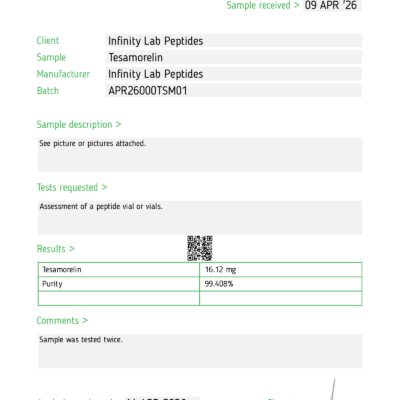
Our Epithalon 50 mg listing is supplied strictly for in vitro and laboratory research. At the time of writing our COA page lists no certificate for Epithalon, so we do not quote a purity figure, batch or test date for it here. If you are building a wider ageing panel, our earlier comparisons of epithalon and NAD+ and of DSIP and melatonin cover the neighbouring literature. To browse the full catalogue, you can buy research peptides in Canada from Infinity Lab Peptides.
Frequently asked questions
What is the difference between epithalon and melatonin?
Epithalon is a synthetic four-residue peptide (Ala-Glu-Asp-Gly) designed from the amino-acid composition of a bovine pineal extract. Melatonin is the pineal gland’s own indoleamine hormone, made from serotonin, and it acts through the MT1 and MT2 receptors. Epithalon has no identified receptor.
Does epithalon increase melatonin?
It depends on the model. In perifused rat pineal glands it had no significant effect on melatonin secretion in young or old animals, while a study in old female rhesus monkeys reported higher evening melatonin. The evidence does not show a direct action on the gland.
Have epithalon and melatonin been tested in the same study?
Yes, in a few rodent studies. In senescence-accelerated mice both were followed by longer survival in the last surviving animals, but only melatonin slowed the measured ageing rate. In rats, the two diverged on blood lymphocyte counts.
Is epithalon the same as epithalamin?
No. Epithalamin is a polypeptide extract of bovine pineal gland; epithalon is the synthetic tetrapeptide designed from that extract’s composition. A 2026 review evaluates their studies separately.
Does Infinity Lab Peptides post a COA for Epithalon?
Not at the time of writing. Our COA page lists no certificate for Epithalon 50 mg, so we do not quote a purity figure, batch or test date for it.
References
- Araj SK, Brzezik J, Mądra-Gackowska K et al. (2025). Overview of Epitalon-Highly Bioactive Pineal Tetrapeptide with Promising Properties. Int J Mol Sci. PMID: 40141333. doi: 10.3390/ijms26062691.
- Anisimov VN, Popovich IG, Zabezhinskiĭ MA et al. (2005). [Effect of epitalon and melatonin on life span and spontaneous carcinogenesis in senescence accelerated mice (SAM)]. Vopr Onkol. PMID: 15909815.
- Uzenbaeva LB, Vinogradova IA, Golubeva AG et al. (2008). [The influence of melatonin and epithalon on blood leukocyte count and leukocyte alkaline phosphatase in rats under different lighting conditions during ontogenesis]. Adv Gerontol. PMID: 19432172.
- Korenevsky AV, Milyutina YP, Bukalyov AV et al. (2013). [Protective effect of melatonin and epithalon on hypothalamic regulation of reproduction in female rats in its premature aging model and on estrous cycles in senescent animals in various lighting regimes]. Adv Gerontol. PMID: 28976150.
- Jockers R, Delagrange P, Dubocovich ML et al. (2016). Update on melatonin receptors: IUPHAR Review 20. Br J Pharmacol. PMID: 27314810. doi: 10.1111/bph.13536.
- Djeridane Y, Khavinson VKh, Anisimov VN et al. (2003). Effect of a synthetic pineal tetrapeptide (Ala-Glu-Asp-GLy) on melatonin secretion by the pineal gland of young and old rats. J Endocrinol Invest. PMID: 12809170. doi: 10.1007/BF03345159.
- Goncharova ND, Khavinson BK, Lapin BA (2001). Regulatory effect of Epithalon on production of melatonin and cortisol in old monkeys. Bull Exp Biol Med. PMID: 11550036. doi: 10.1023/a:1017928925177.
- Ganguly S, Coon SL, Klein DC (2002). Control of melatonin synthesis in the mammalian pineal gland: the critical role of serotonin acetylation. Cell Tissue Res. PMID: 12111543. doi: 10.1007/s00441-002-0579-y.
- Ackermann K, Stehle JH (2006). Melatonin synthesis in the human pineal gland: advantages, implications, and difficulties. Chronobiol Int. PMID: 16687310. doi: 10.1080/07420520500464379.
- Jain A, Gallacher DM, Issa MA et al. (2026). Epitalon and Epithalamin: A Narrative Review of Mechanistic, Preclinical, and Clinical Evidence. Int J Mol Sci. PMID: 42884164. doi: 10.3390/ijms27198922.
- Sibarov DA, Kovalenko RI, Malinin VV et al. (2002). Epitalon influences pineal secretion in stress-exposed rats in the daytime. Neuro Endocrinol Lett. PMID: 12500171.
- Tan DX, Reiter RJ, Manchester LC et al. (2002). Chemical and physical properties and potential mechanisms: melatonin as a broad spectrum antioxidant and free radical scavenger. Curr Top Med Chem. PMID: 11899100. doi: 10.2174/1568026023394443.
- Reiter RJ (1994). Pineal function during aging: attenuation of the melatonin rhythm and its neurobiological consequences. Acta Neurobiol Exp (Wars). PMID: 7801790.
- Khavinson VKh, Bondarev IE, Butyugov AA (2003). Epithalon peptide induces telomerase activity and telomere elongation in human somatic cells. Bull Exp Biol Med. PMID: 12937682. doi: 10.1023/a:1025493705728.
- Al-Dulaimi S, Thomas R, Matta S et al. (2025). Epitalon increases telomere length in human cell lines through telomerase upregulation or ALT activity. Biogerontology. PMID: 40908429. doi: 10.1007/s10522-025-10315-x.