For laboratory research only. Not for human or animal use. This article gives no dosing, administration or therapeutic advice.
Short answer: DSIP and melatonin get compared because both carry a sleep label. As research subjects they have almost nothing else in common. Melatonin is a small indoleamine with a known biosynthetic pathway: the enzyme serotonin N-acetyltransferase drives a night-time rise in the pineal gland [1], and two cloned receptors, MT1 and MT2, mediate its actions [2]. DSIP (delta sleep-inducing peptide) is a nine-residue peptide isolated from rabbit blood in 1977 [3]. Nearly fifty years on, no gene, precursor protein or receptor has been confirmed for it, and a 2006 review called the sleep-factor hypothesis “extremely poorly documented and still weak” [4]. This article compares how much is known about each molecule. It makes no claims about sleep.
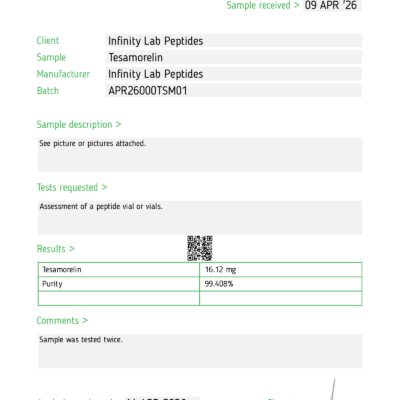
Spec cards from our COA library
DSIP
Purity: not shown
Batch: not shown
Analysis date: not shown
Lab: not shown
Listing: DSIP 15 mg
No certificate is posted for this product on our COA page at the time of writing.
Melatonin
Purity: not applicable
Batch: not applicable
Analysis date: not applicable
Lab: not applicable
Listing: not sold here
We do not list melatonin. It is here as the reference molecule people most often compare DSIP with.
We would rather leave a card blank than borrow a figure from another product. If a certificate is posted for the DSIP listing, this section will be updated.
Identity: a nonapeptide and an indoleamine
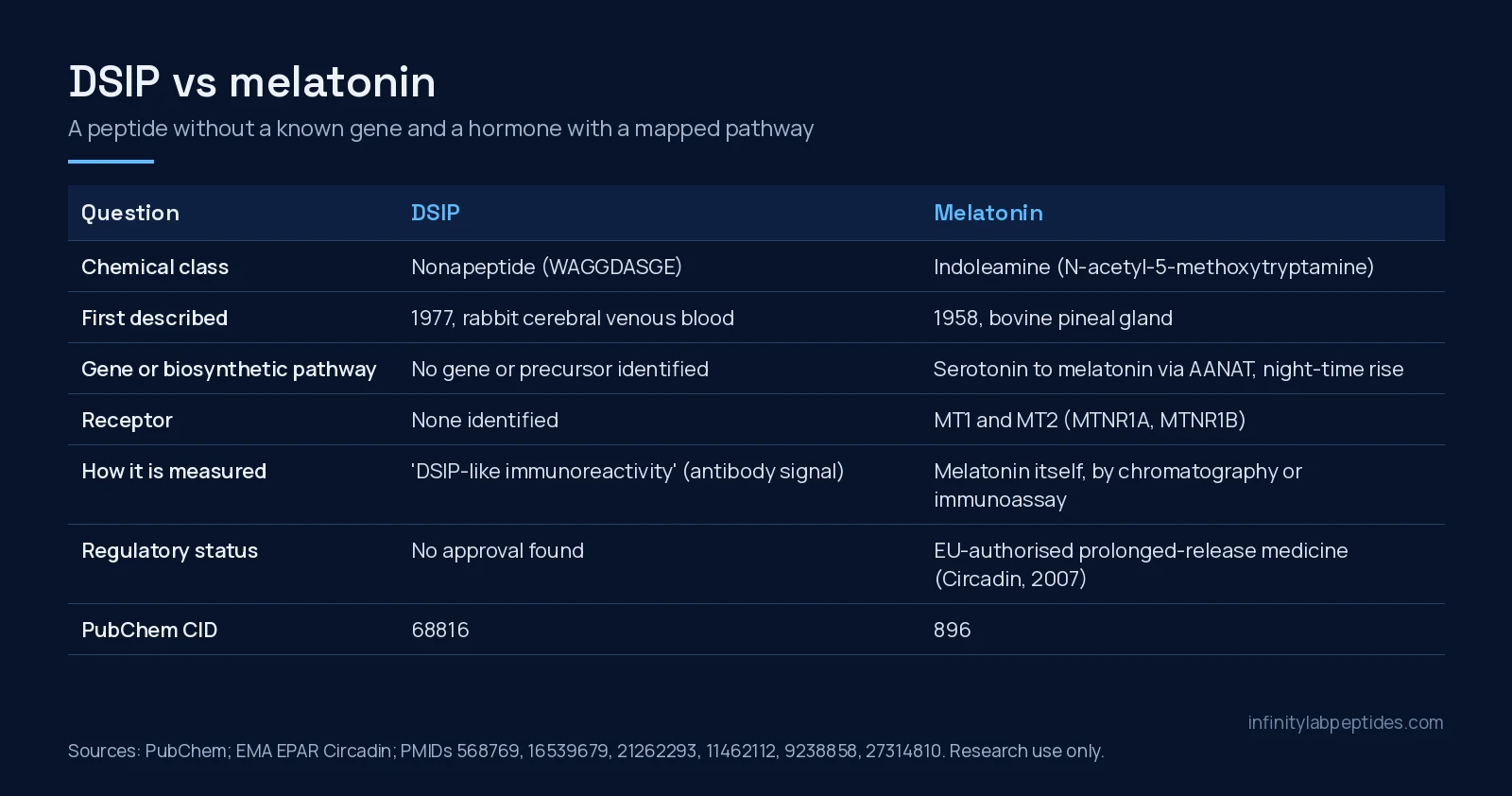
| Field | DSIP | Melatonin |
|---|---|---|
| Other names (PubChem synonyms) | Emideltide [INN], delta sleep-inducing peptide (rabbit) | N-acetyl-5-methoxytryptamine, Circadin |
| Structure | Trp-Ala-Gly-Gly-Asp-Ala-Ser-Gly-Glu (WAGGDASGE), linear | N-[2-(5-methoxy-1H-indol-3-yl)ethyl]acetamide |
| Molecular formula | C35H48N10O15 | C13H16N2O2 |
| Molecular weight (PubChem) | 848.8 g/mol | 232.28 g/mol |
| CAS (PubChem synonym) | 62568-57-4 | 73-31-4 |
| PubChem CID | 68816 | 896 |
| Endogenous source | Unconfirmed; detected only as “DSIP-like” immunoreactivity | Pineal gland, with extra-pineal production including the gut |
DSIP is roughly 3.7 times heavier than melatonin and, as a peptide, behaves very differently in solution and in assays. The original sequencing work found that only the alpha-aspartyl form of synthetic DSIP was highly active in its rabbit test; the beta-Asp isomer was not [3]. That point matters for anyone sourcing the peptide, because aspartate isomerisation is a known synthesis and storage issue.
Two discovery stories
Melatonin, 1958
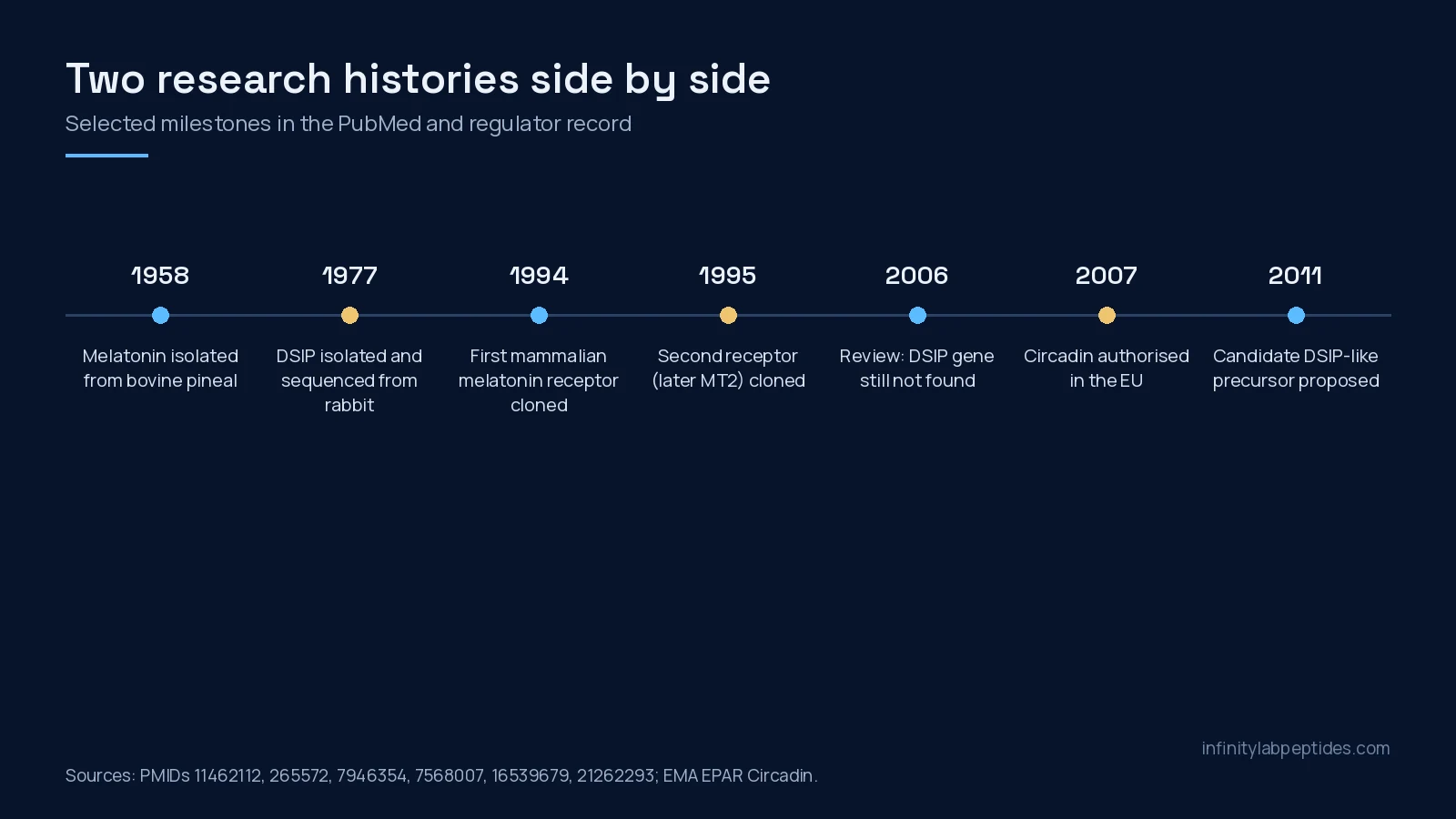
The pineal gland had been described since antiquity, but no secretory product was known until 1958, when Lerner and co-workers isolated a compound from bovine pineal glands. They named it melatonin after its blanching effect on melanophores, the pigment cells of amphibian skin [5]. So melatonin entered the literature as a skin-pigment factor, and its link to circadian rhythms came later.
DSIP, 1977
DSIP came out of a Basel group led by Schoenenberger and Monnier. They electrically stimulated a thalamic area in rabbits to induce sleep, collected dialysate from cerebral venous blood, and isolated a peptide that increased delta and spindle EEG activity when infused into the brain ventricles of other rabbits [3][6]. They sequenced it as WAGGDASGE and tested synthetic DSIP against five possible fragments, two altered nonapeptides and a related tripeptide under double-blind conditions. Only intact DSIP produced the specific EEG effect [6]. It is a careful piece of work, but it rests on one species, one route and one EEG readout.
The core difference: a mapped system vs an orphan peptide
For melatonin, each step from synthesis to signal has been described:
- Synthesis and rhythm. Circulating melatonin rises at night in every vertebrate studied. The rhythm-generating step is serotonin N-acetyltransferase (AANAT), whose activity climbs 7- to 150-fold at night depending on species and falls quickly on exposure to light [1].
- Sites outside the pineal. Melatonin has also been found in the gastrointestinal tract, where in carp the AANAT-linked rhythm peaks at midday rather than at night [7].
- Receptors. In 1994, high-affinity melatonin receptors were cloned from sheep and human as a new group of G protein-coupled receptors that inhibit adenylyl cyclase [8]. A second subtype expressed in human retina and brain followed in 1995 [9]. IUPHAR now names them MT1 and MT2, encoded by MTNR1A and MTNR1B [2].
For DSIP, every one of those steps is still open:
- No gene or precursor. A 2006 review attributes the weak state of the sleep hypothesis partly to the failure to isolate a DSIP gene, protein or receptor, and notes that DSIP’s structure does not match any known peptide family [4]. A 2011 database search found a closely related sequence (WKGGNASGE, two residues different) inside JMJD1B-type histone demethylases. The authors proposed these proteins as possible precursors of DSIP-like peptides. That remains a hypothesis [10].
- No receptor. No DSIP receptor has been identified [4]. A 1986 update listed modulation of adrenergic transmission as a possible mechanism “that remain[s] to be established” [11].
- A naming trap. The protein sometimes listed as “DSIP immunoreactor” is glucocorticoid-induced leucine zipper (GILZ), a circadian-regulated transcriptional regulator studied in adipose tissue [12]. It was named for antibody cross-reactivity. It is not a DSIP precursor or receptor, and research on it is not research on DSIP.
Comparison at a glance
| Question | DSIP | Melatonin | Source |
|---|---|---|---|
| Where it was first found | Rabbit cerebral venous blood, 1977 | Bovine pineal gland, 1958 | [3][5] |
| Biosynthesis | Unknown; candidate precursor proposed | AANAT-driven night-time synthesis | [10][1] |
| Receptor | Not identified | MT1 and MT2 (GPCRs) | [4][2] |
| What assays detect | “DSIP-like immunoreactivity” | Melatonin itself (for example by liquid chromatography) | [13][14] |
| Dose-response in animals | U-shaped curve reported | Not compared here | [15] |
| Regulatory status | No approval found | Circadin (prolonged-release melatonin) authorised in the EU on 29 June 2007 | EMA EPAR |
Research models and what they measured
DSIP: rabbits, rats and a handful of small human studies
Early reviews list effects of DSIP on EEG activity, brain neurotransmitter levels, circadian and locomotor patterns, hormone levels and drug withdrawal across rabbits, rats, mice and humans. They also report a U-shaped relationship for both dose and infusion time [15]. A U-shaped curve makes results hard to reproduce, because a small change in conditions can turn a positive finding into a null one.
More recent animal work has moved away from sleep. In a rat model of focal stroke, intranasal DSIP was followed by faster recovery on the rotarod motor test, but the reduction in infarct volume did not reach significance [16]. Russian groups have also tested DSIP and a glycine-containing formulation in rat stress and ischaemia models [17].
The human record is small and mostly decades old. In a double-blind study of 16 people with chronic insomnia, the authors found only weak effects that may partly have reflected an incidental change in the placebo group, and concluded that short-term DSIP was “not likely to be of major therapeutic benefit” [18]. Studies measuring DSIP-like immunoreactivity also point in different directions. In 15 men with schizophrenia, CSF levels correlated with slow-wave sleep measures [13]. In Cushing syndrome, plasma levels correlated negatively with delta sleep, which the authors read as evidence against a causal link [19].
Melatonin: from receptor knockouts to large trial pools
Melatonin research runs from receptor biology, including knockout mice and type 2 diabetes-associated MTNR1B variants [2], to many controlled human trials. Meta-analyses of those trials have used sleep onset latency, total sleep time and sleep efficiency as outcomes. Their authors stress that the trials differ widely in populations, measures and timing, and that earlier results were inconsistent [20][21]. We list the endpoints to show how mature that literature is, not to make any claim for melatonin.
One finding matters directly to lab buyers. In an analysis of 31 commercial melatonin supplements, measured content ranged from 83% below to 478% above the labelled amount, lot-to-lot variation within one product reached 465%, and eight products contained serotonin [14]. Label claims, in other words, are not analytical data. That holds for any research compound, which is why we explain why purity matters in research peptides.
What the evidence does not show
- That DSIP is an endogenous sleep factor. Without a confirmed gene, precursor or receptor, that idea is still a hypothesis [4]. One review notes that its authors’ own early rabbit and rat studies found slow-wave-sleep activity with certain synthetic DSIP analogues but not with DSIP itself [4].
- What “DSIP-like immunoreactivity” actually measures. Antibody signals may come from related peptides rather than DSIP, and human correlation studies disagree on direction [13][19].
- Any direct comparison. We found no study testing DSIP and melatonin side by side in the same model.
- Modern replication for DSIP. Most DSIP sleep data date from the 1970s to the 1990s, come from a small number of groups, and used EEG methods and sample sizes that would be considered limited today [6][18].
- A shared mechanism. Melatonin acts through MT1/MT2 [2]. No evidence links DSIP to those receptors, and DSIP’s own receptor, if one exists, is unknown [4].
For lab buyers
If you work with DSIP, specify the exact sequence (WAGGDASGE), confirm the aspartate is the alpha-linked form, and ask for batch-level identity and purity data. Our DSIP 15 mg listing has no certificate posted on our COA page at the time of writing. You can browse our catalogue and buy research peptides in Canada; every product is sold for laboratory research only.
Frequently asked questions
What is the difference between DSIP and melatonin?
DSIP is a nine-residue peptide (WAGGDASGE) isolated from rabbit blood in 1977. No gene, precursor or receptor has been confirmed for it. Melatonin is a small indoleamine made from serotonin, with a known synthetic enzyme (AANAT) and two cloned receptors, MT1 and MT2.
Does DSIP have a known receptor?
No. Reviews note that no DSIP gene, precursor protein or receptor has been isolated. A 2011 study proposed JMJD1B-type histone demethylases as possible precursors of DSIP-like peptides, but that is still a hypothesis.
Is the ‘DSIP immunoreactor’ protein the same as DSIP?
No. That name refers to glucocorticoid-induced leucine zipper (GILZ), a transcriptional regulator named for antibody cross-reactivity. It is a different molecule from the DSIP nonapeptide.
What is melatonin’s regulatory status?
A prolonged-release melatonin medicine, Circadin, received an EU marketing authorisation on 29 June 2007 (EMA product number EMEA/H/C/000695). We make no claims about any use of melatonin.
Is there a COA for DSIP at Infinity Lab Peptides?
Not at the time of writing. No certificate is posted for our DSIP 15 mg listing on our COA page. We do not sell melatonin.
References
- Klein DC, Coon SL, Roseboom PH et al. (1997). The melatonin rhythm-generating enzyme: molecular regulation of serotonin N-acetyltransferase in the pineal gland. Recent Prog Horm Res. PMID: 9238858.
- Jockers R, Delagrange P, Dubocovich ML et al. (2016). Update on melatonin receptors: IUPHAR Review 20. Br J Pharmacol. PMID: 27314810. doi: 10.1111/bph.13536.
- Schoenenberger GA, Maier PF, Tobler HJ et al. (1978). The delta EEG (sleep)-inducing peptide (DSIP). XI. Amino-acid analysis, sequence, synthesis and activity of the nonapeptide. Pflugers Arch. PMID: 568769. doi: 10.1007/BF00581575.
- Kovalzon VM, Strekalova TV (2006). Delta sleep-inducing peptide (DSIP): a still unresolved riddle. J Neurochem. PMID: 16539679. doi: 10.1111/j.1471-4159.2006.03693.x.
- Karasek M (1999). Melatonin in humans-where we are 40 years after its discovery. Neuro Endocrinol Lett. PMID: 11462112.
- Schoenenberger GA, Monnier M (1977). Characterization of a delta-electroencephalogram (-sleep)-inducing peptide. Proc Natl Acad Sci U S A. PMID: 265572. doi: 10.1073/pnas.74.3.1282.
- Mukherjee S, Maitra SK (2015). Gut Melatonin in Vertebrates: Chronobiology and Physiology. Front Endocrinol (Lausanne). PMID: 26257705. doi: 10.3389/fendo.2015.00112.
- Reppert SM, Weaver DR, Ebisawa T (1994). Cloning and characterization of a mammalian melatonin receptor that mediates reproductive and circadian responses. Neuron. PMID: 7946354. doi: 10.1016/0896-6273(94)90055-8.
- Reppert SM, Godson C, Mahle CD et al. (1995). Molecular characterization of a second melatonin receptor expressed in human retina and brain: the Mel1b melatonin receptor. Proc Natl Acad Sci U S A. PMID: 7568007. doi: 10.1073/pnas.92.19.8734.
- Mikhaleva II, Prudchenko IA, Ivanov VT et al. (2011). JmjC-domain-containing histone demethylases of the JMJD1B type as putative precursors of endogenous DSIP. Peptides. PMID: 21262293. doi: 10.1016/j.peptides.2011.01.006.
- Graf MV, Kastin AJ (1986). Delta-sleep-inducing peptide (DSIP): an update. Peptides. PMID: 3550726. doi: 10.1016/0196-9781(86)90148-8.
- Gimble JM, Ptitsyn AA, Goh BC et al. (2009). Delta sleep-inducing peptide and glucocorticoid-induced leucine zipper: potential links between circadian mechanisms and obesity?. Obes Rev. PMID: 19849801. doi: 10.1111/j.1467-789X.2009.00661.x.
- van Kammen DP, Widerlöv E, Neylan TC et al. (1992). Delta sleep-inducing-peptide-like immunoreactivity (DSIP-LI) and delta sleep in schizophrenic volunteers. Sleep. PMID: 1475566. doi: 10.1093/sleep/15.6.519.
- Erland LA, Saxena PK (2017). Melatonin Natural Health Products and Supplements: Presence of Serotonin and Significant Variability of Melatonin Content. J Clin Sleep Med. PMID: 27855744. doi: 10.5664/jcsm.6462.
- Graf MV, Kastin AJ (1984). Delta-sleep-inducing peptide (DSIP): a review. Neurosci Biobehav Rev. PMID: 6145137. doi: 10.1016/0149-7634(84)90022-8.
- Tukhovskaya EA, Ismailova AM, Shaykhutdinova ER et al. (2021). Delta Sleep-Inducing Peptide Recovers Motor Function in SD Rats after Focal Stroke. Molecules. PMID: 34500605. doi: 10.3390/molecules26175173.
- Koplik EV, Umryukhin PE, Konorova IL et al. (2008). Delta sleep-inducing peptide and Deltaran: potential approaches to antistress protection. Neurosci Behav Physiol. PMID: 18975104. doi: 10.1007/s11055-008-9076-4.
- Bes F, Hofman W, Schuur J et al. (1992). Effects of delta sleep-inducing peptide on sleep of chronic insomniac patients. A double-blind study. Neuropsychobiology. PMID: 1299794. doi: 10.1159/000118919.
- Friedman TC, García-Borreguero D, Hardwick D et al. (1994). Decreased delta-sleep and plasma delta-sleep-inducing peptide in patients with Cushing syndrome. Neuroendocrinology. PMID: 7700506. doi: 10.1159/000126806.
- Brzezinski A, Vangel MG, Wurtman RJ et al. (2005). Effects of exogenous melatonin on sleep: a meta-analysis. Sleep Med Rev. PMID: 15649737. doi: 10.1016/j.smrv.2004.06.004.
- Cruz-Sanabria F, Bruno S, Crippa A et al. (2024). Optimizing the Time and Dose of Melatonin as a Sleep-Promoting Drug: A Systematic Review of Randomized Controlled Trials and Dose-Response Meta-Analysis. J Pineal Res. PMID: 38888087. doi: 10.1111/jpi.12985.