For laboratory research only. Not for human or animal use. This article gives no dosing, administration or therapeutic advice.
Short answer: DSIP and epithalon are both small peptides that get filed under “sleep and ageing”, but they reached the lab by opposite routes. DSIP (delta sleep-inducing peptide) is a nine-residue peptide that a Basel group isolated in 1977 from the blood of rabbits during electrically induced sleep [1][2]; decades later its gene, precursor and receptor are still unidentified [2]. Epithalon (also spelled epitalon) is a four-residue peptide, Ala-Glu-Asp-Gly, that was designed from the amino-acid composition of a bovine pineal extract [3]. Where the two literatures overlap is the pineal gland, and there the results point in different directions: DSIP raised melatonin release from isolated rat pineal glands [4], while epithalon had no significant effect in the same kind of preparation [5]. Neither has an adequately powered human trial.
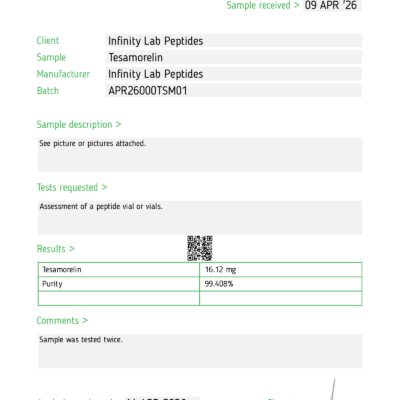
Spec cards from our COA library
DSIP
Purity: not shown
Batch: not shown
Analysis date: not shown
Lab: not shown
Listing: DSIP 15 mg
No certificate is posted for this product on our COA page at the time of writing.
Epithalon
Purity: not shown
Batch: not shown
Analysis date: not shown
Lab: not shown
Listing: Epithalon 50 mg
No certificate is posted for this product on our COA page at the time of writing.
We would rather leave both cards blank than borrow numbers from another product. If certificates are added, this section will be updated.
Identity at a glance
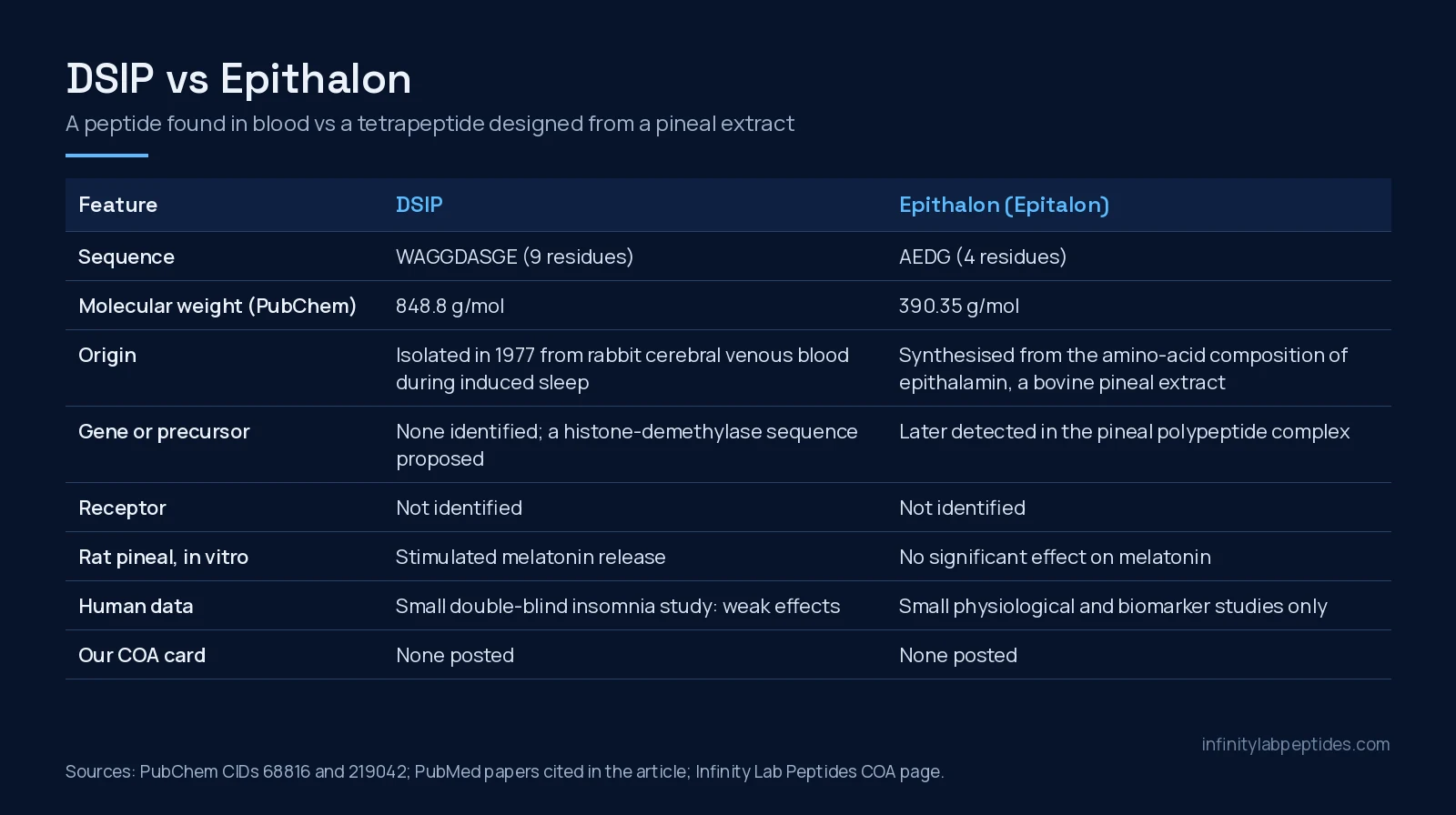
Values come from PubChem. Both are short, unmodified linear peptides, which makes identity testing simple: the measured mass should match the expected value closely.
| Field | DSIP | Epithalon |
|---|---|---|
| Other names (PubChem) | Emideltide (INN), delta sleep-inducing peptide (rabbit) | Epitalon, Epithalone, Ala-Glu-Asp-Gly, AEDG |
| Sequence | Trp-Ala-Gly-Gly-Asp-Ala-Ser-Gly-Glu (WAGGDASGE) | Ala-Glu-Asp-Gly (AEDG) |
| Length | 9 residues | 4 residues |
| Molecular formula | C35H48N10O15 | C14H22N4O9 |
| Molecular weight | 848.8 g/mol | 390.35 g/mol |
| CAS (PubChem synonym) | 62568-57-4 | 307297-39-8 |
| PubChem CID | 68816 | 219042 |
| FDA UNII | YN28Z5YZ73 | O65P17785G |
| How it entered research | Isolated from blood, then sequenced and synthesised | Designed and synthesised first, detected in pineal material later |
Both chains are rich in acidic residues (aspartate and glutamate), and DSIP carries a single tryptophan at its N-terminus. Beyond that they share nothing structurally.
Found versus designed
DSIP started as a physiological finding. The Basel group of Schoenenberger and Monnier [2] collected dialysate from the cerebral venous blood of rabbits whose sleep was induced by electrical stimulation of the thalamus. The peptide they isolated enhanced slow-wave (delta) and spindle activity on the EEG when infused into the brain ventricles of other rabbits, and they sequenced it as Trp-Ala-Gly-Gly-Asp-Ala-Ser-Gly-Glu [1][6]. The 1978 synthesis paper tested the synthetic nonapeptide, five possible breakdown fragments and analogues under double-blind conditions, and reported a specific delta and spindle effect for synthetic DSIP [6].
What happened next is the odd part. A 2006 review called the link between DSIP and sleep “extremely poorly documented”, in part because no DSIP gene, precursor protein or receptor had been isolated, and noted that DSIP’s structure does not resemble any known peptide family [2]. A 2011 database search proposed a candidate source: a family of JmjC-domain histone demethylases, one of which (encoded by JMJD1B) contains the sequence WKGGNASGE, differing from DSIP at two positions [7]. That remains a hypothesis.
Epithalon started as a chemistry decision. Researchers working with epithalamin, a polypeptide extract of bovine pineal gland, synthesised the tetrapeptide Ala-Glu-Asp-Gly on the basis of that extract’s amino-acid composition [3]. Only in 2017 did a mass-spectrometry study report detecting AEDG among the tetrapeptides of the pineal polypeptide complex [8]. A 2026 narrative review stresses that epithalamin is a chemically distinct preparation and treats its studies separately from those on synthetic epithalon [9].
Where they meet: the pineal gland
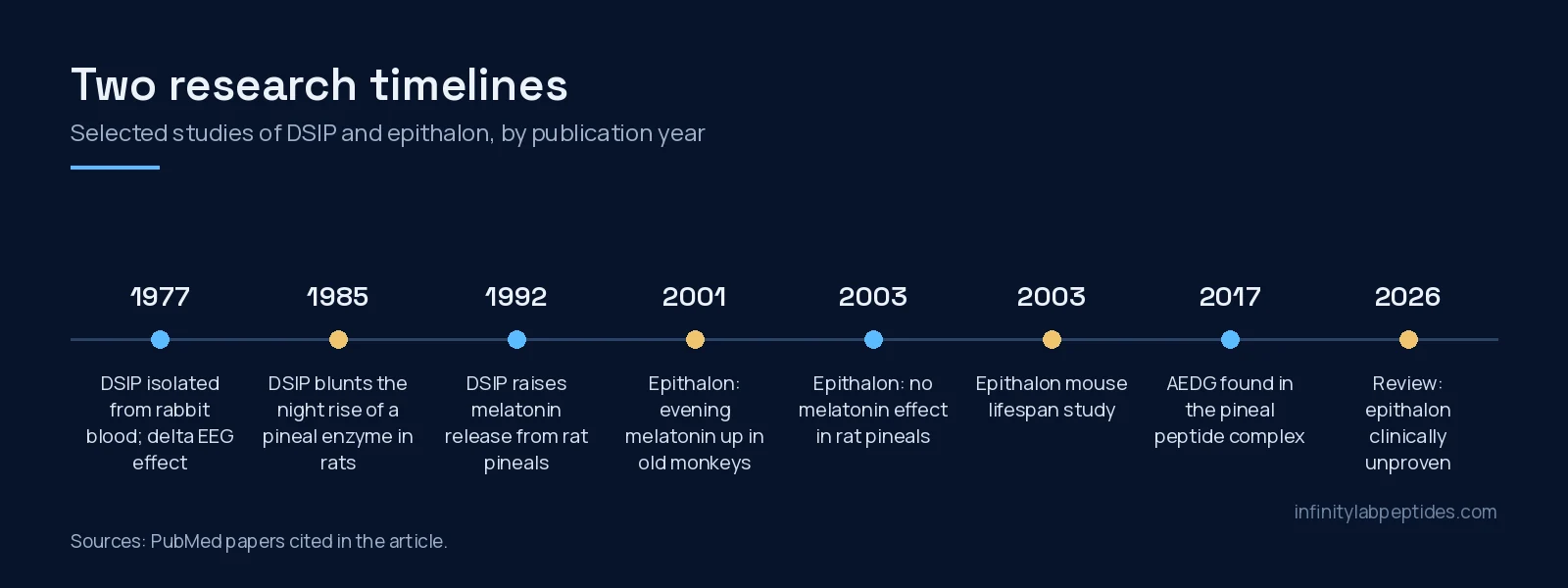
Melatonin is made in the pineal gland, and the enzyme serotonin N-acetyltransferase (NAT) controls its nightly rise. Both peptides have been tested against this system, which makes it the most useful place to compare them.
| Study | Peptide | Model | Reported result |
|---|---|---|---|
| 1985 [10] | DSIP and two analogues | Rats, given in the evening | Reduced the night-time increase in pineal NAT four hours later; morning administration did not change the enzyme |
| 1986 [11] | DSIP | Rats, given just before lights out | Slowed the rise of NAT and melatonin at three hours into the dark phase; later time points matched controls |
| 1987 [12] | DSIP and a phosphorylated analogue | Rat pineal glands in vitro | Enhanced norepinephrine-stimulated NAT; prazosin abolished the effect, pointing to the alpha-1 adrenergic receptor |
| 1992 [4] | DSIP | Perifused rat pineal glands | Stimulated melatonin, 5-methoxytryptophol and serotonin release without changing cyclic AMP |
| 2001 [13] | Epithalon | Female rhesus monkeys of various ages | Stimulated evening melatonin production and normalised the 24-hour cortisol rhythm in old monkeys |
| 2003 [5] | Epithalon | Perifused pineal glands from young and old rats | No significant effect on melatonin secretion, alone or with isoproterenol stimulation |
Two things stand out. DSIP’s in-vivo and in-vitro results do not line up neatly: given to rats in the evening it briefly slowed the nocturnal melatonin rise, while in isolated glands it increased melatonin release. And the only isolated-gland study of epithalon was negative, whereas its positive melatonin result comes from monkeys. These are separate studies from different laboratories and decades, not a head-to-head test, so they cannot rank the two.
Sleep and 24-hour rhythms in people
DSIP has two human data points worth knowing. A study that sampled plasma every 30 minutes for 24 hours in 12 volunteers found a clear 24-hour rhythm in DSIP-like immunoreactivity, highest in mid-afternoon and lowest around 1 a.m., closely tracking body temperature; levels were lower during REM and slow-wave sleep than during wakefulness, which the authors took to suggest that higher circulating DSIP may go with less, not more, slow-wave and REM sleep [14]. A double-blind study in 16 people with chronic insomnia reported higher sleep efficiency and shorter sleep latency with DSIP, but the authors judged the effects weak, partly explained by a change in the placebo group, and concluded that short-term DSIP treatment was unlikely to be of major benefit [15].
We found no polysomnography or sleep EEG trial of epithalon. Its circadian data are hormone rhythms in monkeys [13], and the 2026 review describes the human evidence as small physiological or biomarker studies plus an older controlled study in retinitis pigmentosa [9].
Lifespan models: epithalon’s main literature
Epithalon’s best-known animal work is in ageing models. In female outbred mice, long-term treatment did not change food consumption, body weight or mean lifespan, but the authors reported longer survival in the last 10% of animals, a slower age-related loss of oestrous function, fewer chromosome aberrations in bone marrow and less leukaemia [16]. In female rats kept under different lighting, it did not change lifespan under a standard light-dark cycle, while maximum lifespan was longer under natural northern light and constant light [17]. The DSIP papers we read deal mainly with sleep, stress tolerance and neuroendocrine effects rather than lifespan [7][2].
Mechanism: two orphan peptides
- DSIP: the pineal work suggested that DSIP modulates the alpha-1 adrenergic receptor’s response rather than acting through a receptor of its own [12]. The 2006 review proposed instead that a still-unidentified DSIP-like peptide may explain much of the DSIP-like immunoreactivity and activity reported over the years [2].
- Epithalon: a 2020 study in human gingival mesenchymal stem cells reported increased neurogenic differentiation markers, and molecular modelling suggested binding to linker histones H1/3 and H1/6 as a possible epigenetic route [18]. A 2025 overview noted that it remains uncertain whether the reported effects are the compound’s only mechanisms, and that physico-chemical and structural studies of it are limited [3].
Comparison at a glance
| Question | DSIP | Epithalon |
|---|---|---|
| Natural occurrence | Reported in blood; precursor unknown [7] | Detected in pineal polypeptide complex [8] |
| Identified receptor | None | None |
| Isolated rat pineal | Melatonin release increased [4] | No significant effect [5] |
| Primate or human hormone data | 24-hour plasma rhythm tracking body temperature [14] | Evening melatonin increase in old monkeys [13] |
| Controlled human study | 16-patient insomnia study, weak effects [15] | No adequately powered randomised trial [9] |
| Our posted COA | None | None |
Regulatory status
We know of no regulator approval for either peptide as a medicine. DSIP carries an international non-proprietary name, emideltide (PubChem synonym), but a name is not an approval. The 2026 epithalon review calls it biologically active but clinically unproven and lists regulatory uncertainties following a 2026 FDA advisory review as unresolved [9]. Status can change, so check the regulator, for example Health Canada’s Drug Product Database, rather than any vendor page, including ours.
What the evidence does not show
- No head-to-head study. We found no paper that tested DSIP and epithalon in the same experiment. The pineal comparison above sets separate studies side by side [4][5].
- DSIP’s sleep link is weak. Its own reviewers call it poorly documented [2], and the controlled insomnia study was close to null [15].
- Epithalon’s human evidence is thin. The 2026 review weighed study design, sample size and independent replication and still judged the compound clinically unproven [9].
- Epithalamin results are not epithalon results. The extract and the synthetic tetrapeptide are different materials [9].
- A certificate documents a batch, not biology. Purity and mass confirm what is in a vial, not what it does in a model.
What our documentation covers
For short peptides like these, a useful certificate reports chromatographic purity plus a measured mass near 848.8 Da for DSIP or 390.35 Da for epithalon. Our COA page does not yet list a report for DSIP 15 mg or Epithalon 50 mg, so we do not quote any purity for them here. For DSIP set against melatonin itself, see our DSIP vs melatonin comparison. Researchers comparing suppliers can buy research peptides in Canada with the documentation status of each product stated on its page.
Frequently asked questions
What is the main difference between DSIP and epithalon?
Origin and size. DSIP is a nine-residue peptide (WAGGDASGE) isolated in 1977 from rabbit blood during induced sleep. Epithalon is a synthetic four-residue peptide (AEDG) designed from the amino-acid composition of epithalamin, a bovine pineal extract. Neither has an identified receptor.
Do DSIP and epithalon affect melatonin?
Results differ by model. DSIP increased melatonin release from perifused rat pineal glands but briefly slowed the night-time melatonin rise when given to rats in the evening. Epithalon had no significant effect in perifused rat pineals, while a study in old rhesus monkeys reported higher evening melatonin.
Is DSIP proven to promote sleep?
No. A 2006 review called the sleep link extremely poorly documented, and a double-blind study in 16 people with chronic insomnia found weak effects that the authors judged unlikely to be of major benefit.
Is epithalon the same as epithalamin?
No. Epithalamin is a polypeptide extract of bovine pineal gland; epithalon is the synthetic tetrapeptide Ala-Glu-Asp-Gly designed from that extract’s composition. A 2026 review treats their studies separately.
Does Infinity Lab Peptides post a COA for DSIP or epithalon?
Not at the time of writing. Our COA page lists no report for DSIP 15 mg or Epithalon 50 mg, so we leave purity, batch and date blank rather than borrow figures from another product.
Research-use notice
DSIP and Epithalon from Infinity Lab Peptides are sold for laboratory research and analytical use only. They are not for human or animal consumption. This article summarises published research as reported by its authors; it is not medical advice and makes no claim about any product’s effects.
References
- Schoenenberger GA, Monnier M (1977). Characterization of a delta-electroencephalogram (-sleep)-inducing peptide. Proc Natl Acad Sci U S A. PMID: 265572. doi: 10.1073/pnas.74.3.1282.
- Kovalzon VM, Strekalova TV (2006). Delta sleep-inducing peptide (DSIP): a still unresolved riddle. J Neurochem. PMID: 16539679. doi: 10.1111/j.1471-4159.2006.03693.x.
- Araj SK, Brzezik J, Mądra-Gackowska K et al. (2025). Overview of Epitalon-Highly Bioactive Pineal Tetrapeptide with Promising Properties. Int J Mol Sci. PMID: 40141333. doi: 10.3390/ijms26062691.
- Ouichou A, Zitouni M, Raynaud F et al. (1992). Delta-sleep-inducing peptide stimulates melatonin, 5-methoxytryptophol and serotonin secretion from perifused rat pineal glands. Biol Signals. PMID: 1339175. doi: 10.1159/000109312.
- Djeridane Y, Khavinson VKh, Anisimov VN et al. (2003). Effect of a synthetic pineal tetrapeptide (Ala-Glu-Asp-GLy) on melatonin secretion by the pineal gland of young and old rats. J Endocrinol Invest. PMID: 12809170. doi: 10.1007/BF03345159.
- Schoenenberger GA, Maier PF, Tobler HJ et al. (1978). The delta EEG (sleep)-inducing peptide (DSIP). XI. Amino-acid analysis, sequence, synthesis and activity of the nonapeptide. Pflugers Arch. PMID: 568769. doi: 10.1007/BF00581575.
- Mikhaleva II, Prudchenko IA, Ivanov VT et al. (2011). JmjC-domain-containing histone demethylases of the JMJD1B type as putative precursors of endogenous DSIP. Peptides. PMID: 21262293. doi: 10.1016/j.peptides.2011.01.006.
- Khavinson VK, Kopylov AT, Vaskovsky BV et al. (2017). Identification of Peptide AEDG in the Polypeptide Complex of the Pineal Gland. Bull Exp Biol Med. PMID: 29124531. doi: 10.1007/s10517-017-3922-8.
- Jain A, Gallacher DM, Issa MA et al. (2026). Epitalon and Epithalamin: A Narrative Review of Mechanistic, Preclinical, and Clinical Evidence. Int J Mol Sci. PMID: 42884164. doi: 10.3390/ijms27198922.
- Graf MV, Kastin AJ, Schoenenberger GA (1985). Delta-sleep-inducing peptide and two of its analogs reduce nocturnal increase of N-acetyltransferase activity in rat pineal gland. J Neurochem. PMID: 3838100. doi: 10.1111/j.1471-4159.1985.tb05458.x.
- Oaknin S, Troiani ME, Webb SM et al. (1986). Influence of delta-sleep inducing peptide on melatonin synthesis in the rat pineal gland. Neurosci Lett. PMID: 3774211. doi: 10.1016/0304-3940(86)90450-7.
- Graf MV, Schoenenberger GA (1987). Delta sleep-inducing peptide modulates the stimulation of rat pineal N-acetyltransferase activity by involving the alpha 1-adrenergic receptor. J Neurochem. PMID: 3029331. doi: 10.1111/j.1471-4159.1987.tb05654.x.
- Goncharova ND, Khavinson BK, Lapin BA (2001). Regulatory effect of Epithalon on production of melatonin and cortisol in old monkeys. Bull Exp Biol Med. PMID: 11550036. doi: 10.1023/a:1017928925177.
- Friedman TC, Garcia-Borreguero D, Hardwick D et al. (1994). Diurnal rhythm of plasma delta-sleep-inducing peptide in humans: evidence for positive correlation with body temperature and negative correlation with rapid eye movement and slow wave sleep. J Clin Endocrinol Metab. PMID: 8175965. doi: 10.1210/jcem.78.5.8175965.
- Bes F, Hofman W, Schuur J et al. (1992). Effects of delta sleep-inducing peptide on sleep of chronic insomniac patients. A double-blind study. Neuropsychobiology. PMID: 1299794. doi: 10.1159/000118919.
- Anisimov VN, Khavinson VKh, Popovich IG et al. (2003). Effect of Epitalon on biomarkers of aging, life span and spontaneous tumor incidence in female Swiss-derived SHR mice. Biogerontology. PMID: 14501183. doi: 10.1023/a:1025114230714.
- Vinogradova IA, Bukalev AV, Zabezhinski MA et al. (2007). Effect of Ala-Glu-Asp-Gly peptide on life span and development of spontaneous tumors in female rats exposed to different illumination regimes. Bull Exp Biol Med. PMID: 18856211. doi: 10.1007/s10517-007-0441-z.
- Khavinson V, Diomede F, Mironova E et al. (2020). AEDG Peptide (Epitalon) Stimulates Gene Expression and Protein Synthesis during Neurogenesis: Possible Epigenetic Mechanism. Molecules. PMID: 32019204. doi: 10.3390/molecules25030609.