For laboratory research only. Not for human or animal use. This article gives no dosing, administration or therapeutic advice.
Short answer: SS-31 and MOTS-c are both called “mitochondrial peptides”, but they have almost nothing else in common. SS-31 (elamipretide) is a designed four-residue peptide, D-Arg-Dmt-Lys-Phe-NH2. It enters cells, concentrates at the inner mitochondrial membrane [1] and binds the phospholipid cardiolipin [2]. MOTS-c is a natural 16-residue peptide encoded by a short open reading frame inside mitochondrial DNA. In mouse work it acts as a signal: it inhibits the folate cycle, activates AMPK [3] and, under metabolic stress, moves into the nucleus to regulate gene expression [4]. One is a membrane-binding drug candidate that now has a US accelerated approval for one rare disease [5]. The other is a research peptide with no approved product and no interventional human trial that we could find.
Batch documentation at a glance
Our COA library is the only source for the statements below.
SS-31 50 mg
Purity: not available
Batch: not available
Lab: not available
Listing: SS-31 50 mg vial
No certificate is posted for this product on our COA page at the time of writing.
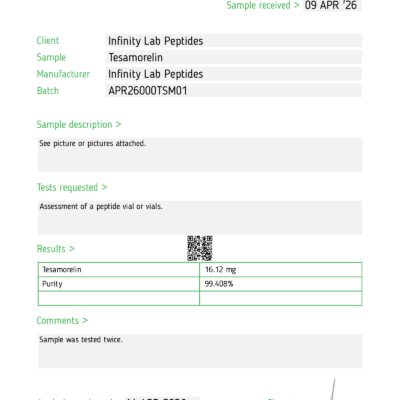
MOTS-c
Purity: 99.515%
Batch: APR26000MSC01
Analysis date: 14 APR 2026
Lab: Janoshik
Verification key: 34CJ3CIUKX6L
Listings: MOTS-C 10 mg, MOTS-C 40 mg
On our COA page this one report is listed for several MOTS-C listings (10 mg, 40 mg vial and pen). It is a single batch result, not a per-vial test.
For SS-31 there is no posted report, so identity and purity cannot be checked from our library today. Ask for batch documentation before you plan around it, and build identity confirmation into your own method.
Identity
Values below are PubChem’s.
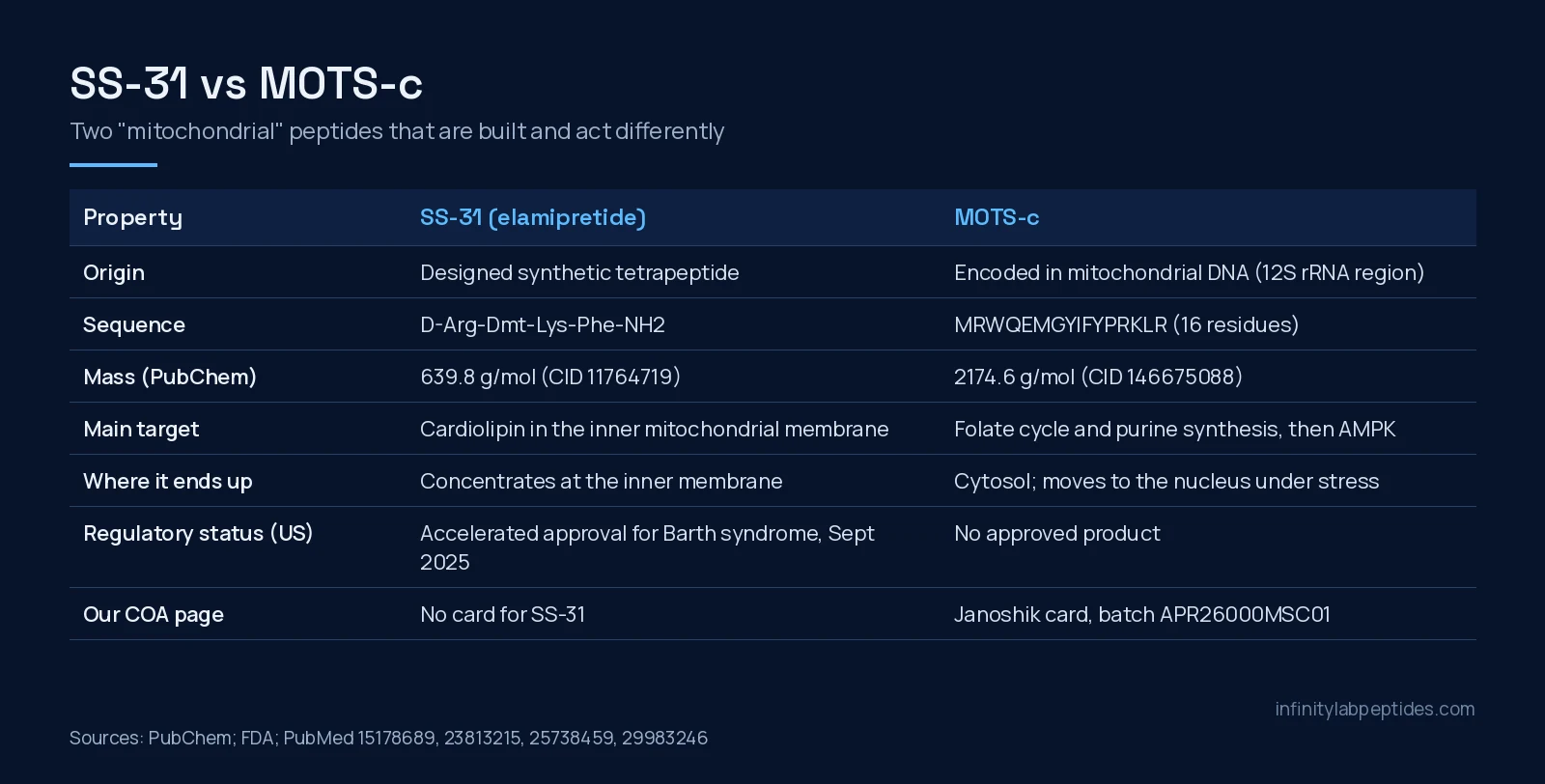
| Property | SS-31 | MOTS-c |
|---|---|---|
| Class | Synthetic tetrapeptide, amidated C-terminus | Mitochondrial-derived peptide, 16 residues |
| Sequence | D-Arg-Dmt-Lys-Phe-NH2 (Dmt = 2′,6′-dimethyltyrosine) | MRWQEMGYIFYPRKLR |
| Synonyms | Elamipretide, MTP-131, Bendavia | Mitochondrial open reading frame of the 12S rRNA-c |
| Molecular formula | C32H49N9O5 | C101H152N28O22S2 |
| Molecular weight | 639.8 g/mol | 2174.6 g/mol |
| CAS | 736992-21-5 | 1627580-64-6 |
| PubChem CID | 11764719 | 146675088 |
The structural contrast matters for lab work. SS-31 carries a D-amino acid and a non-natural tyrosine, so it is not something cells make. MOTS-c is an all-L natural sequence that your cells or animals already produce, which complicates any measurement of an added amount.
SS-31: a peptide that binds a membrane lipid
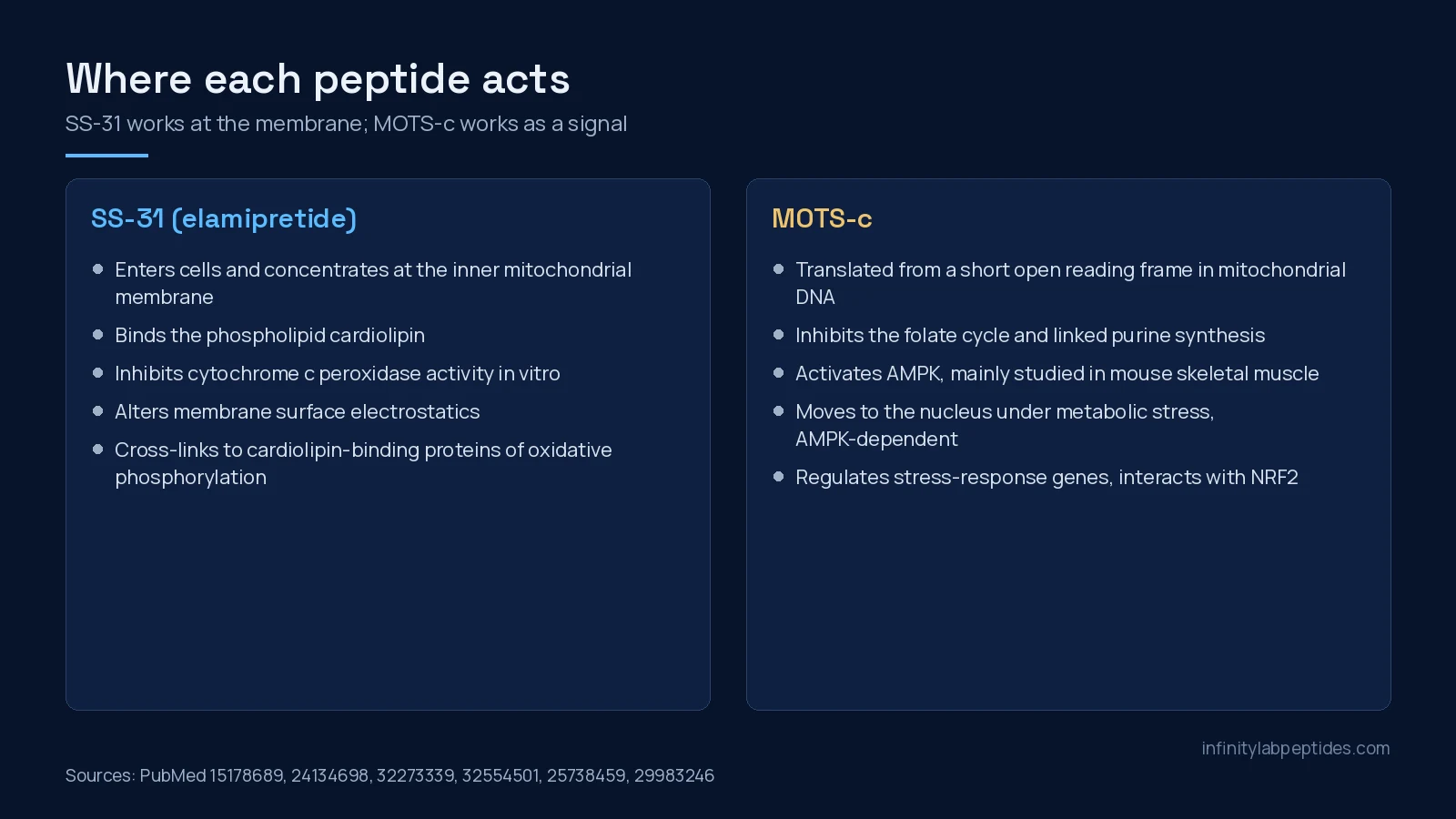
The Szeto-Schiller peptides were built from alternating aromatic and basic residues. In the founding cell study, they were cell-permeable and concentrated in the inner mitochondrial membrane. There they reduced mitochondrial swelling, cytochrome c release and oxidative cell death in cell models [1]. The early explanation was antioxidant chemistry, but the mechanism was later reframed around cardiolipin. Using a fluorescent analogue, Birk and colleagues showed high-affinity binding to cardiolipin. The SS-31/cardiolipin complex inhibited cytochrome c peroxidase activity, and in a rat kidney ischemia model pretreatment protected cristae membranes [2]. Liposome and NMR work found that SS-31 interacted only with cardiolipin-containing membranes, at about a 1:1 ratio, and restored cytochrome c reduction in vitro [6].
Later biophysics broadened the picture. SS-31 sits in the membrane interface in proportion to surface charge and changes membrane surface electrostatics without destabilising the bilayer [7]. Cross-linking mass spectrometry found that its protein partners in mitochondria are all known cardiolipin binders, mostly in oxidative phosphorylation and 2-oxoglutarate metabolism [8]. In aged mice, an eight-week course restored measures of mitochondrial ATP production and redox status in skeletal muscle, without raising mitochondrial protein levels [9].
MOTS-c: a peptide encoded by mitochondrial DNA
MOTS-c was reported in 2015 as a 16-residue peptide translated from a short open reading frame within the mitochondrial 12S rRNA gene. Its main target organ in mice appeared to be skeletal muscle. There it inhibited the folate cycle and the linked de novo purine synthesis, which built up the AMP-like intermediate AICAR and activated AMPK [3]. A 2018 follow-up showed that MOTS-c moves into the nucleus under metabolic stress such as glucose restriction, in an AMPK-dependent way. There it regulated many genes, including ones with antioxidant response elements, and interacted with the stress-responsive transcription factor NRF2 [4].
Work since then has stayed largely in animals and cells. MOTS-c treatment improved physical performance in young, middle-aged and old mice, and exercise raised MOTS-c in human skeletal muscle and plasma [10]. The human data are observational. In one small study, plasma levels were similar in lean and obese groups but tracked insulin-sensitivity indices mainly in lean people [11]. Another found lower circulating but higher muscle MOTS-c in older men than in young men [12]. A natural East Asian mtDNA variant changes residue 14 from lysine to glutamine (K14Q). The variant form was less active in mouse and cell tests, and the allele was associated with type 2 diabetes in men in cohort data [13].
Regulatory status, stated neutrally
On September 19, 2025, the U.S. Food and Drug Administration granted accelerated approval to Forzinity (elamipretide) for Barth syndrome, a rare inherited disorder of cardiolipin remodelling. The FDA notes that accelerated approval rests on a measure considered reasonably likely to predict benefit, and that it requires a confirmatory randomized trial. A drug review summarises the same milestone and notes other indications still in development [5]. Elsewhere the trial record is mixed. A phase 3 trial in primary mitochondrial myopathy did not meet its primary endpoints [14], and in a phase 2/3 Barth syndrome trial the randomized part did not meet its primary endpoints before an open-label extension [15]. We give these by design and outcome only. The research material we list is not the approved medicine and is not for human use. MOTS-c has no approved product anywhere that we found.
Side-by-side comparison
| Question | SS-31 (elamipretide) | MOTS-c |
|---|---|---|
| Where it comes from | Designed synthetic peptide [1] | Encoded in mitochondrial DNA [3] |
| Primary molecular partner | Cardiolipin in the inner membrane [2],[6] | Folate cycle and purine synthesis, then AMPK [3] |
| Location in the cell | Inner mitochondrial membrane [1] | Cytosol, moving to the nucleus under stress [4] |
| Kind of action | Membrane biophysics, electrostatics [7] | Signalling and gene regulation [4] |
| Key model systems | Cell lines, isolated mitochondria, rat kidney, aged mice [2],[9] | Mouse muscle and diet models, cell lines [3],[10] |
| Human data | Randomized trials, mixed results [14],[15] | Observational plasma and muscle levels only [11],[12] |
| Status | US accelerated approval for Barth syndrome [5] | None |
What the evidence does not show
- It does not show that SS-31 and MOTS-c act on the same pathway, or that combining them does anything. We found no published study testing the two together.
- For SS-31, a US approval for one rare disease does not show benefit in other settings. The phase 3 myopathy trial missed its primary endpoints [14].
- For MOTS-c, the metabolic and performance findings come from mice and cells [3],[10]. The human studies measured natural levels and cannot show what an added peptide does [11],[12].
- The exact protein receptor for MOTS-c is not established in the papers cited here. Its AMPK effects are described through metabolic changes [3].
- The SS-31 mechanism is still being refined, from early antioxidant chemistry to cardiolipin binding to membrane electrostatics [1],[2],[7].
Practical notes for lab work
Because SS-31 works by partitioning into charged membranes, buffer composition and lipid content in an assay can change results [7]. With MOTS-c, any experiment in living cells has to account for the peptide the cells already make, and for whether the system carries the K14Q variant [13]. For related reading, see our SS-31 vs NAD+ comparison and MOTS-c vs metformin. You can view the SS-31 50 mg and MOTS-C 10 mg listings, or buy research peptides in Canada from our catalogue.
Frequently asked questions
Are SS-31 and MOTS-c the same kind of peptide?
No. SS-31 is a synthetic four-residue peptide with a D-amino acid and a modified tyrosine. MOTS-c is a natural 16-residue peptide encoded in mitochondrial DNA. They share the word mitochondrial and little else.
What does SS-31 bind to?
Research shows SS-31 concentrates at the inner mitochondrial membrane and binds cardiolipin, an anionic phospholipid. The SS-31/cardiolipin complex inhibited cytochrome c peroxidase activity in vitro, and later work showed it changes membrane surface electrostatics.
How does MOTS-c reach AMPK?
In mouse and cell studies MOTS-c inhibited the folate cycle and linked purine synthesis, which raised the AMP-like intermediate AICAR and activated AMPK. Under metabolic stress it also moved into the nucleus and regulated stress-response genes.
Is elamipretide approved?
The U.S. FDA granted Forzinity (elamipretide) accelerated approval for Barth syndrome on September 19, 2025, with a confirmatory trial required. MOTS-c has no approved product. Research-grade material is not the approved medicine and is not for human use.
Does Infinity Lab Peptides post COAs for SS-31 and MOTS-c?
MOTS-c: yes, a Janoshik report, batch APR26000MSC01, purity 99.515%, analysis date 14 APR 2026, key 34CJ3CIUKX6L, listed for several MOTS-C listings. SS-31: no certificate is posted on our COA page at the time of writing.
References
- Zhao K, Zhao GM, Wu D et al. (2004). Cell-permeable peptide antioxidants targeted to inner mitochondrial membrane inhibit mitochondrial swelling, oxidative cell death, and reperfusion injury. J Biol Chem. PMID: 15178689. doi: 10.1074/jbc.M402999200.
- Birk AV, Liu S, Soong Y et al. (2013). The mitochondrial-targeted compound SS-31 re-energizes ischemic mitochondria by interacting with cardiolipin. J Am Soc Nephrol. PMID: 23813215. doi: 10.1681/ASN.2012121216.
- Lee C, Zeng J, Drew BG et al. (2015). The mitochondrial-derived peptide MOTS-c promotes metabolic homeostasis and reduces obesity and insulin resistance. Cell Metab. PMID: 25738459. doi: 10.1016/j.cmet.2015.02.009.
- Kim KH, Son JM, Benayoun BA et al. (2018). The Mitochondrial-Encoded Peptide MOTS-c Translocates to the Nucleus to Regulate Nuclear Gene Expression in Response to Metabolic Stress. Cell Metab. PMID: 29983246. doi: 10.1016/j.cmet.2018.06.008.
- Shirley M (2026). Elamipretide: First Approval. Drugs. PMID: 41335372. doi: 10.1007/s40265-025-02269-8.
- Birk AV, Chao WM, Bracken C et al. (2014). Targeting mitochondrial cardiolipin and the cytochrome c/cardiolipin complex to promote electron transport and optimize mitochondrial ATP synthesis. Br J Pharmacol. PMID: 24134698. doi: 10.1111/bph.12468.
- Mitchell W, Ng EA, Tamucci JD et al. (2020). The mitochondria-targeted peptide SS-31 binds lipid bilayers and modulates surface electrostatics as a key component of its mechanism of action. J Biol Chem. PMID: 32273339. doi: 10.1074/jbc.RA119.012094.
- Chavez JD, Tang X, Campbell MD et al. (2020). Mitochondrial protein interaction landscape of SS-31. Proc Natl Acad Sci U S A. PMID: 32554501. doi: 10.1073/pnas.2002250117.
- Campbell MD, Duan J, Samuelson AT et al. (2019). Improving mitochondrial function with SS-31 reverses age-related redox stress and improves exercise tolerance in aged mice. Free Radic Biol Med. PMID: 30597195. doi: 10.1016/j.freeradbiomed.2018.12.031.
- Reynolds JC, Lai RW, Woodhead JST et al. (2021). MOTS-c is an exercise-induced mitochondrial-encoded regulator of age-dependent physical decline and muscle homeostasis. Nat Commun. PMID: 33473109. doi: 10.1038/s41467-020-20790-0.
- Cataldo LR, Fernández-Verdejo R, Santos JL et al. (2018). Plasma MOTS-c levels are associated with insulin sensitivity in lean but not in obese individuals. J Investig Med. PMID: 29593067. doi: 10.1136/jim-2017-000681.
- D’Souza RF, Woodhead JST, Hedges CP et al. (2020). Increased expression of the mitochondrial derived peptide, MOTS-c, in skeletal muscle of healthy aging men is associated with myofiber composition. Aging (Albany NY). PMID: 32182209. doi: 10.18632/aging.102944.
- Zempo H, Kim SJ, Fuku N et al. (2021). A pro-diabetogenic mtDNA polymorphism in the mitochondrial-derived peptide, MOTS-c. Aging (Albany NY). PMID: 33468709. doi: 10.18632/aging.202529.
- Karaa A, Bertini E, Carelli V et al. (2023). Efficacy and Safety of Elamipretide in Individuals With Primary Mitochondrial Myopathy: The MMPOWER-3 Randomized Clinical Trial. Neurology. PMID: 37268435. doi: 10.1212/WNL.0000000000207402.
- Reid Thompson W, Hornby B, Manuel R et al. (2021). A phase 2/3 randomized clinical trial followed by an open-label extension to evaluate the effectiveness of elamipretide in Barth syndrome, a genetic disorder of mitochondrial cardiolipin metabolism. Genet Med. PMID: 33077895. doi: 10.1038/s41436-020-01006-8.
Research use only. All products referenced on this page are intended for laboratory research and analytical use. They are not drugs, supplements or cosmetics and are not for human or animal consumption.