For laboratory research only. Not for human or animal use. This article gives no dosing, administration or therapeutic advice.
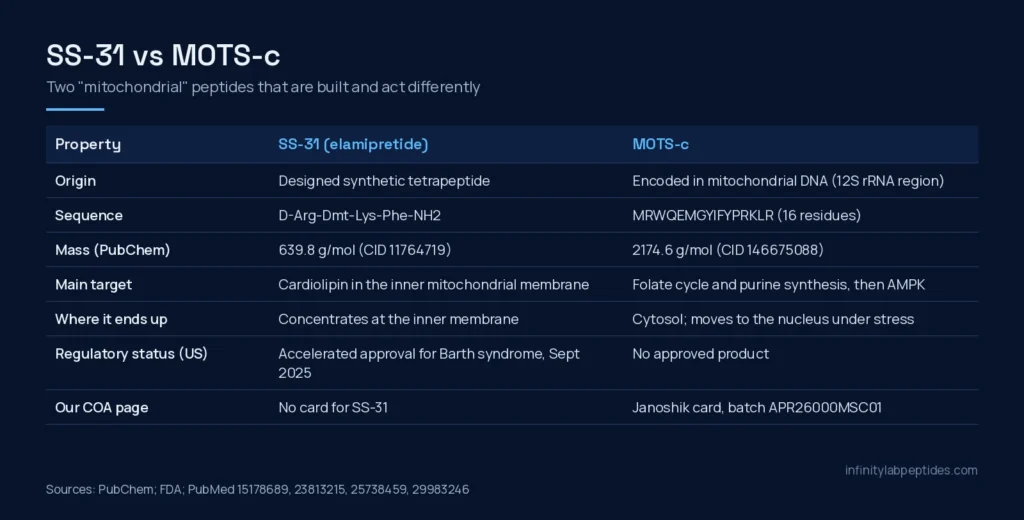
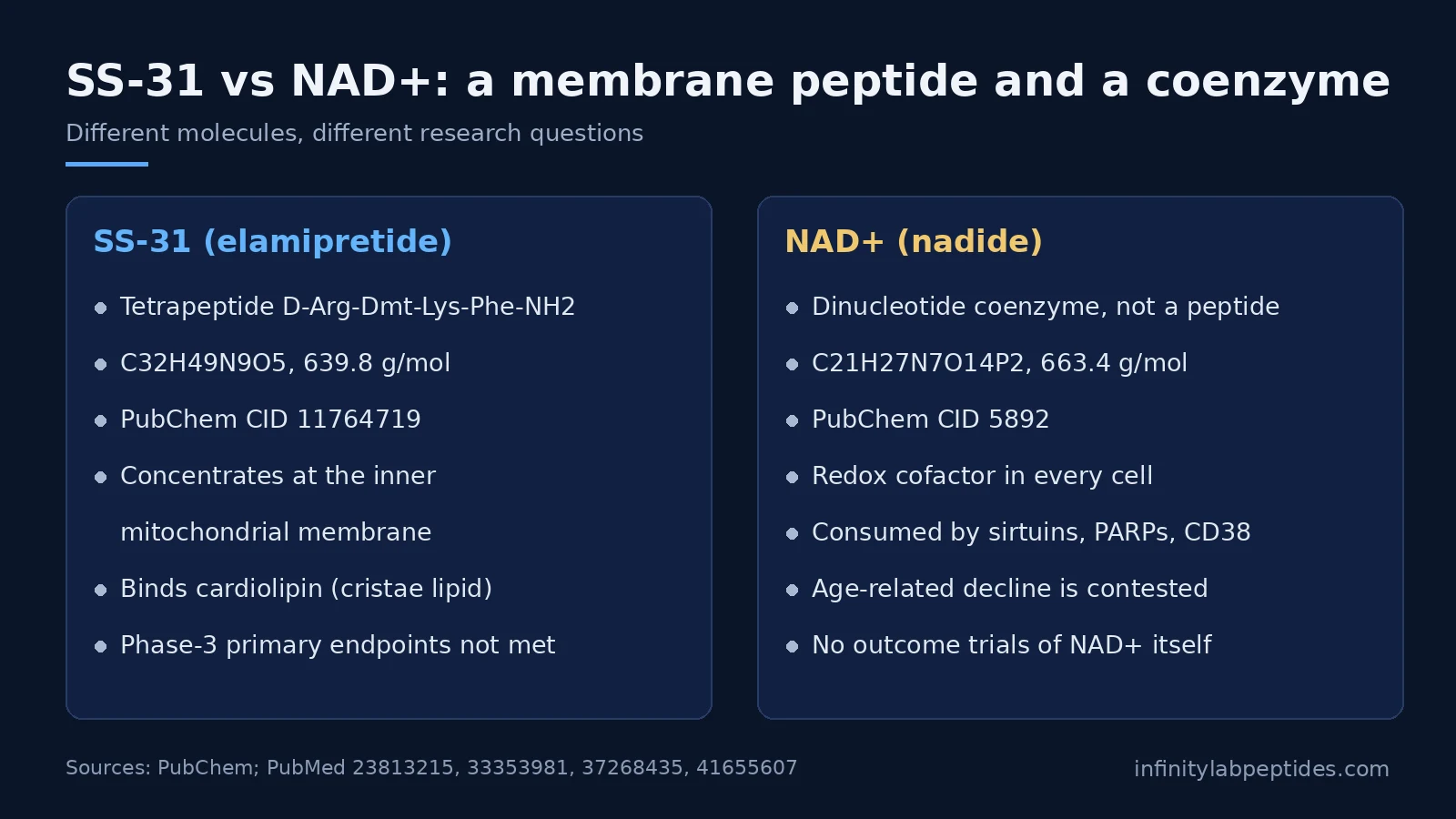
Short answer: SS-31 and NAD+ both turn up in mitochondrial research, but they work at different points. SS-31 (also called elamipretide, MTP-131 or Bendavia) is a synthetic four-residue peptide built to cross cell membranes and concentrate at the inner mitochondrial membrane, where it binds the phospholipid cardiolipin[1],[2]. NAD+ is a dinucleotide coenzyme found in every living cell. It carries electrons in redox reactions and is consumed by sirtuins, PARPs and CD38[4]. Put simply, SS-31 is studied as a membrane-structure tool, and NAD+ as a metabolic cofactor and enzyme substrate. Both have larger claims around them than the controlled evidence supports[12],[10].
Batch documentation at a glance
Our COA library is the only source for the statements below.
SS-31 50 mg
Listing: SS-31 50 mg vial
Purity: not available
Batch: not available
No certificate is posted for this product on our COA page at the time of writing.
NAD+ 1000 mg
Listing: NAD+ 1000 mg vial
Purity: not available
Batch: not available
No certificate is posted for this product on our COA page at the time of writing.
With no posted report for either listing, identity and content cannot be checked from our library today. If your work depends on either compound, ask for batch documentation before you plan around it, and build identity confirmation into your own method. Our guide on why purity matters in research peptides explains what a certificate should show.
Identity
Values below are PubChem’s.
| Property | SS-31 | NAD+ |
|---|---|---|
| Chemical class | Synthetic tetrapeptide (amidated C-terminus) | Dinucleotide coenzyme; not a peptide |
| Sequence / structure | D-Arg-Dmt-Lys-Phe-NH2 (Dmt = 2′,6′-dimethyltyrosine) | Nicotinamide riboside and adenosine joined through a pyrophosphate |
| Synonyms | Elamipretide, MTP-131, Bendavia, Szeto-Schiller peptide 31 | Nadide, beta-NAD, coenzyme I, diphosphopyridine nucleotide |
| Molecular formula | C32H49N9O5 | C21H27N7O14P2 |
| Molecular weight | 639.8 g/mol | 663.4 g/mol |
| CAS | 736992-21-5 | 53-84-9 |
| PubChem CID | 11764719 | 5892 |
Their molecular weights are close, but that is the only real similarity. SS-31 is a designed peptide with a D-amino acid at position one and a modified tyrosine at position two. NAD+ is a natural metabolite your experimental system already makes.
What SS-31 is studied for
The Szeto-Schiller peptides were designed around alternating aromatic and basic residues. In the original 2004 work, these peptides were cell-permeable and concentrated about 1000-fold in the inner mitochondrial membrane in cell models[1]. The 2,6-dimethyltyrosine residue was included for its radical-scavenging chemistry[1].
Later work changed the main explanation. In 2013, a fluorescent SS-31 analogue was shown to bind cardiolipin with high affinity. Cardiolipin is the anionic phospholipid that shapes the inner-membrane folds called cristae. The SS-31/cardiolipin complex also inhibited the peroxidase activity of cytochrome c, which drives cardiolipin oxidation, in a rat kidney ischemia model[2]. A 2014 review by the peptide’s originator describes it as a “cardiolipin-protective” compound rather than a simple antioxidant[3].
For a lab, this means SS-31 questions are usually about membrane structure: cristae shape, cardiolipin oxidation, how cytochrome c behaves, and the coupling of the electron transport chain. The usual readouts are oxygen consumption, membrane potential, cardiolipin oxidation products and electron microscopy of cristae.
What NAD+ is studied for
NAD+ and its reduced form NADH carry electrons between metabolic reactions. NAD+ is also a co-substrate that sirtuins, poly(ADP-ribose) polymerases and CD38 break down as they work. That links it to DNA repair, chromatin regulation and immune signalling[4]. Its turnover is fast: in some tissues the NAD pool has a half-life of minutes[5].
The “NAD+ declines with age” story is real but more complicated than marketing suggests. In mice, the NAD-consuming enzyme CD38 rises with age and drives much of the tissue decline[6]. But isotope-tracing work in aged mice found only a modest drop (median about 30%), with synthesis flux maintained and consumption faster[7]. A 2021 review of studies across species concluded that the evidence for a general age-related decline, especially in humans, is very limited and often comes from a single tissue[8].
Most NAD+ research tests precursors such as nicotinamide riboside and nicotinamide mononucleotide, not NAD+ itself[9]. A 2026 systematic review of 113 studies found that precursors reliably raise NAD-related metabolites in humans, but functional and metabolic outcomes were mixed and often null. It found no eligible outcome trials of NAD+ itself[10].
Side-by-side comparison
| Question | SS-31 | NAD+ |
|---|---|---|
| Where it acts | Inner mitochondrial membrane (cardiolipin)[2] | Cytosol, nucleus and mitochondria (separate pools)[4] |
| Main research model | Mitochondrial structure and bioenergetics[3] | Redox metabolism and NAD-consuming enzymes[5] |
| Made by the cell? | No, synthetic | Yes, from tryptophan and vitamin B3 precursors[7] |
| Key design problem | Separating cardiolipin effects from general antioxidant effects | NAD+ itself vs a precursor vs measured intracellular levels |
| Controlled human trials | Several; main phase-3 endpoints not met[12] | Precursor trials mixed; none for NAD+ itself[10] |
| Our posted COA | None posted | None posted |
What the evidence does not show
- SS-31’s controlled trials have mostly missed their main endpoints. In MMPOWER-2, a crossover trial in 30 adults with primary mitochondrial myopathy, the walk-test difference was not statistically significant (p = 0.08)[11]. The phase-3 MMPOWER-3 trial (218 participants) did not meet either primary endpoint, a 6-minute walk test and a fatigue score[12]. In the randomized part of the TAZPOWER trial in Barth syndrome, neither primary endpoint was met; the reported signals came from the open-label extension, which had no placebo group[13].
- A short-term heart failure study is not a long-term result. A small placebo-controlled study in heart failure with reduced ejection fraction measured left-ventricular volumes over 24 hours only, and its authors called for further study of long-term safety and outcomes[14].
- Cell and rodent mechanism work does not carry over automatically. The cardiolipin model rests largely on cell, isolated-mitochondria and rat data[2],[3].
- NAD+ levels and NAD+ flux are different things. A lower tissue concentration can sit beside normal synthesis[7], so a single NAD+ measurement says little about turnover.
- No head-to-head studies exist. We found no published study comparing SS-31 with NAD+ or its precursors in the same model.
Practical notes for lab work
Pick the compound that matches your question. If the question is about membrane structure, cardiolipin or cristae, SS-31 is the tool the literature uses, and it should be paired with a cardiolipin readout. If the question is about redox balance or sirtuin and PARP activity, NAD+ biology is the field, and you need to decide early whether you are testing NAD+ itself, a precursor, or measured intracellular levels. For both, report lot numbers, check identity yourself where no certificate is posted, and follow our notes on storage and handling of research peptides. NAD+ in particular is sensitive to light, heat and moisture.
For related mitochondrial reading, see our MOTS-c vs 5-Amino-1MQ comparison. Our research peptides overview lists related compounds, and you can buy research peptides in Canada from our catalogue with Canadian shipping.
Frequently asked questions
Is SS-31 the same as elamipretide?
Yes. SS-31 is the original laboratory name (Szeto-Schiller peptide 31). Elamipretide, MTP-131 and Bendavia are later names for the same tetrapeptide, D-Arg-Dmt-Lys-Phe-NH2 (PubChem CID 11764719, CAS 736992-21-5).
How does SS-31 differ from NAD+ at the molecular level?
SS-31 is a synthetic peptide that concentrates at the inner mitochondrial membrane and binds cardiolipin. NAD+ is a natural dinucleotide coenzyme that carries electrons in redox reactions and is consumed by sirtuins, PARPs and CD38. One is studied as a membrane-structure tool, the other as a metabolic cofactor.
Did the elamipretide trials succeed?
Mostly not on their main endpoints. The phase-3 MMPOWER-3 trial in primary mitochondrial myopathy did not meet either primary endpoint, and the randomized part of the TAZPOWER trial in Barth syndrome did not meet its primary endpoints either. Signals reported from open-label extensions had no placebo comparison.
Does NAD+ really decline with age?
Partly. In mice, tissue NAD+ falls modestly with age and the enzyme CD38 drives much of the drop, but isotope tracing found synthesis flux maintained. A 2021 review judged the evidence for a general age-related decline in humans to be very limited.
Are COAs posted for SS-31 50 mg and NAD+ 1000 mg?
No. At the time of writing our COA page shows no certificate for either listing, so purity and identity cannot be checked from our library for these products.
References
- Zhao K, Zhao GM, Wu D et al. (2004). Cell-permeable peptide antioxidants targeted to inner mitochondrial membrane inhibit mitochondrial swelling, oxidative cell death, and reperfusion injury. J Biol Chem. PMID: 15178689. doi: 10.1074/jbc.M402999200.
- Birk AV, Liu S, Soong Y et al. (2013). The mitochondrial-targeted compound SS-31 re-energizes ischemic mitochondria by interacting with cardiolipin. J Am Soc Nephrol. PMID: 23813215. doi: 10.1681/ASN.2012121216.
- Szeto HH (2014). First-in-class cardiolipin-protective compound as a therapeutic agent to restore mitochondrial bioenergetics. Br J Pharmacol. PMID: 24117165. doi: 10.1111/bph.12461.
- Covarrubias AJ, Perrone R, Grozio A et al. (2021). NAD(+) metabolism and its roles in cellular processes during ageing. Nat Rev Mol Cell Biol. PMID: 33353981. doi: 10.1038/s41580-020-00313-x.
- Chini CCS, Zeidler JD, Kashyap S et al. (2021). Evolving concepts in NAD(+) metabolism. Cell Metab. PMID: 33930322. doi: 10.1016/j.cmet.2021.04.003.
- Camacho-Pereira J, Tarragó MG, Chini CCS et al. (2016). CD38 Dictates Age-Related NAD Decline and Mitochondrial Dysfunction through an SIRT3-Dependent Mechanism. Cell Metab. PMID: 27304511. doi: 10.1016/j.cmet.2016.05.006.
- McReynolds MR, Chellappa K, Chiles E et al. (2021). NAD(+) flux is maintained in aged mice despite lower tissue concentrations. Cell Syst. PMID: 34559996. doi: 10.1016/j.cels.2021.09.001.
- Peluso A, Damgaard MV, Mori MAS et al. (2021). Age-Dependent Decline of NAD(+)-Universal Truth or Confounded Consensus?. Nutrients. PMID: 35010977. doi: 10.3390/nu14010101.
- Rajman L, Chwalek K, Sinclair DA (2018). Therapeutic Potential of NAD-Boosting Molecules: The In Vivo Evidence. Cell Metab. PMID: 29514064. doi: 10.1016/j.cmet.2018.02.011.
- Gallagher C, Emmanuel OO (2026). NAD⁺ supplementation for anti-aging and wellness: A PRISMA-guided systematic review of preclinical and clinical evidence. Ageing Res Rev. PMID: 41655607. doi: 10.1016/j.arr.2026.103057.
- Karaa A, Haas R, Goldstein A et al. (2020). A randomized crossover trial of elamipretide in adults with primary mitochondrial myopathy. J Cachexia Sarcopenia Muscle. PMID: 32096613. doi: 10.1002/jcsm.12559.
- Karaa A, Bertini E, Carelli V et al. (2023). Efficacy and Safety of Elamipretide in Individuals With Primary Mitochondrial Myopathy: The MMPOWER-3 Randomized Clinical Trial. Neurology. PMID: 37268435. doi: 10.1212/WNL.0000000000207402.
- Reid Thompson W, Hornby B, Manuel R et al. (2021). A phase 2/3 randomized clinical trial followed by an open-label extension to evaluate the effectiveness of elamipretide in Barth syndrome, a genetic disorder of mitochondrial cardiolipin metabolism. Genet Med. PMID: 33077895. doi: 10.1038/s41436-020-01006-8.
- Daubert MA, Yow E, Dunn G et al. (2017). Novel Mitochondria-Targeting Peptide in Heart Failure Treatment: A Randomized, Placebo-Controlled Trial of Elamipretide. Circ Heart Fail. PMID: 29217757. doi: 10.1161/CIRCHEARTFAILURE.117.004389.
Research use only. All products referenced on this page are intended for laboratory research and analytical use. They are not drugs, supplements or cosmetics and are not for human or animal consumption.