For laboratory research only. Not for human or animal use. This article gives no dosing, administration or therapeutic advice.
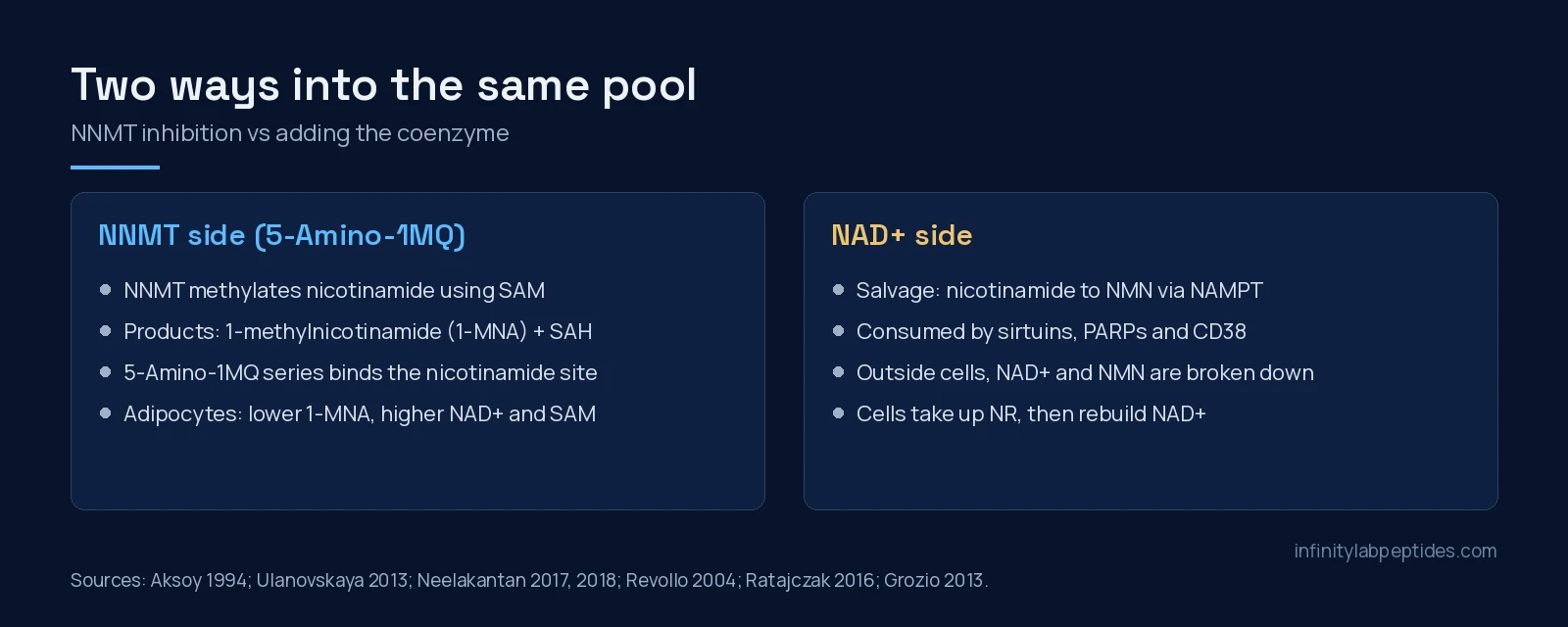
Short answer: 5-Amino-1MQ and NAD+ are often sold side by side, but they are different kinds of research tools. NAD+ (nicotinamide adenine dinucleotide) is the coenzyme itself: a redox carrier and the substrate that sirtuins, PARPs and CD38 consume [1][2]. 5-Amino-1MQ (5-amino-1-methylquinolinium) is a small synthetic cation, not a peptide, from a series of inhibitors of nicotinamide N-methyltransferase (NNMT) [3]. NNMT uses S-adenosylmethionine (SAM) to methylate nicotinamide, turning it into 1-methylnicotinamide (1-MNA) [4][5]. In cultured adipocytes, inhibitors from this series lowered 1-MNA and raised intracellular NAD+ and SAM [6]. So one compound was studied as a way to change how cells handle nicotinamide, and the other is the end product of that pathway. This article compares the two as research subjects and makes no claims about any use in people.
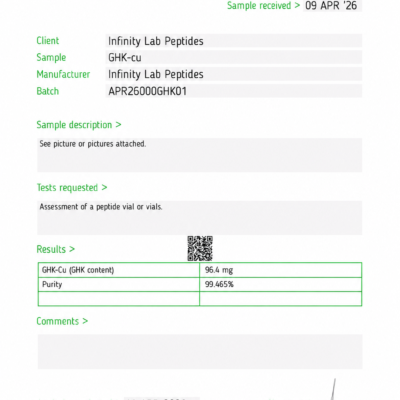
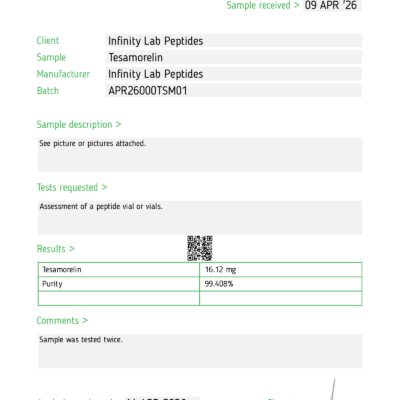
Spec cards from our COA library
5-Amino-1MQ
Purity: not shown
Batch: not shown
Analysis date: not shown
Lab: not shown
Listing: 5-Amino-1MQ 50 mg
No certificate is posted for this product on our COA page at the time of writing.
NAD+
Purity: not shown
Batch: not shown
Analysis date: not shown
Lab: not shown
Listing: NAD+ 1000 mg
No certificate is posted for this product on our COA page at the time of writing.
Neither listing has a posted certificate as of this review, so we have left the cards blank rather than borrow a figure from another product. If a report is posted for either one, this section will be updated.
Identity: a quinolinium cation and a dinucleotide
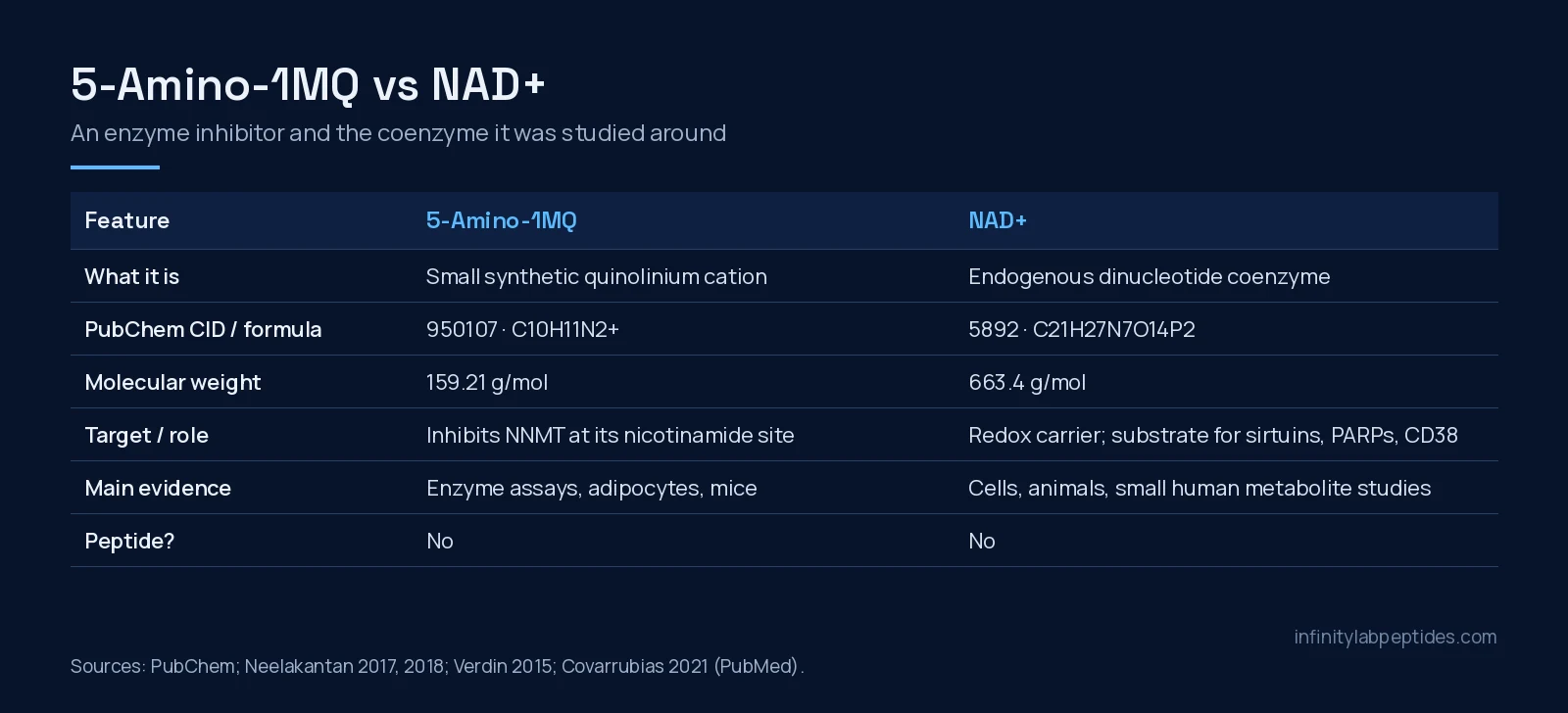
| Field | 5-Amino-1MQ | NAD+ |
|---|---|---|
| PubChem title | 5-Amino-1-methylquinolinium | Nadide |
| Other names (PubChem synonyms) | 5-amino-1-methylquinolinium ion; CHEMBL4116828 | nicotinamide adenine dinucleotide, beta-NAD, coenzyme I, diphosphopyridine nucleotide |
| Molecular formula | C10H11N2+ | C21H27N7O14P2 |
| Molecular weight (PubChem) | 159.21 g/mol | 663.4 g/mol |
| CAS (PubChem synonym) | 685079-15-6 | 53-84-9 |
| PubChem CID | 950107 | 5892 |
| Class | Small-molecule enzyme inhibitor (not a peptide) | Endogenous coenzyme (not a peptide) |
The PubChem record for 5-Amino-1MQ describes the cation; a supplied material will carry a counter-ion, and the salt form changes the mass per milligram weighed. The NNMT product 1-MNA (CID 457, C7H9N2O+, 137.16 g/mol) is worth knowing too, because it is the readout most NNMT inhibitor studies measure.
How NNMT sits next to the NAD+ pool
NNMT is a cytosolic methyltransferase. The 1994 cloning paper characterised the human liver enzyme with two co-substrates, nicotinamide and SAM, and showed that its own product, N1-methylnicotinamide, inhibits it [4]. That reaction matters for two pools at once:
- Nicotinamide. In mammalian cells NAD+ is largely rebuilt from nicotinamide through the salvage pathway, and NAMPT (nicotinamide phosphoribosyltransferase) is the rate-limiting step. Raising Nampt, but not Nmnat, increased total NAD in mouse fibroblasts [7]. Nicotinamide that NNMT methylates leaves this loop as 1-MNA.
- Methyl groups. In cancer cell lines, Ulanovskaya and colleagues showed by metabolomics that NNMT consumes methyl units from SAM to make the stable product 1-MNA. They called this a “methylation sink”: NNMT-expressing cells had hypomethylated histones and other proteins [5].
Reviews now describe NNMT as more than a vitamin B3 clearance enzyme, with links to energy metabolism and methylation in fat and liver [8]. The case for it as a metabolic target came largely from mice. In a 2014 study, antisense knockdown of Nnmt in adipose tissue and liver protected high-fat-fed mice from diet-induced obesity. The authors linked this to higher energy expenditure, higher adipose SAM and NAD+, changes in histone methylation and more polyamine flux [9].
That picture is not settled. A 2019 study using both knockdown and full Nnmt knockout found sex- and diet-specific results. Male knockouts showed better insulin-sensitivity estimates, but there was no improvement in glucose tolerance [10]. That is the kind of null result a buyer reading vendor copy rarely sees.
What the 5-Amino-1MQ studies actually tested
The compound comes from one research program: nearly every primary paper lists Neelakantan and Watowich among the authors [3][11].
Enzyme and cell work
A 2017 structure-activity study screened quinoline-based small molecules and found NNMT inhibitors spanning more than a 1000-fold range of activity. Docking placed the quinolinium analogues in the nicotinamide-binding site [3]. The 2018 follow-up tested membrane permeability (PAMPA and Caco-2 assays) and selectivity. Methylquinolinium analogues with primary amine substitutions crossed membranes well and did not inhibit related SAM-dependent methyltransferases or NAD+ salvage enzymes [6]. In cultured adipocytes, the inhibitors reduced intracellular 1-MNA, increased intracellular NAD+ and SAM, and suppressed lipogenesis [6]. That is the experiment most “5-Amino-1MQ raises NAD+” claims trace back to: a cell-culture measurement in fat cells.
Mouse work
- Diet-induced obese mice (2018). A potent NNMT inhibitor reduced body weight, white adipose mass, adipocyte size and plasma total cholesterol, with no change in food intake reported [6].
- Aged muscle injury (2019). In 24-month-old mice with an induced muscle injury, an NNMT inhibitor from the series increased muscle stem cell proliferation and fusion, and C2C12 myoblasts showed shifts in NAD+/NADH redox state [12].
- Diet switch (2021). Combined with a lean-diet substitution in obese mice, NNMT inhibition produced a distinct adipose metabolomic signature [13].
- Named compound, 2024. A study that names the compound (as 5A1MQ) reported dose-dependent limits on weight and fat-mass gain in obese mice, with plasma pharmacokinetics and distribution to fat, muscle and liver [11].
All of these are rodent or cell models from one group. We found no published human study of 5-Amino-1MQ in PubMed.
What the exogenous NAD+ studies did and did not show
NAD+ is not a mystery molecule; its chemistry is textbook. The open questions are about what happens when it is supplied from outside a cell.
- It is broken down outside cells. In human cell models, extracellular NMN is converted to nicotinamide riboside (NR) before uptake. CD73 enables that step, and CD38 impairs it [14]. Stable-isotope work confirmed that cells need NMN turned into NR, then use NRK1 to rebuild NAD+ [15].
- CD38 is a major consumer. In mice, CD38 expression and activity rose with age and were required for the age-related NAD decline. CD38 was also the main enzyme degrading NMN in vivo [16].
- A small human metabolite study. A pilot study tracked plasma and urine NAD+ metabolites over six hours of exogenous NAD+ in a small group of healthy adults. Plasma NAD+ and its metabolites did not change for the first two hours. The pattern fitted NAD+ glycohydrolase and pyrophosphatase activity, and urine at six hours contained NAD+ and methylnicotinamide, the NNMT product [17]. That study measured metabolites only; it was not designed to test any outcome.
Reviews of “NAD-boosting” molecules list encouraging animal data but stress that the human evidence is early and that precursors, not NAD+ itself, dominate the trial literature [18][2].
Measuring NAD+ is harder than it sounds
Many claims in this space rest on one number: “NAD+ went up”. Trammell and Brenner point out that HPLC with UV detection lacks the specificity and sensitivity to quantify NAD+ metabolites in complex samples. They built a targeted LC-MS method that also corrects for ionisation suppression [19]. When you read an NNMT or NAD+ paper, check the sample (whole tissue, blood or cultured cells), whether NADH was measured separately, and the assay. The 2018 adipocyte result was an intracellular cell-culture measurement [6]. Plasma NAD+ in the human pilot is a different compartment [17].
Comparison at a glance
| Question | 5-Amino-1MQ | NAD+ |
|---|---|---|
| Where it acts | Upstream: blocks NNMT methylation of nicotinamide [3] | Is the pool: consumed by sirtuins, PARPs, CD38 [1] |
| Main readout in papers | Lower 1-MNA; higher intracellular NAD+ and SAM in adipocytes [6] | Plasma/urine metabolome; tissue NAD+ by LC-MS [17][19] |
| Strongest model | Cultured adipocytes; obese and aged mice [6][12] | Cell, mouse and small human metabolite studies [15][16] |
| Known complication | Genetic Nnmt loss gave sex- and diet-specific results [10] | Degraded outside cells before uptake [14][15] |
| Human data | None found in PubMed | Small pharmacokinetic/metabolite pilots [17] |
| Independent groups | Mostly one lab | Many labs over decades [2] |
If you are comparing NAD+ with other compounds, our earlier pieces on SS-31 vs NAD+ and MOTS-c vs 5-Amino-1MQ cover different angles.
What the evidence does not show
- That 5-Amino-1MQ raises NAD+ in a whole animal or person. The NAD+ increase was measured inside cultured adipocytes [6]. The 2019 muscle study reported redox-state shifts in a myoblast line, not a measured rise in whole-body NAD+ [12].
- Any human data on 5-Amino-1MQ. We found none. Mouse body-weight results do not transfer to people by default.
- Independent replication. The inhibitor papers come mainly from one group [3][11]. Genetic Nnmt models from another group did not reproduce every metabolic effect [10].
- That added NAD+ enters cells intact. Cell work indicates extracellular NAD+ precursors are broken down first [14][15], and the human pilot saw no plasma change for two hours [17].
- A head-to-head study. We found no paper testing 5-Amino-1MQ against NAD+ in the same model.
For lab buyers
For 5-Amino-1MQ, ask which salt form you are getting and confirm identity by mass spectrometry, since the cation alone is 159.21 g/mol. For NAD+, ask for the identity method used and whether the oxidised form was confirmed, since NAD+ and NADH are separate analytes [19]. Our 5-Amino-1MQ 50 mg and NAD+ 1000 mg listings have no certificate posted on our COA page at the time of writing. You can browse the catalogue and buy research peptides in Canada; every product is sold for laboratory research only.
Frequently asked questions
Is 5-Amino-1MQ a peptide?
No. PubChem lists it as 5-amino-1-methylquinolinium, a small cation with the formula C10H11N2+ and a mass of 159.21 g/mol. It is a synthetic NNMT inhibitor, and it is sold alongside peptides but is not one.
How is 5-Amino-1MQ connected to NAD+?
It inhibits NNMT, the enzyme that methylates nicotinamide using SAM to make 1-methylnicotinamide. In cultured adipocytes, inhibitors from this series lowered 1-MNA and raised intracellular NAD+ and SAM. That is a cell-culture finding, not a whole-body measurement.
Does adding NAD+ to cells raise intracellular NAD+ directly?
Cell studies indicate that extracellular NAD+ precursors such as NMN are broken down to nicotinamide riboside before uptake, with CD73 enabling and CD38 impairing that step. Cells then rebuild NAD+ inside.
Has 5-Amino-1MQ been studied in humans?
We found no human study in PubMed. The published work covers enzyme assays, cultured cells and mice, and most of it comes from one research group.
Is there a COA for 5-Amino-1MQ or NAD+ at Infinity Lab Peptides?
Not at the time of writing. No certificate is posted for our 5-Amino-1MQ 50 mg or NAD+ 1000 mg listings on our COA page.
References
- Verdin E (2015). NAD⁺ in aging, metabolism, and neurodegeneration. Science. PMID: 26785480. doi: 10.1126/science.aac4854.
- Covarrubias AJ, Perrone R, Grozio A et al. (2021). NAD(+) metabolism and its roles in cellular processes during ageing. Nat Rev Mol Cell Biol. PMID: 33353981. doi: 10.1038/s41580-020-00313-x.
- Neelakantan H, Wang HY, Vance V et al. (2017). Structure-Activity Relationship for Small Molecule Inhibitors of Nicotinamide N-Methyltransferase. J Med Chem. PMID: 28548833. doi: 10.1021/acs.jmedchem.7b00389.
- Aksoy S, Szumlanski CL, Weinshilboum RM (1994). Human liver nicotinamide N-methyltransferase. cDNA cloning, expression, and biochemical characterization. J Biol Chem. PMID: 8182091.
- Ulanovskaya OA, Zuhl AM, Cravatt BF (2013). NNMT promotes epigenetic remodeling in cancer by creating a metabolic methylation sink. Nat Chem Biol. PMID: 23455543. doi: 10.1038/nchembio.1204.
- Neelakantan H, Vance V, Wetzel MD et al. (2018). Selective and membrane-permeable small molecule inhibitors of nicotinamide N-methyltransferase reverse high fat diet-induced obesity in mice. Biochem Pharmacol. PMID: 29155147. doi: 10.1016/j.bcp.2017.11.007.
- Revollo JR, Grimm AA, Imai S (2004). The NAD biosynthesis pathway mediated by nicotinamide phosphoribosyltransferase regulates Sir2 activity in mammalian cells. J Biol Chem. PMID: 15381699. doi: 10.1074/jbc.M408388200.
- Pissios P (2017). Nicotinamide N-Methyltransferase: More Than a Vitamin B3 Clearance Enzyme. Trends Endocrinol Metab. PMID: 28291578. doi: 10.1016/j.tem.2017.02.004.
- Kraus D, Yang Q, Kong D et al. (2014). Nicotinamide N-methyltransferase knockdown protects against diet-induced obesity. Nature. PMID: 24717514. doi: 10.1038/nature13198.
- Brachs S, Polack J, Brachs M et al. (2019). Genetic Nicotinamide N-Methyltransferase (Nnmt) Deficiency in Male Mice Improves Insulin Sensitivity in Diet-Induced Obesity but Does Not Affect Glucose Tolerance. Diabetes. PMID: 30552109. doi: 10.2337/db18-0780.
- Babula JJ, Bui D, Stevenson HL et al. (2024). Nicotinamide N-methyltransferase inhibition mitigates obesity-related metabolic dysfunction. Diabetes Obes Metab. PMID: 39161060. doi: 10.1111/dom.15879.
- Neelakantan H, Brightwell CR, Graber TG et al. (2019). Small molecule nicotinamide N-methyltransferase inhibitor activates senescent muscle stem cells and improves regenerative capacity of aged skeletal muscle. Biochem Pharmacol. PMID: 30753815. doi: 10.1016/j.bcp.2019.02.008.
- Sampson CM, Dimet AL, Neelakantan H et al. (2021). Combined nicotinamide N-methyltransferase inhibition and reduced-calorie diet normalizes body composition and enhances metabolic benefits in obese mice. Sci Rep. PMID: 33707534. doi: 10.1038/s41598-021-85051-6.
- Grozio A, Sociali G, Sturla L et al. (2013). CD73 protein as a source of extracellular precursors for sustained NAD+ biosynthesis in FK866-treated tumor cells. J Biol Chem. PMID: 23880765. doi: 10.1074/jbc.M113.470435.
- Ratajczak J, Joffraud M, Trammell SA et al. (2016). NRK1 controls nicotinamide mononucleotide and nicotinamide riboside metabolism in mammalian cells. Nat Commun. PMID: 27725675. doi: 10.1038/ncomms13103.
- Camacho-Pereira J, Tarragó MG, Chini CCS et al. (2016). CD38 Dictates Age-Related NAD Decline and Mitochondrial Dysfunction through an SIRT3-Dependent Mechanism. Cell Metab. PMID: 27304511. doi: 10.1016/j.cmet.2016.05.006.
- Grant R, Berg J, Mestayer R et al. (2019). A Pilot Study Investigating Changes in the Human Plasma and Urine NAD+ Metabolome During a 6 Hour Intravenous Infusion of NAD. Front Aging Neurosci. PMID: 31572171. doi: 10.3389/fnagi.2019.00257.
- Rajman L, Chwalek K, Sinclair DA (2018). Therapeutic Potential of NAD-Boosting Molecules: The In Vivo Evidence. Cell Metab. PMID: 29514064. doi: 10.1016/j.cmet.2018.02.011.
- Trammell SA, Brenner C (2013). Targeted, LCMS-based Metabolomics for Quantitative Measurement of NAD(+) Metabolites. Comput Struct Biotechnol J. PMID: 24688693. doi: 10.5936/csbj.201301012.